


Crypto has a recovery problem. A piece of paper gets lost, a hard drive gets thrown away, a phone breaks. And with it, everything’s gone. No appeal process, no customer support call, no way back in.
A social recovery wallet is one of the most practical solutions the crypto space has come up with to fix that, and it does it without handing control back to a company.
The seed phrase problem every crypto user faces
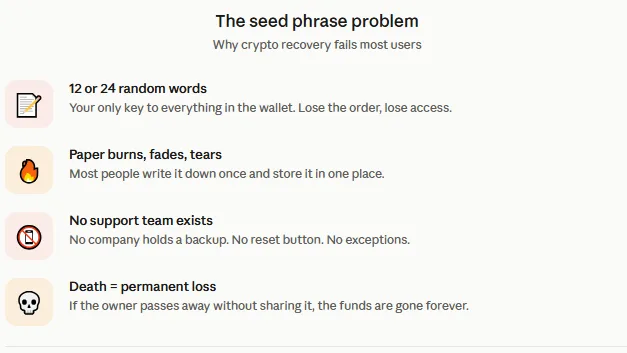
When a crypto wallet is set up, it generates a seed phrase. This is a list of either 12 or 24 random words, in a specific order, that acts as the master key to everything inside that wallet. Write them down wrong, store them somewhere that gets damaged, or simply forget where you put them, and the funds are gone. Permanently.
No one holds a backup copy. That’s the whole point of self-custody. But it also means there’s zero safety net.
It’s not a rare situation either. Estimates suggest that roughly one in five Bitcoin ever mined sits in wallets that can no longer be accessed. Forgotten seed phrases, lost devices, people who passed away without leaving instructions. It’s a structural flaw in how most wallets have worked since the beginning, and one of the biggest reasons everyday people stay on exchanges instead of holding their own keys.
How other wallets compare
To understand why a social recovery wallet matters, it helps to know what the alternatives look like and where each one falls short.
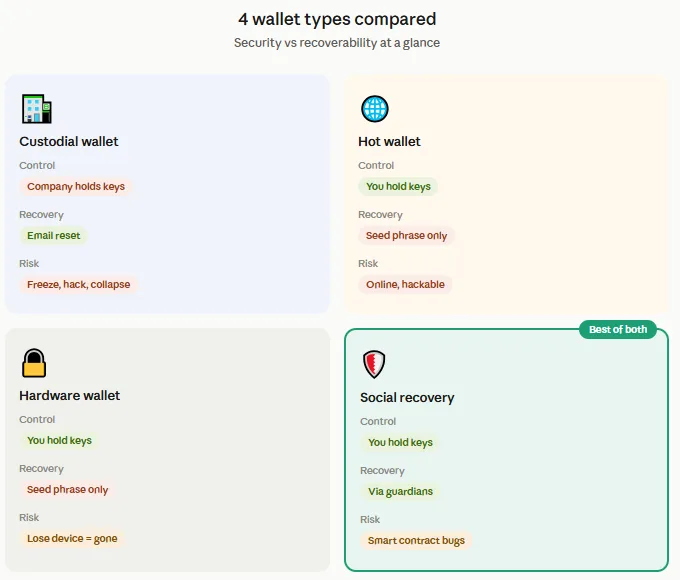
Custodial wallets, like keeping funds on Binance or Coinbase, are the easiest option. Forget the password and reset it by email. But the exchange holds the keys, not the user. That means the company can freeze the account, get hacked, or collapse entirely. Several major exchanges have done exactly that.
Hot wallets like MetaMask or Trust Wallet put the keys back in the user’s hands. More control, but the device is online and one malware infection away from being compromised. And if the phone or laptop it sits on gets wiped, that seed phrase is the only way back in.
Hardware wallets like Ledger or Trezor keep keys completely offline, which makes them the hardest to hack. But if the device gets lost or damaged and the seed phrase is nowhere to be found, there’s no fallback. The funds just sit there, permanently out of reach.
Each option makes a tradeoff between security and recoverability. Social recovery wallets are the first approach that genuinely tries to solve both at once.
Here’s how a social recovery wallet actually works
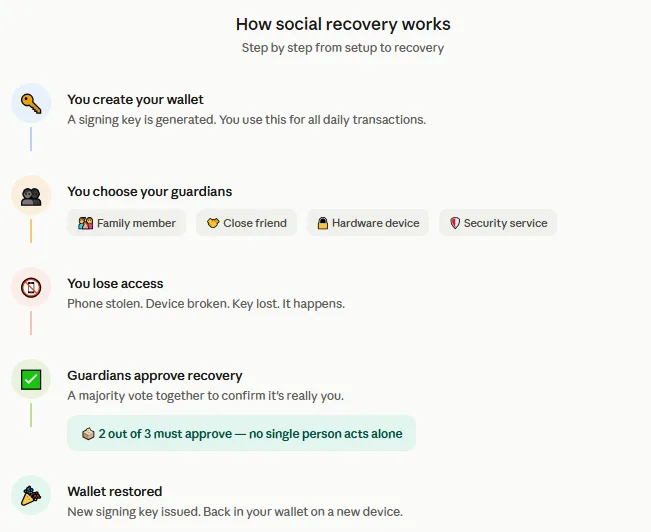
A social recovery wallet works like most wallets for day-to-day use. There’s a signing key that approves transactions, and the user’s the only one who controls it during normal operation.
The difference is what happens when that key is lost. Instead of everything depending on a seed phrase on paper, the wallet has a set of guardians. These are trusted contacts or devices chosen in advance. If access is ever lost, a majority of those guardians can work together to restore it.
The word majority is important. One guardian acting alone can’t do anything. They need enough others on board to hit the minimum required, so if the setup is 2 out of 3, one person going rogue simply doesn’t move the needle. This matters because it means even if someone close to the user turns untrustworthy, the wallet stays safe as long as the others don’t go along with it.
Guardians can be:
- A family member or close friend, connected through their own wallet address
- A personal hardware device owned separately
- A security service offered by the wallet provider itself
Vitalik Buterin, co-founder of Ethereum, has described social recovery as his preferred model for wallet security, calling it a strictly better approach than depending on a single seed phrase.
Smart contract wallet recovery: The technical foundation
A social recovery wallet is a smart contract wallet. That means it’s not just software on a phone. It’s a small program written directly onto the blockchain, running according to rules that no one can quietly change.
Smart contract wallet recovery encodes the guardian setup into that on-chain program. The list of approved guardians, how many need to agree before recovery happens, and how the signing key gets replaced are all baked into the code. No company has a backdoor. When the threshold of guardians approves a request, the contract executes automatically.
It’s fundamentally different from how a bank works. At a bank, a forgotten password leads to a call with a human who has the power to grant or deny access. In smart contract wallet recovery, the rules are fixed in code and enforced by the blockchain.
Argent’s the most well-known wallet to bring social recovery to everyday individual users. It lets users set guardians from their contacts, add a Ledger device as one of them, or use Argent’s own Guardian service as a backup. There’s also a built-in time-lock on guardian changes, typically around 24 hours, which gives the owner a window to catch and cancel any unauthorized change before it takes effect.
Why a social recovery wallet is better than seed phrases
Jake drops his phone into the sea on holiday. His seed phrase is at home but two words are smudged. The wallet’s inaccessible and so is everything in it.
Sarah drops her phone on the same holiday. She’d set up a social recovery wallet beforehand. She contacts two of her three guardians, who each approve the recovery request from their own phones. By the time she lands home, she’s already back inside her wallet on a new device.
Beyond convenience, there’s a security angle worth noting. A seed phrase on paper can be stolen by one person finding it. With crypto wallet social recovery, a thief would need to compromise the majority of guardians simultaneously. That’s a significantly harder task.
The ERC-4337 standard, deployed on Ethereum in March 2023, made this approach practical at scale. Over 40 million smart accounts have been deployed using this standard across Ethereum and its Layer 2 networks since then.
What to watch out for
The main risk with a social recovery wallet is a bad choice of guardians. If a majority decided to work together against the wallet owner, they could technically approve a recovery and redirect the funds. In practice it’s unlikely with the right setup, but it’s worth thinking through carefully.
- Pick guardians who don’t know each other well and aren’t in the same location
- Include at least one hardware device, since it can’t be pressured or manipulated
- Require at least 3 guardians to approve recovery so coordination becomes genuinely difficult
Smart contract bugs are also worth keeping in mind. Sticking with established and heavily audited wallets like Argent or Safe is the simplest way to reduce that risk. The longer a contract’s been running without incident, the more confidence there is behind it.