


A stablecoin peg is one of the most foundational ideas in crypto. It’s also one of the most misunderstood. The concept didn’t originate with blockchain technology, and understanding its roots makes the crypto version far easier to follow.
So, here’s a full look at what a stablecoin peg is, how stablecoins maintain their peg, what depegging looks like in practice, and what the two most significant real-world cases reveal about how these systems come apart.
Stablecoin peg explained
A peg is a fixed exchange rate between two assets. One asset is promised to always be worth a specific amount of another. In crypto, that means one stablecoin is always worth exactly $1. The stablecoin peg is the mechanism that enforces this.
It’s not a new concept. The Hong Kong dollar has been pegged to the US dollar since 1983, always trading within a band of HK$7.75 to HK$7.85. The Saudi riyal and UAE dirham maintain fixed USD pegs too. In fact, experts point to the UAE dirham’s dollar peg as one of the region’s biggest advantages for stablecoin adoption. The Bretton Woods system, which ran from 1944 to 1971, kept every major global currency tied to the US dollar, which was itself backed by gold.
Stablecoins like Tether (USDT) and USD Coin (USDC) apply the same stablecoin peg mechanism to blockchain tokens. By the end of 2024, the total stablecoin market cap had grown to approximately $200 billion, with USDT and USDC alone processing $23 trillion in transfer volume during the year.
How stablecoins maintain their peg
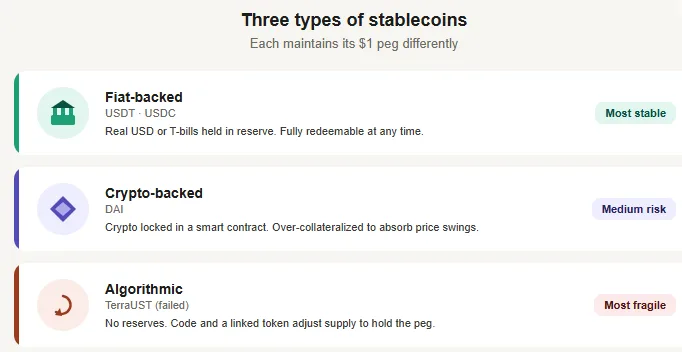
How stablecoins maintain their peg depends entirely on what backs them. There are three main models, and each carries a different level of risk when the peg comes under pressure.
Fiat-backed stablecoins
These hold real US dollars or short-term government securities as reserves. For every USDT in circulation, Tether holds equivalent reserves in US Treasuries, cash, and other assets. For every USDC, Circle holds reserves in cash and short-term US Treasuries. These tokens can be redeemed for actual dollars at any time, which is what keeps the USD peg stable. USDT and USDC are the two largest stablecoins by market cap.
Crypto-backed stablecoins
These use other cryptocurrencies as collateral. Because crypto prices can move sharply, they require over-collateralization. A user might lock up $170 worth of Ethereum to mint $100 of DAI, a stablecoin issued by the MakerDAO protocol. If ETH drops 20% overnight, overcollateralization is what prevents DAI from losing its peg.
Algorithmic stablecoins
There’s no vault of dollars sitting behind these. Instead, they rely on automated code and a linked token to keep the price at $1, expanding or contracting supply as the market moves. When the price drops below $1, the algorithm reduces supply to push it back up. It’s the most capital-efficient model and by far the most fragile.
How arbitrage enforces the peg
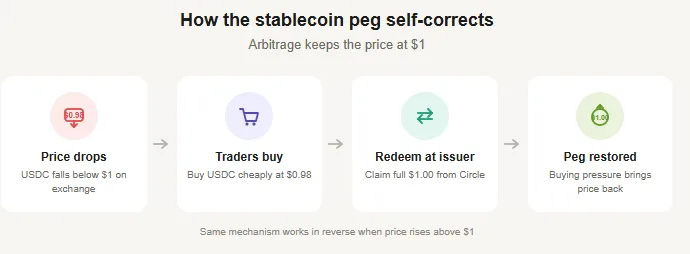
In all three cases, arbitrage is what enforces the stablecoin peg day to day. If USDC drops to $0.98 on an exchange, traders buy it cheaply, redeem it with Circle for the full $1, and pocket the difference. That buying pressure pushes the price back to $1. If USDC rises above $1, the reverse happens. The system self-corrects as long as redemptions work and reserves are genuine.
USD pegs, and why this isn’t a crypto-specific phenomenon
Pegging one currency to another has been standard practice for a long time. Countries do it when they need their currency to be perceived as trustworthy, especially for trade and foreign investment. The USD is the most common anchor because of its global dominance.
The Bahraini dinar has held a fixed USD peg since 1980. The Qatari riyal and Omani rial have done the same for decades. These aren’t exotic arrangements. They’re deliberate policy choices made by governments that want stability over flexibility. A country with a volatile local currency ties it to the dollar, and suddenly importers, exporters, and investors all have one less thing to worry about.
Stablecoins borrow this logic directly. The difference is that there’s no central bank involved, no government backing, and no decades-long institutional track record. It runs on code and, depending on the type, on whatever reserves the issuer actually holds.
When a stablecoin peg breaks: The Circle and USDC case
In March 2023, Silicon Valley Bank was shut down by regulators on a Friday. Circle had $3.3 billion of USDC’s reserves sitting at SVB when it happened. With no access to those funds over the weekend, that was enough to send USDC down to as low as around $0.88 before markets reopened Monday.
People didn’t wait to find out whether the money was recoverable. They sold. The price dropped further. It had the shape of a classic bank run, just playing out through a stablecoin instead of a deposit window.
USDC was back at $1 within roughly 72 hours, once the US government announced on Sunday that all SVB deposits would be guaranteed. But the episode made one thing clear: the stablecoin peg is only as solid as whatever is behind it. In this case, the reserves were real, the problem was external, and the recovery was fast. That’s the best-case version of a depegging event.
TerraUST: When depegging leads to total collapse
UST’s collapse in May 2022 is the worst-case version. There were no sufficient reserves, and once confidence slipped, there was nothing to catch it.
UST was an algorithmic stablecoin that relied on a sister token, LUNA, to maintain its $1 peg. The basic idea was that if UST fell below $1, users could burn it and get $1 worth of LUNA in return. That reduction in supply was supposed to push UST back up. It worked fine until it didn’t.
A big part of why UST got so large was Anchor Protocol, which was paying around 20% annually on UST deposits. By April 2022, keeping that rate going was costing roughly $6 million a day in subsidies. That’s not a yield. That’s a cash burn propping up demand.
On May 7, 2022, large traders began withdrawing hundreds of millions of dollars of UST from a liquidity pool. The price slipped. Confidence cracked. The protocol minted enormous quantities of new LUNA to compensate, flooding the market and crashing LUNA’s price.
With LUNA near zero, the arbitrage mechanism that was supposed to defend the stablecoin peg couldn’t function. Both tokens spiraled to near nothing within days. An estimated $40 billion in market value was destroyed in under a week. It’s the most referenced example of a stablecoin peg breaking completely, with no recovery.
Do Kwon, co-founder of Terraform Labs, was extradited to the United States in December 2024. He pleaded guilty to fraud charges in August 2025.
What causes depegging across different stablecoin types
The trigger for depegging differs depending on the model:
- Fiat-backed: The issuer mismanages reserves, or the bank holding them becomes inaccessible
- Crypto-backed: The collateral asset crashes faster than liquidation mechanisms can respond
- Algorithmic: Confidence disappears and, without real reserves, there’s no floor to stop the stablecoin peg from breaking entirely
USDC and UST sit at opposite ends of this spectrum. One recovered in roughly 72 hours because the reserves were real and the problem was external. The other destroyed $40 billion because there weren’t any reserves to begin with.
What makes a stablecoin peg reliable
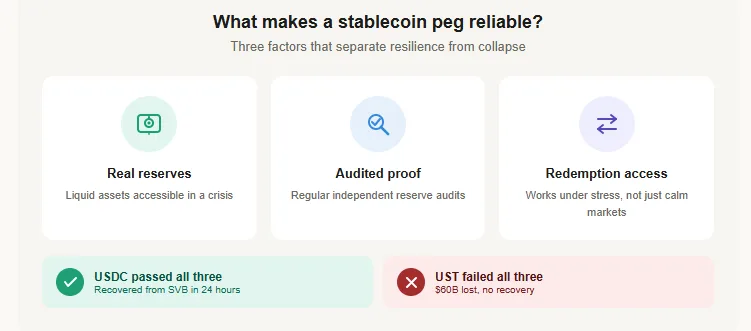
Three things separate stablecoins that survive a crisis from those that don’t:
- Quality of reserves: Real, liquid assets that can be accessed when things go wrong, not just a linked token and market confidence.
- Transparency: Regular, independently audited proof of reserves. If an issuer doesn’t publish this, users are taking their word for it.
- Redemption reliability: The peg has to hold under stress, not just in calm markets.
USDC had all three when SVB went under, which is why it recovered in roughly 72 hours. UST had none. Once LUNA collapsed, there was no reserve to fall back on and no redemption path that didn’t make the spiral worse.
Final thoughts
The concept itself isn’t the problem. It’s worked for national currencies for decades and for fiat-backed crypto tokens through multiple market cycles. In crypto, the difference between a brief depegging event and a $40 billion collapse comes down to one thing: whether there’s something real behind the promise.
For anyone holding or using stablecoins, the question worth asking isn’t whether the peg exists. It’s what’s actually backing it.