

In 2021, Ethereum gas fees peaked at nearly $200 for complex transactions. Simple swaps regularly cost $50 or more. At those prices, DeFi (decentralized finance) stopped being accessible and started being a luxury sport for people with large enough portfolios to absorb the damage.
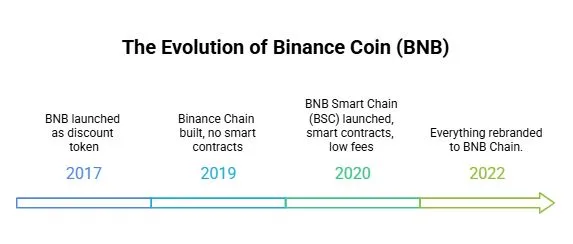
Changpeng Zhao, Binance’s founder, better known in the industry as CZ, had an answer ready. Back in 2017, he launched Binance Coin (BNB), a simple token that gave Binance exchange users a discount on trading fees. Then he built an entire blockchain around it.
BNB Chain offered the same smart contract functionality as Ethereum, the same wallet compatibility, and fees that cost less than a cent. It was never supposed to be a world-changing vision. It was supposed to be practical. And somehow that made it one of the biggest blockchains in the world.
What is BNB Chain, and where did it come from?
When CZ launched Binance Coin, the pitch was simple. Hold BNB, pay less in trading fees on Binance. That was it. Not exactly a moonshot idea, but it worked.
In 2019, Binance built its own blockchain, Binance Chain, and moved BNB to it. Fast for trading, but no smart contracts, no DeFi, no apps. A decent road with nothing to drive on it.
That changed in September 2020 with the launch of BNB Smart Chain, or BSC. Smart contracts, Ethereum compatibility, and fees that were actually affordable. Developers arrived. Users followed. The discount coupon had accidentally become infrastructure.
By 2022, the branding had gotten messy. Two chains, one token, and the Binance name on everything, despite the whole point being decentralization. So everything came under one name: BNB Chain. The token got a new meaning too. BNB now stands for “Build and Build,” a nod to the developer community that actually built on top of it.
What is BNB Smart Chain, and how is it different from BNB Chain?
This is probably the most common point of confusion for beginners, so let’s clear it up.
BNB Chain is the name of the overall ecosystem. BNB Smart Chain, or BSC, is the actual blockchain that sits at the center of it. Think of BNB Chain as the brand and BNB Smart Chain as the engine running underneath it.
Previously, BNB Chain ran two separate blockchains side by side. BNB Beacon Chain handled governance and staking. BNB Smart Chain handled smart contracts, apps, and everything users actually interacted with. The Beacon Chain was eventually retired through a process called BNB Chain Fusion, and all its functions were absorbed into BNB Smart Chain.
Today, BNB Smart Chain does it all. When someone says BNB Chain in 2026, they are talking about BSC.
BNB Smart Chain and smart contracts: Why developers chose it
Smart contracts are self-executing pieces of code that run on a blockchain and automatically carry out agreements without a middleman. No bank, no broker, no support ticket. Just code doing exactly what it was written to do.
BNB Smart Chain runs on the Ethereum Virtual Machine, or EVM, the same engine that executes smart contracts on Ethereum. This single decision is what drove BSC’s early growth.
For developers, it meant porting an Ethereum app to BNB Smart Chain with minimal changes. For users, MetaMask connected to BSC with a single network setting change. Same wallet, same interface, completely different blockchain.
That familiarity made switching almost frictionless. BNB Smart Chain was Ethereum, but cheaper, and in a market drowning in gas fees, that was a very compelling argument.
BNB gas fees on BNB Smart Chain
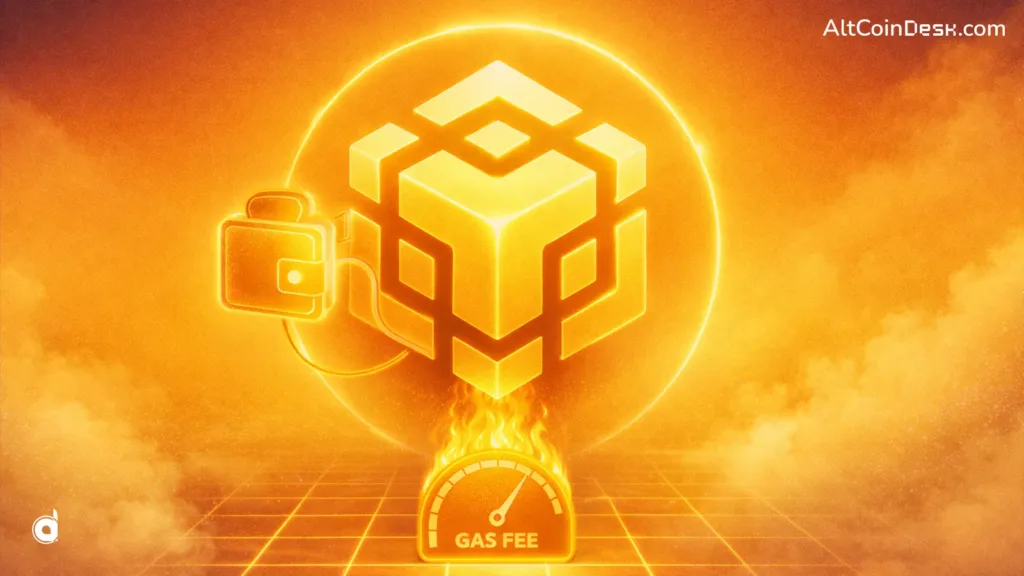
Gas fees are what you pay to execute any action on BNB Smart Chain. Every swap, transfer, or smart contract interaction costs gas, paid in BNB.
On Ethereum, those fees were brutal at peak. On BNB Smart Chain, the average transaction costs a fraction of a cent. After three major hardforks in 2025, gas prices dropped from 1 gwei to 0.05 gwei, a 20 times reduction. Even during the busiest periods on the network, fees stayed manageable.
BNB staking on BNB Chain and what BNB actually does
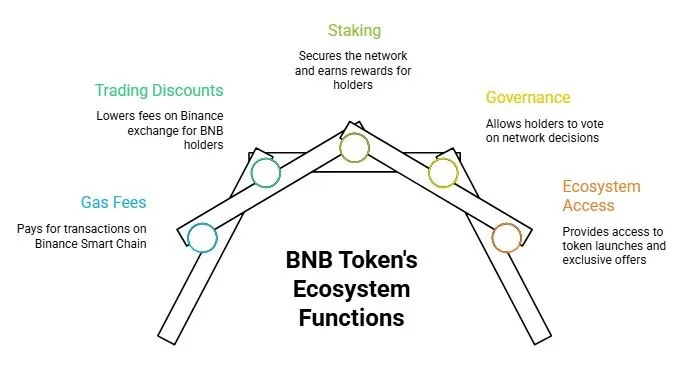
BNB does considerably more than pay gas fees. Here is everything it handles inside the ecosystem:
- Pay gas fees on every BNB Smart Chain transaction
- Get trading fee discounts on the Binance exchange
- Stake BNB to become a validator or delegate to one
- Vote on governance decisions about the network’s future
- Access token launches, NFT drops, and exclusive ecosystem offers
On the supply side, BNB launched with 200 million tokens and is being burned down to 100 million. The quarterly Auto-Burn destroys tokens based on price and network activity. The real-time gas fee burn, known as BEP-95, removes a portion of every block’s fees around the clock.
Over 63 million BNB have been burned so far, the circulating supply sits around 136 million, and the 100 million target is still years away, with current burn rates pointing toward the early 2030s.
BNB Smart Chain wallet: How to set one up
To use anything on BNB Smart Chain, you need a wallet. The most straightforward option for most people is MetaMask, which most Ethereum users already have sitting in their browser.
Here is how to create a BNB Smart Chain wallet using MetaMask:
- Open MetaMask and click the network dropdown at the top
- Select Add Network, then Add Network Manually
- Enter network name: BNB Smart Chain
- Enter RPC URL: https://bsc-dataseed.binance.org
- Enter chain ID: 56 and currency symbol: BNB
- Save and switch to the new network
Your existing MetaMask address now works on BNB Smart Chain. No new wallet needed.
If you want something with zero setup, Trust Wallet comes with BNB Smart Chain support built in and is ready to use the moment you create an account. Either way, you will need a small amount of BNB in your wallet to cover gas on any transaction.
The BNB Chain web3 ecosystem
BNB Smart Chain is the core, but the wider BNB Chain web3 ecosystem has expanded well beyond a single blockchain.
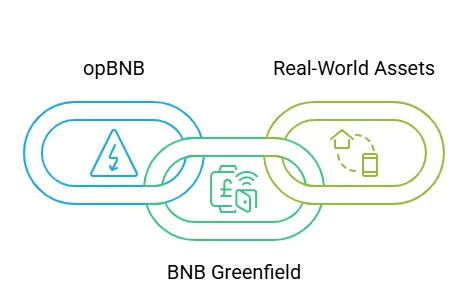
- opBNB: The Layer 2 built on top of BNB Smart Chain, processing transactions at near-zero cost before settling back to the main chain. Handles 4,000 transactions per second with 250 millisecond confirmations
- BNB Greenfield: Decentralized storage, essentially a blockchain alternative to cloud storage, where users actually own their data rather than renting it from a corporation
- Real-world assets: By the end of 2025, over $2 billion in tokenized real-world assets were live on BNB Chain, with Franklin Templeton and VanEck both deploying directly on the network
DeFi, NFTs, GameFi, payments, and AI applications all run across this ecosystem. The full picture looks nothing like the discount token it started as.
Where BNB Chain stands in 2026
Three hardforks in 2025, Pascal, Lorentz, and Maxwell, pushed BNB Smart Chain block times from 3 seconds to 0.75 seconds and cut gas fees 20 times over.
At peak periods, BNB Chain briefly overtook both Solana and Ethereum in daily DEX volume, capturing nearly 30% of the total DEX market share. The network hit 31 million transactions in a single day without going down once.
The Fermi hardfork began rolling out in late 2025 and landed its biggest impact in January 2026, cutting block times by another 40%. The 2026 roadmap targets 20,000 transactions per second, confirmation times under 150 milliseconds, a new Rust-based client, and native privacy features for transactions and smart contracts.
Final thoughts
BNB Chain started as a practical fix to an expensive problem and grew into a full ecosystem. One unified chain, a Layer 2 for scale, a storage layer for data, and a token burning steadily toward scarcity.
It makes real tradeoffs to achieve its speed and low fees, and those tradeoffs are worth understanding before putting money into anything built on top of it. But for most users, when transactions confirm in under a second for less than a cent, the experience speaks for itself.
The discount coupon now powers billions in daily trading volume. CZ probably saw some of this coming. Nobody saw all of it.