

There is a trick that crypto projects use to make their token more valuable, and unlike most tricks in this industry, this one actually works when done right. It’s called buyback and burn, and the basic idea is almost embarrassingly simple: buy your own token, destroy it forever, watch supply drop.
The problem is that some projects do this with real money earned from real users, while others do it with smoke, mirrors, and freshly minted tokens they just printed five minutes ago. The price chart looks the same either way, at least for a little while. Knowing the difference is the whole game.
What is buyback and burn in crypto tokens?
Crypto buyback and burn is exactly what it sounds like. A project uses its money to buy its token from the open market, then destroys those tokens permanently. Gone forever. Not coming back, much like your altcoin portfolio from 2022.
Think of it like a pizza shop that buys back its own gift cards and shreds them. Each remaining card is now harder to come by.
In crypto, the shredding happens by sending tokens to a burn address – a wallet that has no private key. Nobody controls it, nothing sent there can ever be retrieved, and every burn transaction sits permanently on the blockchain for anyone to check. You do not have to take anyone’s word for it.
Why do projects use the buyback and burn mechanism?
It comes down to basic supply and demand. Fewer tokens chasing the same demand means each remaining token is worth more. That is why burning reduces the circulating supply – the total number of tokens actually available in the market – rather than just locking them away somewhere they could theoretically come back from.
But there is something beyond the math. When a project spends real money buying back its own token, it is saying: we believe in this enough to put our revenue behind it. Crypto borrowed the concept straight from traditional finance, where companies have repurchased their own shares for decades to reduce the float and increase the value of what remains.
How does the token burn mechanism actually work?
Here is the step-by-step of how a standard token burn mechanism works:
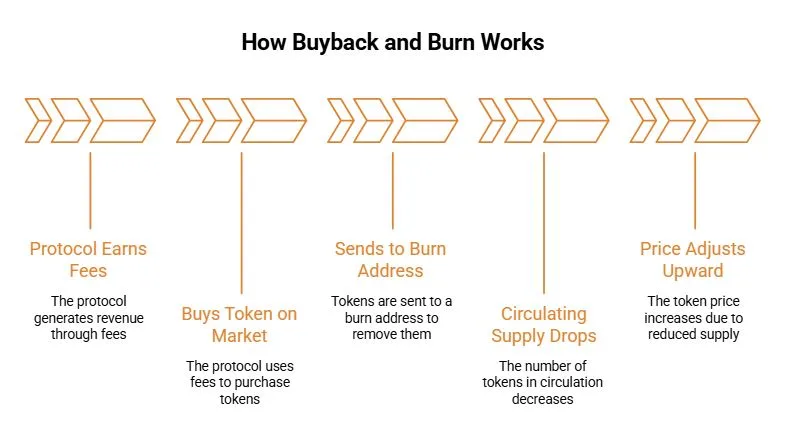
- The project earns revenue through trading fees, protocol fees, or exchange profits
- A portion of that revenue buys the token on the open market, creating buy pressure
- The purchased tokens are sent to a burn address permanently
- The transaction is recorded on the blockchain, and anyone can verify it
- Circulating supply drops, and if demand holds, price adjusts upward
The buying and the burning are both important. The buyback creates immediate demand. The burn makes the reduction permanent. Together, they hit supply from both sides.
Where does the crypto buyback and burn money come from?
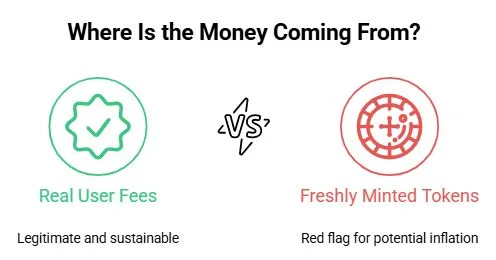
Most beginners stop at “they burned tokens” and never ask what funded it. That is the most important question.
- Revenue-funded burns are the real deal. The project earns fees from actual users and deploys that income to buy and burn. Binance Coin (BNB), Hyperliquid (HYPE), and MakerDAO (MKR) all do this.
- Treasury-funded burns use reserves set aside at launch. Still reduces supply, but no external money is coming in.
- Inflation-funded burns are the ones to watch out for. The project mints new tokens, sells them, then burns others with the proceeds. You are printing money to destroy money. The headline reads beautifully. The math does not.
Always ask: where is the money coming from?
Scheduled, real-time, and one-time: Not all token buyback and burn programs are equal
These programs are structured very differently, and the market reacts to each in its own way.
Scheduled burns happen at fixed intervals. BNB’s quarterly Auto-Burn is the classic example. Predictable and transparent, though less exciting after 34 rounds.
Real-time burns happen with every transaction. BNB’s BEP-95 protocol, which stands for BNB Evolution Proposal 95, removes a percentage of every block’s gas fees around the clock. Quiet and steady but constantly deflationary.
One-time burns are the theatrical ones. OKX burned 65.26 million OKB tokens in August 2025, cutting total supply by 52% and fixing it permanently at 21 million. OKB surged 160% in a single day, jumping from around $45 to $135. Spectacular, but obviously not repeatable.
Buyback and burn in action: Real examples and what happened
BNB is the original proof of concept. After 34 quarterly burns, the most recent, on January 15, 2026, destroyed 1.37 million BNB worth $1.28 billion. Circulating supply now sits at 136.36 million, down from 200 million, with a long-term target of 100 million. BEP-95 has quietly burned an additional 281,000 BNB through real-time gas fees on top of that.
Hyperliquid allocates roughly 97% of all trading fees to buying HYPE tokens. In 2025, the protocol spent $644 million on buybacks, representing 46% of all DeFi buyback spending across the entire industry. In December 2025, validators voted with 85% approval to permanently burn 37 million HYPE worth around $1 billion.
MakerDAO only runs its Smart Burn Engine when surplus revenue crosses a defined threshold. No surplus, no burn. MKR rose 29% during an active burn period because the market knew it was funded by real income, not accounting tricks.
Does buyback and burn actually move the price?
Honestly, it depends. PancakeSwap is the cautionary tale.
In 2023, PancakeSwap burned 7 million CAKE worth $15 million. Price fell anyway. Weak revenue, weak demand. A burn cannot fix a product nobody is using. You can burn all the tickets you want. If nobody wants to see the show, the price of remaining tickets still goes to zero.
The burns that create lasting price appreciation are backed by protocols people are actually using every day.
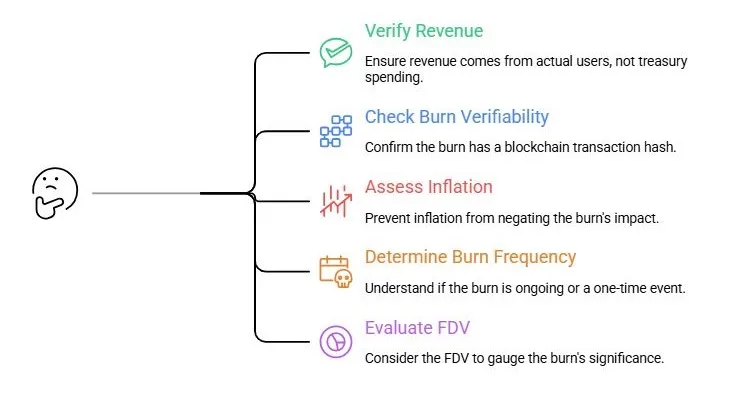
What to check before trusting any buyback burn announcement
- Is the revenue real? Actual users paying actual fees, not treasury spending dressed as income.
- Is the burn verifiable? Every legitimate burn has a transaction hash on a blockchain explorer like BscScan or Etherscan.
- Is inflation eating the burn? Some projects mint faster than they destroy.
- Is this ongoing or a one-time event? A single burn is a headline. A sustained program is actual tokenomics.
- What is the FDV? Fully Diluted Valuation (FDV) is the market cap calculated using the total token supply, not just what’s currently circulating. A burn matters less if 80% of tokens have not been released yet.
Final thoughts
Buyback and burn is one of the most powerful tools in crypto tokenomics when done right. A project earns real revenue, uses it to buy its own token, destroys those tokens permanently, and repeats the process consistently. That combination reduces supply, signals confidence, and creates genuine price support over time.
When done wrong, it’s just a headline. A one-time event with no real revenue behind it, designed to generate excitement rather than actual scarcity.
The concept itself is simple. The execution is where projects either prove themselves or expose themselves. You now know what to look for, what questions to ask, and what a real burn program looks like versus a fake one. That puts you well ahead of most people clicking on that price chart, wondering what just happened.