



Crypto was invented to get rid of banks. No middlemen, no gatekeepers, no suits in a boardroom deciding what you can do with your money. Then, Coinbase alone picked up 120 million registered users, and the revolution got a little complicated.
Turns out most people are perfectly happy with a middleman, as long as the signup takes five minutes. The crypto industry calls that middleman CeFi, short for centralized finance. It’s the part of crypto that works most like the banking system it was supposed to replace. A company holds your funds, manages your transactions, and gives you a balance on a screen.
Around 80% of all crypto trading worldwide still runs through centralized platforms.
What is CeFi, and why does it exist?
CeFi isn’t just for buying crypto. You can trade, earn interest, borrow against your holdings, or simply buy and hold, all without ever touching a blockchain. The platform handles the technical side, so you don’t have to.
Think of it like online banking for crypto. You sign up, verify your identity, deposit money, and the platform does the rest. If something goes wrong, there’s actually someone to call. In most of crypto, there’s not.
That accessibility is exactly why CeFi exists. Most people want to get into crypto without having to learn how it actually works first, and managing your own wallets, recovery phrases, and private keys on day one is a lot to ask. CeFi removes that friction.
The major platforms most beginners come across are Coinbase, Kraken, and Binance. Coinbase and Kraken are both regulated and connected to the traditional banking system. Binance is the largest by global trading volume, but has faced significant regulatory scrutiny in multiple countries.
Centralized finance explained: What you can actually do with it
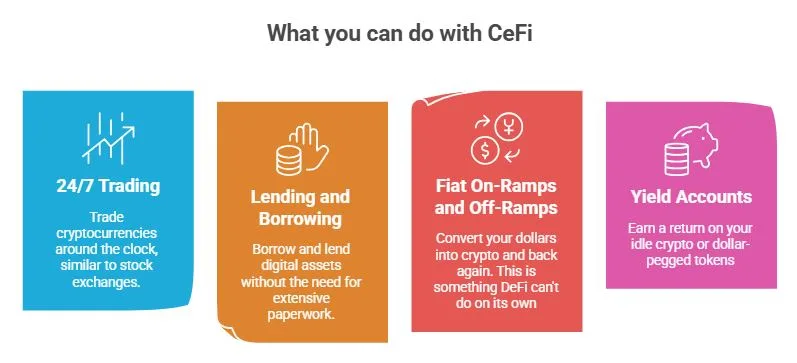
Here’s what you can actually do inside a CeFi platform:
- Trading: Buy, sell, and swap cryptocurrencies, just like a stock exchange, but open 24 hours a day.
- Lending and borrowing: Earn interest on your crypto while the platform lends it out, or borrow against it as collateral with almost no paperwork.
- Fiat on-ramps and off-ramps: Convert your dollars into crypto and back again. This is something DeFi (decentralized finance) can’t do on its own, making CeFi the entry point for most people.
- Yield accounts: Park your crypto or dollar-pegged tokens and earn a return, similar to a savings account but usually at much higher rates.
It works well, as long as the company holding your funds is actually trustworthy. That last part is where things get complicated.
Not your keys, not your coins
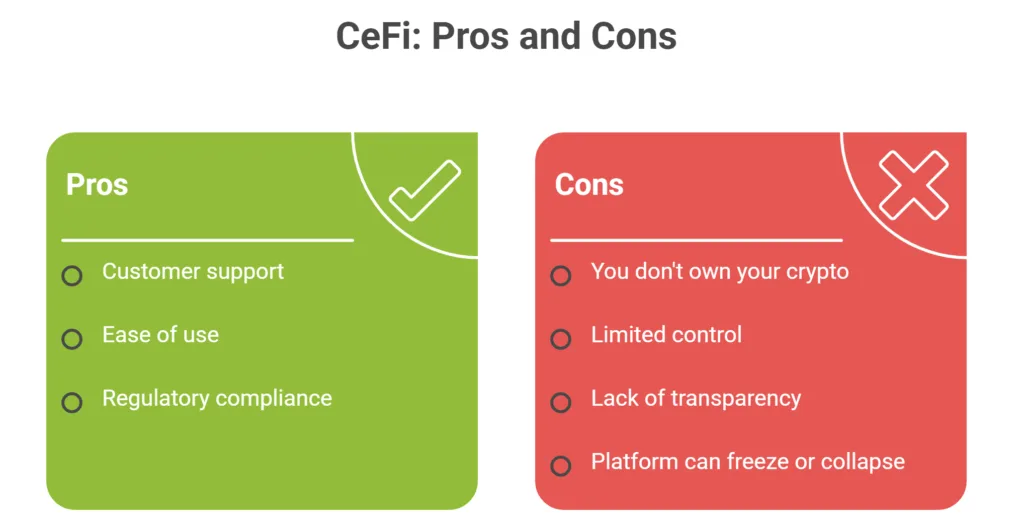
There’s a phrase you’ll hear constantly in crypto: not your keys, not your coins. It exists because of CeFi. When you deposit crypto into a CeFi platform, you no longer own it in any technical sense. You own a promise. The platform holds the private keys, which are the actual proof of ownership on the blockchain, and your balance is just a number in their database.
If they get hacked, your crypto goes with it. If they go bankrupt, your funds get frozen in their bankruptcy proceedings. If they halt withdrawals, there’s nothing you can do about it. There’s no FDIC insurance, no government backstop, and none of the deposit protection you’d have at a regular bank. You are, legally speaking, an unsecured creditor, meaning you’re last in line if anything goes wrong.
When CeFi broke: Celsius, BlockFi, and the 2022 collapse
In 2022, the risks of CeFi stopped being theoretical. The damage was enormous.
Celsius Network promised users up to 18% annual yield on crypto deposits, and millions treated it like a savings account. Behind the scenes, it was making risky bets it couldn’t back up. When the $60 billion Terra/Luna collapse triggered defaults across the industry, Celsius froze all customer funds without warning in June 2022 and filed for bankruptcy a month later, owing $4.7 billion specifically to its users, with total liabilities of $5.5 billion against only $4.3 billion in assets.
BlockFi survived that wave only because FTX bailed it out with a $400 million credit line. When FTX collapsed in November 2022, BlockFi had $671 million in outstanding loans to Alameda Research, FTX’s trading arm, that it couldn’t recover. It paused withdrawals the same day FTX filed and followed with its own bankruptcy weeks later, leaving over 100,000 creditors waiting to find out what was left.
Voyager Digital and Genesis fell the same way. The pattern was identical across all of them: instant withdrawals promised while actual funds sat locked in illiquid, high-risk bets. When users rushed to exit, the math stopped working.
CeFi vs DeFi: Understanding the difference
What makes the 2022 collapse so instructive is what didn’t happen at the same time. While Celsius, FTX, BlockFi, and Voyager were freezing accounts and filing for bankruptcy, Uniswap, Aave, and Compound kept running without a single day of downtime. No fraud, no emergency decisions. The code ran exactly as written.
That’s the core difference between CeFi and DeFi. In CeFi, you trust a company. In DeFi, you trust code.
DeFi removes the middleman entirely. Smart contracts, which are self-executing pieces of code on the blockchain, handle everything automatically. You keep your own keys, and no one can freeze your funds. But DeFi is far from risk-free:
- Smart contract bugs: The Wormhole bridge lost $320 million in 2022 when attackers exploited a code flaw to generate tokens without putting up any real money. By the time anyone noticed, it was gone.
- Rug pulls: Developers launch a project, attract money, then disappear with it. The Squid Game token crashed from nearly $2,862 to zero in minutes after developers locked users out and drained the funds.
- No mistakes allowed: Send crypto to the wrong address, and it’s gone. No reversal, no support team, nothing.
- Impermanent loss: If prices shift while your funds are sitting in a shared pool that facilitates trades, you can end up with less than you started with, even after earning fees.
- Oracle manipulation: Mango Markets lost over $100 million in 2022 when an attacker artificially pumped a token’s price to borrow far more than their collateral was worth.
DeFi isn’t a safer alternative to CeFi. It just carries a different set of risks.
CeFi is the gateway into DeFi
Most beginners don’t realize that CeFi is how almost everyone enters crypto in the first place. DeFi only accepts crypto, and your dollars or euros are useless inside it. CeFi is where you convert real-world money into the crypto you need to get started.
For most people, the path looks like this: buy on Coinbase, transfer to your own wallet, then interact with Uniswap or Aave directly. Without CeFi, almost nobody gets through the door.
The bigger picture
CeFi made crypto accessible to people who would never have managed a hardware wallet on their own. It connects the traditional financial system to the blockchain and gives beginners somewhere familiar to start.
But the tradeoff is real. The moment you deposit, you’re trusting a company with your assets, and that trust has been broken before at a scale that wiped out billions of dollars. Use CeFi for what it’s good at, but understand exactly what you’re handing over when you do. In crypto, a promise is not the same as ownership. The sooner you understand that, the better off you’ll be.