



Decentralized finance (DeFi) is growing very fast. However, many traders still face the same problems that existed in early decentralized exchanges: confusing interfaces, too many approvals, and transactions that fail when conditions change. For new users, the experience can feel more like navigating a complex infrastructure.
That friction is exactly what intent-based trading crypto models aim to resolve. Rather than requiring traders to specify each step in a trade order, intent-based trading enables users to specify the outcome they desire. The protocol decides how to best execute the order cost-effectively and securely.
What is intent-based trading?
An intent in crypto refers to a user’s desired outcome. In intent-based trading, a user sends a request with conditions, allowing the transaction to be executed based on the intent.
For instance, a user might give instructions like “I want to convert ETH to USDC at the most optimal price, or I want to swap my assets at the cheapest cost“.
The DeFi protocol then determines the best route to achieve this goal, allowing the user to have a seamless experience. In traditional trading, users need to specify routes, gas, and execution instructions.
On the other hand, intent-based trading in crypto allows users to define the desired result and limits. This model requires specialized solvers to compete to fulfill that request most efficiently.
Mostly, the best solution is selected before the transaction is settled on-chain. This removes most of the technical decisions that often slow down or confuse traders.
How intent-based trading crypto systems work
Intent systems have a different architecture compared to the traditional blockchain transaction process. Rather than a transaction being submitted directly to the public memory pool (mempool), it starts with an intent.
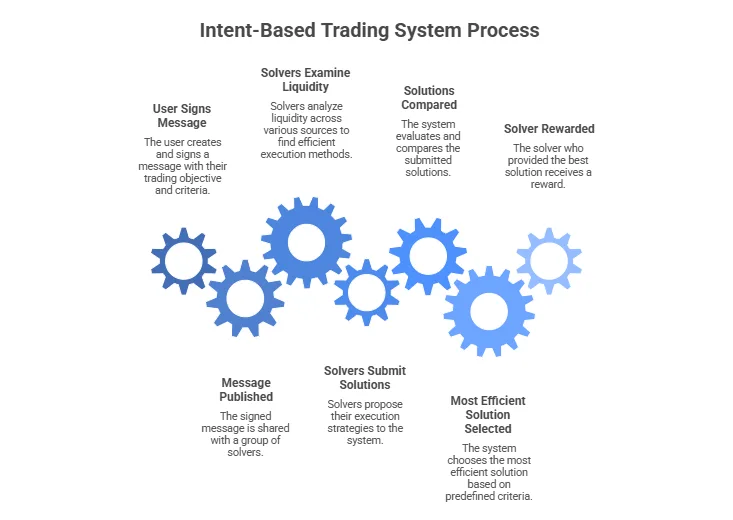
The user signs a message that provides their objective and a set of minimum criteria. That message is then published to a group of solvers.
Solvers are execution participants that examine the liquidity across exchanges, private accounts, and routing proposals. The solvers try to figure out how to fulfil the request efficiently.
They then submit solutions, which are compared, and the most efficient one is selected. The solver that offers the best solution is then rewarded. This approach guarantees quality execution based on certain criteria.
The role of solvers in intent-based execution
Solvers are responsible for executing transactions on intent-based trading crypto platforms. They act as custom-designed execution engines that compete to get the best prices. For solvers to be successful, they need to watch different markets across many platforms and quickly take action when opportunities arise.
They may choose to spread trades across a range of crypto exchanges or match traders directly if their objectives overlap. This competition benefits users by driving the delivery of better outcomes, whereby solvers are rewarded for delivering the best outcome.
The approach also takes the burden off the trader. Rather than users searching for the best path to execute their intended transactions, they leave it up to solver competition.
The benefits of intent-based trading
Intent-based trading has become more popular due to the benefits it introduces to users. Some of the key benefits include:
- Improved user experience (UX): Intent-based systems eliminate complexity in DeFi trading through crypto UX innovation. Rather than users worrying about gas spikes, transaction reversion, or the need to move assets back and forth between chains, all they have to do is specify their intent. The protocol provides execution in the background without further user intervention.
- Capital efficiency: Users benefit from price improvement if they leave the transaction to be executed by a competitive market of solvers that can access on-chain as well as off-chain liquidity and pool. Solvers can also aggregate a set of trades into a single trade where possible, which can help reduce the number of trades on the market and improve market efficiency.
- Anti-MEV protection: DeFi trades are frequently exploited by bots that can sniff out arbitrage opportunities in the memory pool to front-run or back-run user transactions. This is mitigated by mindless trading systems, which rely on solvers. Because the trade is only executed if the user’s conditions are satisfied, solvers have an interest in preserving the value of that trade.
Challenges experienced in intent-based trading
Intent-based trading is an evolving process, and therefore, it comes with some risks and challenges, including:
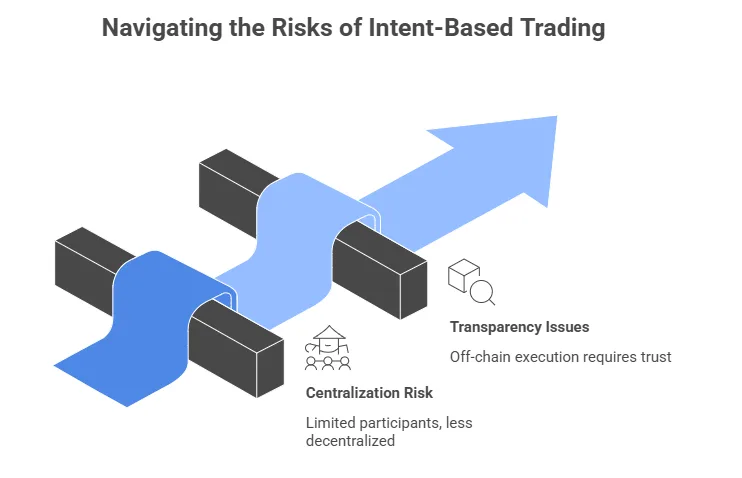
- Centralization risk: This is perhaps the most significant concern in intent-based trading. Running a solver requires technical expertise, capital, and infrastructure. If only a small group of participants can operate solvers, the execution layer could become less decentralized, thus posing a threat to users.
- Transparency issues: Transparency is also another big challenge in intent-based trading. Since some parts of the execution process happen off-chain, users must trust that the system is operating fairly.
Top DeFi platforms that support intent-based transactions
Several DeFi platforms offer intent-based trading to simplify, secure, and improve trading. Some common ones include:
- Across Protocol: Utilizes intent-based execution to speed up and reduce the cost of transfers.
- 1inch Fusion: Allows users to place orders that are executed by solvers, who pay for gas.
- UniswapX: Sources liquidity from several providers via a Dutch auction, and users do not need to cover the gas fees upfront.
Final verdict
Traditional decentralized trading requires users to act like execution engineers. To perform a simple swap, users may need to choose liquidity pools, set slippage, pay gas in the correct token, and then confirm multiple transactions. Each of the complex steps introduces risks to the user.
If liquidity shifts or gas fees spike, a trade may fail or execute poorly. This is one reason many potential users leave decentralized finance after trying it once. But, intent-based trading crypto systems are built to solve that structural issue.
Instead of focusing on transaction mechanics, these systems focus on outcomes. The user defines a goal, while the network coordinates how to achieve it. This shift is one of the clearest examples of how crypto UX innovation is happening right now.