


Every major crypto hack has a simpler explanation than most people expect. It was not the blockchain that failed. It was not the protocol. It was a key. One private key, held in one place, accessed by the wrong person at the wrong time.
That is the vulnerability MPC wallets are designed to make obsolete. By splitting the private key into cryptographic shares distributed across multiple parties, there is no single point that an attacker can target. The key that controls the funds never fully exists anywhere.
Here is a full look at how it works, how it differs from a multisig wallet, and what it means for anyone holding crypto today.
What is a private key?
A private key is the code that authorizes outgoing transactions from a crypto wallet. It proves ownership on the blockchain. Whoever holds it controls the wallet.
There is no bank to call, no password reset, and no way to reverse a transfer once it has been sent.
Most standard wallets store this key in one place. One device, one key, one point of exposure. A hack, a lost phone, or a compromised server means the funds are gone for good. This is what security professionals mean by a single point of failure, and it has cost the industry an enormous amount over the years.
At institutional scale, the risk compounds fast. When an exchange holds crypto on behalf of thousands of users, one compromised key puts all of them at risk at the same time. It is why the structure of a wallet matters far more than most people think.
How a multi party computation wallet works
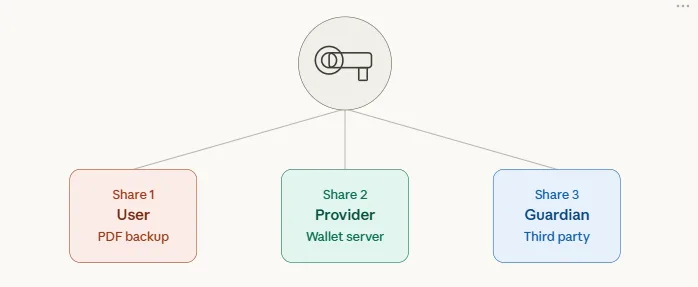
A multi party computation wallet never stores one complete private key anywhere. Instead, it splits the key into cryptographic key shares and distributes them across separate parties or devices. The full key is never assembled, not during storage and not when a transaction is being signed.
The process works like this:
- Each party holds one fragment of the key, known as a key share
- When a transaction is initiated, each party uses only its own fragment in the calculation
- The combined output produces a valid transaction signature
- The full private key never exists in a single location at any point
A common setup uses a 2-of-3 threshold. The user holds one share, the platform holds one, and an independent third party holds the third. Any two of the three can approve a transaction. One stolen fragment alone gives an attacker nothing.
It is worth being specific about what this is not. Storing a backup copy of a key in two different places is not the same thing. In that case, the full key still exists at each location. With MPC, the full key genuinely never exists anywhere as a complete unit.
MPC vs multisig wallet: What is the actual difference?
Both approaches require multiple approvals before a transaction can go through, but they operate at completely different levels.
Multisig uses multiple complete, independent private keys. In a 2-of-3 multisig setup, three separate full keys exist, and two must sign off on every transaction. Each key is a whole secret on its own, which also makes each one a standalone target.
MPC works differently. There is only one underlying key, broken into cryptographic key shares that never come together. Signing happens through a mathematical collaboration between the fragments, without the full key ever being reconstructed.
Privacy
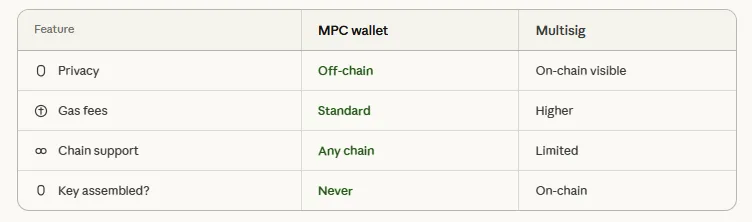
Multisig leaves a trail. Anyone watching the blockchain can see how many signers a wallet requires and who approved a given transaction. MPC signing looks like a normal single-key transaction from the outside. The internal structure stays invisible to observers.
Chain support
Multisig depends on smart contract implementation, and that varies a lot between networks. MPC does not rely on that layer at all. It works across Bitcoin, Ethereum, Solana, and most other chains without special setup.
Fees
Multisig verification gets written to the blockchain, which adds cost to every transaction. MPC signing happens off-chain. The transaction that hits the network looks standard and gets priced like one.
Flexibility
Replacing a keyholder in a multisig usually means moving funds to a new wallet address. With MPC, key shares can be refreshed in place. The wallet address stays the same, and the transaction history stays intact.
Multisig still has a role in DAO treasuries and governance setups where visible on-chain signers are part of the design. For most other use cases, MPC is the more practical and more secure option.
How Cube.Exchange uses MPC wallet crypto technology
Cube.Exchange launched following the FTX collapse with a specific design goal: making it structurally impossible for the exchange itself to access or misuse user funds.
The three-party model
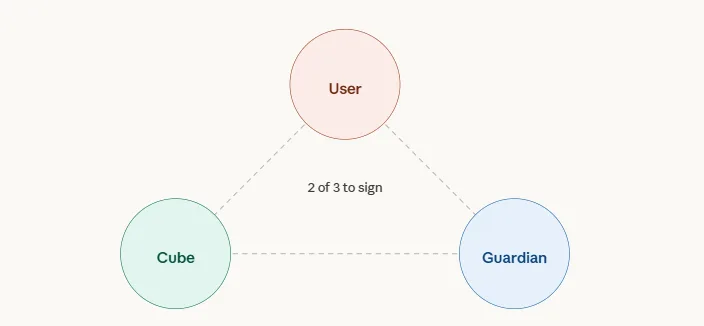
Every Cube user gets a dedicated MPC vault. The distributed key generation process splits control between three parties:
- The user
- Cube.Exchange
- An independent network of trusted institutions called Guardians
Under the 2-of-3 threshold model, no single party can move funds without the cooperation of at least one other.
What this means for user funds
User funds are never pooled across accounts. Each user’s assets sit in a separate on-chain address, verifiable by anyone. Cube becoming insolvent or acting in bad faith cannot cascade across individual balances the way FTX’s collapse did, because the structure prevents it.
The role of the Guardian network
Guardians are trusted third-party institutions that hold one key share each and participate in transaction authorization. Their presence means even Cube itself has no unilateral ability to move user funds.
If a key share is ever lost, users can go through a verification process to generate a new one without losing access to their assets.
Where to learn more
In an interview with AltCoinDesk at Solana Breakpoint 2025, Cube’s CEO Bartosz Lipinski described building the platform around two goals: custody and usability. The conversation covers the exchange’s chain-agnostic trading design, its Solana-based infrastructure, and why MPC was central to the vision from day one.
Wallet security: Who actually needs an MPC wallet?
Not everyone needs MPC. A retail user holding a small amount of crypto on a hardware wallet that barely moves probably does not need it right now.
Where it starts to matter is when the stakes go up. A fund managing assets on behalf of clients needs it. An exchange holding customer deposits needs it. Any team where more than one person has to approve outgoing transactions should be looking at it seriously.
Individual users who want real self-custody without a seed phrase taped inside a drawer somewhere are also a good fit. The MPC model gives them control without putting everything on one physical backup.
Setting it up properly takes work. Managing key shares across multiple parties is not something you configure once and forget. For most retail users, that complexity is exactly why platforms like Cube exist. They handle the infrastructure and still give each user direct control over their own share.
The final thoughts
MPC wallets eliminate crypto’s oldest custody problem by ensuring the private key never fully exists in any one place. Distributed cryptographic key shares and threshold-based signing remove the single point of failure behind so many of the industry’s biggest losses.
Against multisig, MPC wins on privacy, chain compatibility, transaction cost, and operational flexibility.
On a platform like Cube.Exchange, that level of wallet security is already built in by default, with the Guardian network adding an independent layer of protection that not even the exchange itself can bypass.