

Crypto projects love announcing big fee numbers. The community celebrates, the charts move, and new buyers come in expecting to benefit from all that activity. What most of those buyers never stop to ask is whether any of that money is actually coming their way. In most cases, it’s not.
That’s the gap between protocol revenue and token revenue, and once you understand it, you’ll never look at a fee announcement the same way again.
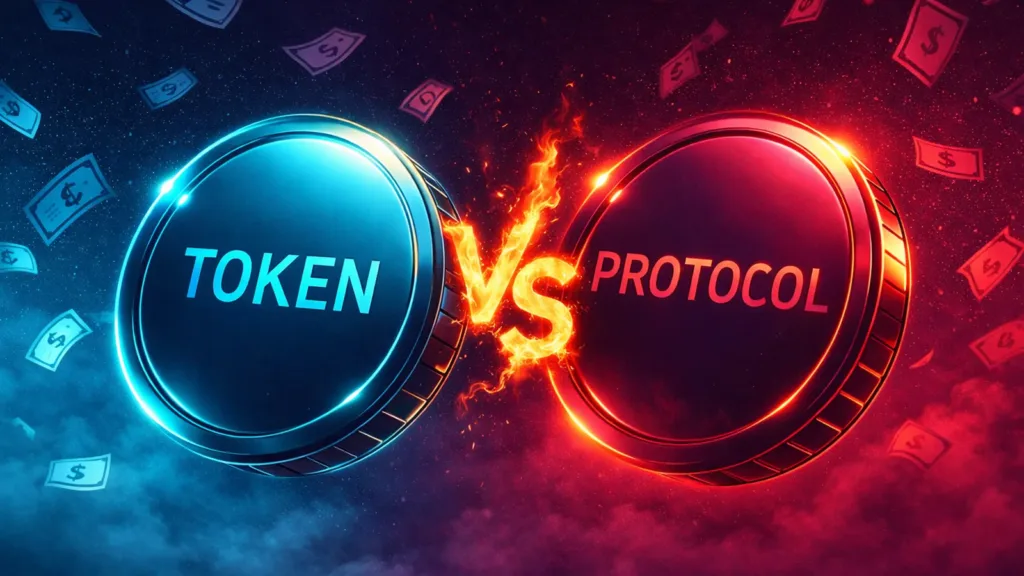
Protocol revenue vs token revenue is covered here from scratch, with real projects as examples and the tools to research any token before putting money into it.
What is crypto protocol revenue?
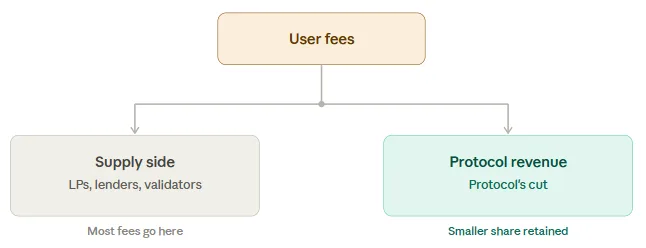
Every time someone uses a crypto application, they pay a fee. Swapping tokens on a decentralized exchange, borrowing against your crypto, bridging assets from one blockchain to another, all of these actions generate fees. Multiply that across thousands of users every day, and the numbers get large quickly.
Here is where most beginners assume all of that money belongs to the project. It does not.
A significant portion goes to the people who make the protocol functional in the first place. On a decentralized exchange, that means liquidity providers who deposit their own crypto so that others can trade. On a lending platform, it means the lenders supplying the capital. These participants are called the supply side, and without them, the protocol cannot operate.
Crypto protocol revenue is what remains after those participants are paid. It’s the project’s actual cut of the activity happening on its platform, similar to how a marketplace like Airbnb keeps a service fee from every booking after the host receives their payment.
The Uniswap example
Uniswap is the clearest illustration of this in practice. For most of its existence, Uniswap generated hundreds of millions of dollars in annual fees. Every dollar of that went to liquidity providers. The protocol itself kept nothing, which meant crypto protocol revenue was effectively zero despite enormous user activity.
That changed in December 2025 when Uniswap activated a fee mechanism to buy back and burn UNI tokens. Before that point, the protocol was one of the most used applications in crypto and offered token holders no financial benefit whatsoever.
Protocol revenue vs token revenue: The distinction that actually matters
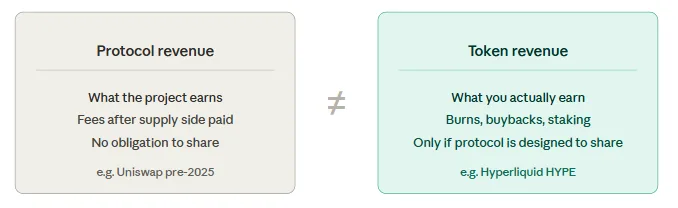
Crypto protocol revenue is what the project earns. Token revenue is what you, as someone holding the token, actually benefit from. These two figures can be completely unrelated, and in a large number of projects, they are.
The reason comes down to a fundamental difference between crypto tokens and traditional stocks. When you own shares in a company, your ownership comes with legal protections and financial rights. Dividends, liquidation claims, and regulatory oversight. Crypto tokens carry none of those rights by default. Holding a token does not give you any automatic claim on what the protocol earns. Whether value reaches you depends entirely on how the tokenomics were designed from the beginning.
A protocol can earn $100 million in a year and, by design, route none of it to token holders. This is legal, common, and something beginners rarely check before buying.
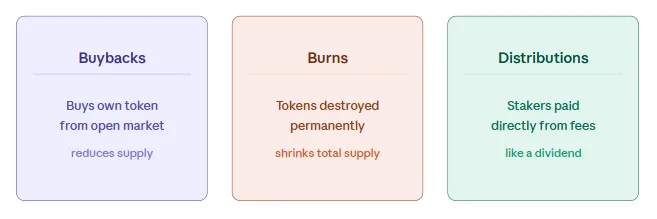
When projects do return value to token holders, they do it through one of three mechanisms.
Buybacks
The protocol uses a portion of its revenue to purchase its own token on the open market. This creates consistent buying pressure and reduces the amount of the token available to other buyers, which can support price over time.
Hyperliquid is one of the strongest current examples, directing roughly 97% of its trading fees toward buying back its HYPE token. The result is a direct, mechanical link between platform usage and token demand.
Burns
Rather than buying tokens and holding them, some projects permanently destroy tokens, removing them from circulation forever. This shrinks total supply, meaning each remaining token represents a larger share of the whole.
Ethereum runs a version of this by burning a portion of every transaction fee paid on the network, which has removed billions of dollars worth of ETH since the mechanism launched in 2021.
Direct distributions
Some protocols pay token holders directly, similar to how a stock pays a dividend. Holders who stake or lock their tokens earn a share of the fees the protocol collects. The more the platform is used, the more holders earn.
If a project does none of these three things, there is no token revenue regardless of how high the fee numbers look.
The hidden cost that changes the whole picture
Even when a project does return value to token holders, there is one more variable that determines whether holders are actually coming out ahead: token emissions.
Many protocols attract new users by distributing free tokens as rewards, a practice called liquidity mining. Every new token printed and handed out dilutes the value of tokens already in circulation.
If a protocol earns $10 million and returns $7 million to holders through buybacks, but simultaneously distributes $12 million in new tokens to attract users, holders are net negative by $5 million. The buyback did not cover the dilution cost.
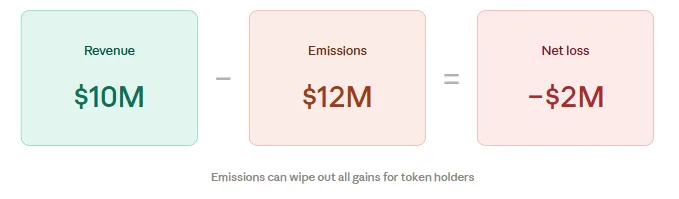
The figure that tells the real story is net earnings, sometimes called protocol earnings: revenue minus emissions. A positive number means the project is creating genuine value for holders. A negative number, which is common among newer protocols, means the project is subsidizing its own growth by inflating supply. That can be a reasonable strategy early on, but it is worth knowing before you buy.
How to research protocol revenue vs token revenue before buying
None of this requires a background in finance or data analysis. Four free tools give beginners a complete picture.
DeFiLlama
DeFiLlama has a dedicated Holders Revenue page that shows specifically how much value flows to token holders, separate from total fees or general protocol revenue. The Earnings by Protocol view goes further by subtracting emissions to show the net figure. For any DeFi token, this is the right starting point.
Token Terminal
Token Terminal presents crypto protocol revenue data in a format similar to a company’s income statement. Fees, protocol revenue, token incentives paid out, and net earnings are all visible in one place. It makes it straightforward to compare two protocols side by side and see which one is actually building financial value for holders.
Messari
Where DeFiLlama gives you the numbers, Messari gives you the context. It covers how the tokenomics are structured, what the treasury holds, the team’s track record, and whether the project has been audited. Reading a Messari profile before buying a token takes ten minutes and answers most of the questions that matter for a longer-term position.
Santiment
Santiment tracks the human behavior around a project rather than the financials. It monitors social media activity across platforms, developer activity on GitHub, and movements from large wallets. A protocol can have strong token revenue that the broader market has not noticed yet. Santiment helps identify that gap between fundamentals and market awareness before price catches up.
Final thoughts
Protocol revenue vs token revenue is not a complicated concept once you see it clearly. One number tells you the project is generating activity. The other tells you whether that activity benefits you as a holder. Only one of those affects your wallet.
Before buying any token, check the holders revenue and net earnings figures on DeFiLlama, then read through the tokenomics on Messari. Those two steps will tell you more about a token’s real value than any price chart or community hype ever will.