



Cardano is a blockchain built around peer-reviewed research. This blockchain utilizes the Proof-of-Stake (PoS) consensus and is designed to address key limitations across first-generation and second-generation blockchain technologies (Bitcoin and Ethereum).
By design, Cardano is a secure, scalable, energy-efficient, and decentralized application system. It uses a research-based development strategy, with a focus on delivering long-term sustainability and viable solutions for businesses, governments, and individual consumers.
The ADA crypto serves as the Cardano blockchain’s native coin. This crypto acts as the primary utility token, facilitating payment of transaction fees, governance voting, and staking.
What is the Cardano blockchain?
Cardano is a public blockchain that solves the challenges faced by Bitcoin and Ethereum. Both Bitcoin and Ethereum face scalability, security, and decentralization issues, often known as the blockchain trilemma. But Cardano uses the PoS consensus mechanism to enhance security, scalability, and governance.
Input Output Global company, together with Emurgo and the Cardano Foundation, launched the Cardano blockchain in 2017. Charles Hoskinson, one of Ethereum’s co-founders, spearheads the Cardano blockchain.
Since it relies on peer-reviewed development, the Cardano team relies on peer-reviewed scholarly articles to make the blockchain secure, robust, and able to scale in an efficient manner.
Currently, Cardano is more than a digital currency transfer and receiver system. It is a smart contract and decentralized application platform, and a native token platform. Its design gives the ability to predict and minimize errors. This renders Cardano suitable for businesses, governments, developers, and everyday users as it provides reliability and transparency.
Understanding of the two-layer architecture of Cardano
The Cardano blockchain is a two-tiered system with a settlement layer and a computational layer. The two-layer network partitioning enables proper handling of transactions and enables smart contracts to interact with one another.
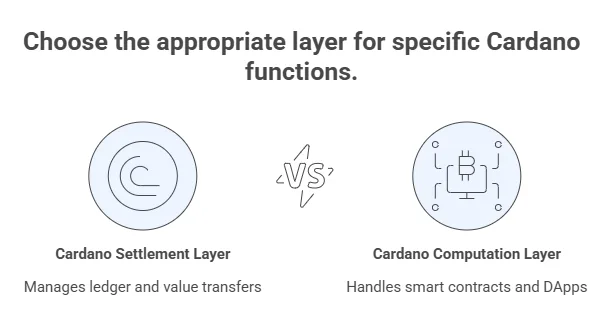
- Cardano Settlement Layer (CSL): It is a layer that supports fast processing of transactions and updating the ledger. It also guarantees efficient transfer of values in the network.
- Cardano Computation Layer (CCL): This layer, unlike CSL, supports the proper execution of smart contracts and Cardano-based dApps.
Cardano’s dual-layered design powers its scalability. The architecture enables programmers to develop dApps on the network without compromising speed and security.
Understanding Cardano’s security
Cardano is developed on the Ouroboros, a Proof-of-Stake (PoS) protocol. This protocol replaces the energy-consuming proof-of-work of Bitcoin.
Ouroboros is a peer-reviewed and formally checked protocol. It not only ensures the security of the network, but also forestalls attacks like double-spending. This makes Cardano a trusted blockchain for both retail users and businesses.
In the Cardano proof-of-stake, validators are selected based on the amount of staked ADA and are given the responsibility of creating new blocks. Validators with more staked ADA are most likely to create the new blocks.
Because of this setup, ADA holders are allowed to stake their tokens to facilitate network security operations. The staking process is simple and safe because Cardano does not have slashing, as is implemented in other blockchain networks.
What is the role of ADA on the Cardano network?
ADA is Cardano’s native token. It supports several processes on the network, which include:
- Governance voting: ADA offers voting rights to holders so that they can vote on new development and funding projects.
- Transaction fees: ADA is used for payment processing by facilitating the payment of transaction fees.
- Staking: ADA holders can stake their tokens to help secure the network and help validate transactions on the network.
These roles imply that ADA makes the network decentralized, secure, and community-based.
Transactions, smart contracts, and native tokens: Cardano (ADA) explained
Cardano leverages the unspent transaction output (UTXO) to make sure all the transactions reference a given ledger entry. Such a design allows predictability and safety, as it minimizes transaction and smart contract errors.
The Plutus platform is used to execute Cardano smart contracts. These smart contracts can be written in either Haskell or the newer Aiken language, depending on the choice of the developers. Furthermore, Cardano separates on-chain and off-chain functions to make sure smart contracts perform without disturbing the primary network.
Native tokens have also become essential in the Cardano blockchain. Unlike Ethereum, where people make use of smart contracts to create tokens, Cardano supports native token creation. This makes it easier and cheaper, and improves the security of both the enterprises and the developers.
What are some of the real-world use cases of Cardano?
The unique design makes Cardano applicable to different industries. The following are some of its main use cases:
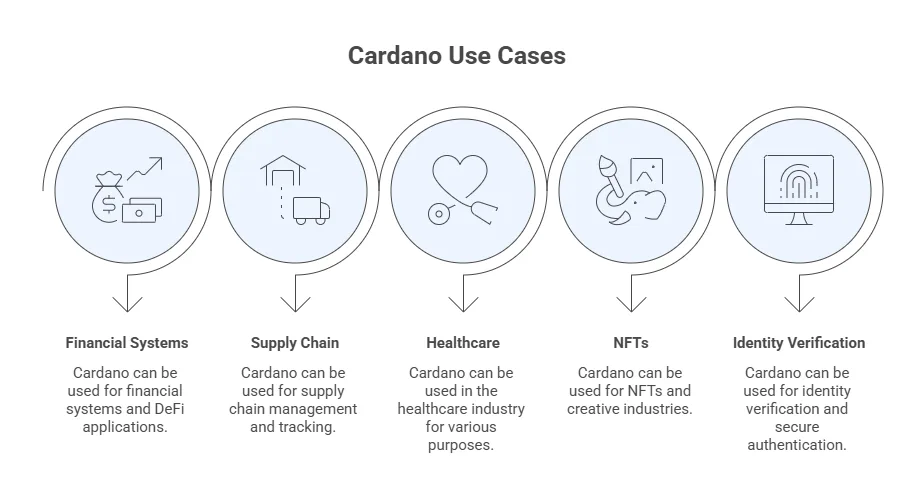
- Financial systems and decentralized finance: The blockchain facilitates secure, transparent, and intermediary-free lending, borrowing, and trading.
- Supply chain management: Cardano is used to track goods from source to delivery, ensuring authenticity and preventing fraud.
- Healthcare: The blockchain is used to store and share immutable medical records, all while ensuring privacy.
- NFTs and creative industries: Cardano offers artists and creators a platform to create, manage, and sell non-fungible tokens (NFTs).
- Identity verification: Cardano’s blockchain technology is applied to decentralized identity solutions that enable users to manage their personal data.
The above applications confirm that Cardano is not only a payment network but a blockchain that can be used by enterprise and consumer applications.
Governance and the Future of Cardano
Cardano emphasizes the importance of community-based governance. Through ADA, holders get the opportunity to make decisions on upgrades, network funds, and developments. Project Catalyst allows anyone to post project proposals and vote on projects to be financed.
Cardano also features a Voltaire period, which introduces delegated representatives (DReps) and a constitutional system to serve as a guide for government governance. This facilitates transparent and sustainable Cardano network development.
What makes Cardano unique?
The Cardano blockchain is a third-generation platform integrating both academic and practical value. The blockchain is dual-layered, energy-efficient, and secure.
ADA crypto is Cardano’s native token. This crypto is used to make transactions, for staking, as well as governance. The blockchain favors decentralized applications, enterprise applications, and tokenization of real-world assets.