



Right now, more than 60 percent of the world’s cloud infrastructure runs on servers owned by three companies: Amazon, Google, and Microsoft. Your Netflix, your banking app, the website you read the news on. Most of it, sitting inside their buildings, on their terms.
Decentralized cloud computing is the pushback against that. And verifiable cloud computing is what makes that pushback actually trustworthy.
Why the world needs cloud computing
Building something on the internet used to require buying physical servers, which meant spending tens of thousands of dollars before a single user signed up. Cloud computing fixed that. Rent a server, pay by the hour, shut it down when you are done.
That shift is what made it possible for small teams to build apps that reach millions of people. A two-person startup in a garage can access the same computing power as a large corporation. That is genuinely useful.
But the tradeoff is that a handful of companies now sit at the center of almost all digital infrastructure. They set the prices. They hold the data. They can shut services down if they decide to. And when AWS had a major outage in December 2021, it took down Amazon itself, Disney Plus, and thousands of other services at once. Everything tied to one point of failure.
That is not a small problem.
What decentralized cloud computing actually is
The idea behind decentralized cloud computing is straightforward. Instead of renting servers from one corporation, users rent from a global open network of independent providers.
Think of the difference between hailing a taxi from one company that controls all the cabs in the city versus using an open marketplace where hundreds of drivers compete for your ride. In the second model, prices drop, no single driver has leverage over you, and if one driver is unavailable there are dozens of others.
Decentralized cloud works the same way. Anyone with spare computing power can become a provider. A data center with unused capacity, a developer with an extra server sitting idle, a business that only uses its machines during work hours. All of that spare capacity gets pooled into an open market.
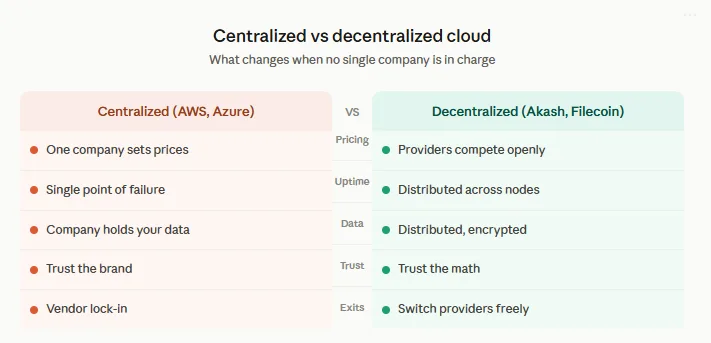
The benefits are real:
- No single company can take everything offline at once
- Prices fall because providers compete openly
- Users are not locked into one vendor’s terms
- Data gets distributed across multiple independent locations
So, what is verifiable cloud computing?
Decentralized cloud sounds great in theory, but it introduces an obvious question. If a random provider anywhere in the world claims to have run your computation, how do you actually know they did it?
With AWS, users trust the Amazon brand. With an unknown provider in a decentralized network, that brand trust is gone.
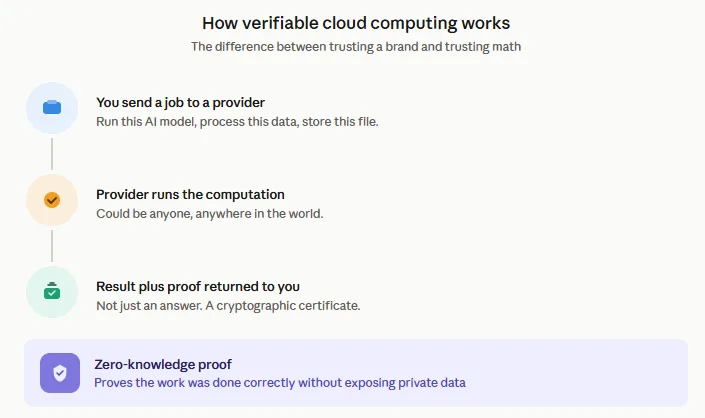
Verifiable cloud computing solves this by attaching a mathematical proof to the result of any computation. The provider does not just hand back an answer. They hand back an answer plus a cryptographic certificate that confirms, beyond doubt, that the work was done exactly as requested.
The most advanced version of this uses something called zero-knowledge proofs. The short explanation is that it lets someone prove they performed a computation correctly without exposing any of the private data that went into it. Proving a fact without revealing the details behind it.
Researchers have been working on this problem for decades. It is only recently, with blockchain infrastructure mature enough to support it, that practical applications have become possible. Verifiable cloud computing is increasingly seen as the key to making decentralized cloud trustworthy enough for real workloads.
Projects building in decentralized cloud computing
These projects achieve trustworthiness in different ways. Some use cryptographic proofs, others use staking and escrow. But all of them remove the need to simply trust a company.
- Akash Network (AKT): a marketplace for raw computing power, including GPUs heavily used in AI
- Filecoin: decentralized storage where users rent out spare disk space for FIL tokens
- Storj: enterprise storage distributed across a global node network with encryption built in
- Arweave: permanent storage paid for once, retained forever on the blockchain
- Render Network: GPU power originally built for 3D rendering, now expanding into AI inference workloads
These are all part of the DePIN category, Decentralized Physical Infrastructure Networks, where real hardware gets coordinated through token incentives rather than a corporate hierarchy.
Akash Network and the decentralized cloud race
Akash Network is one of the most active projects in decentralized cloud computing. It runs as a reverse auction. Users post what they need and what they are willing to pay, and providers bid for the work. The lowest credible bid wins.
GPU pricing on Akash starts at around $1.45 per hour for high-end H100 chips, compared to roughly $3.93 per hour on AWS for the same hardware. That difference comes from the fact that Akash taps into underutilized capacity that providers would otherwise leave idle. For AI developers who burn through GPU hours quickly, that gap is significant.
Akash is built on the Cosmos SDK and supports Docker containers, so developers do not need to rewrite their applications to use it.
Competitors include Render for GPU rendering, Filecoin and Storj for storage, and Ankr for general hosting. Each has carved out a specific niche rather than trying to be a direct AWS replacement. That is probably the right strategy for now, since competing with Amazon on every front at once is not realistic for any of these projects at their current scale.
How tokens power the network
Each platform has a native token that makes the economics work. For Akash, that token is AKT.
It does three things. Tenants pay for compute using ACT, a stable credit created by burning AKT, so the token remains the engine behind every transaction. Providers stake AKT to participate in the network, which creates financial accountability. And token holders vote on upgrades and changes to the protocol, so the community governs the network rather than a board of directors.
A recent upgrade called Burn-Mint Equilibrium takes this further. When a tenant pays for compute, AKT is burned to create their compute credits. When the job is done, AKT is re-minted to the provider. The net effect ties token demand directly to actual usage, and as the network grows, burn pressure can outpace new supply.
How the network stays honest
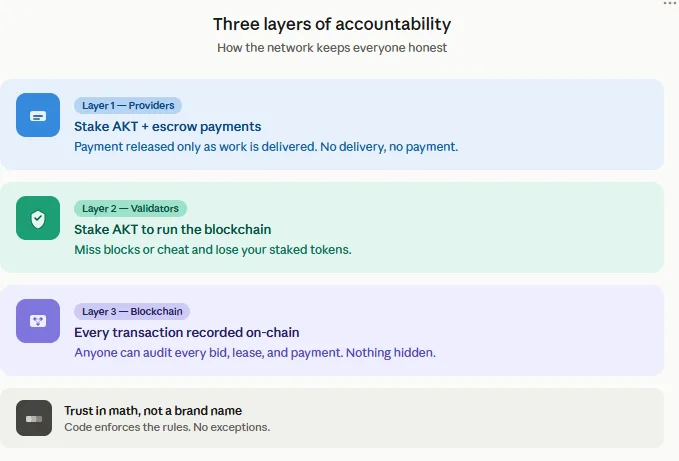
Providers need skin in the game to participate on Akash. Before listing services, they stake AKT, and tenant payments are held in escrow and released gradually as work is delivered. A provider that fails to show up simply does not get paid. That financial pressure is what replaces the brand accountability that AWS has built over years.
Every transaction, every bid, every lease agreement is also recorded on a public blockchain. Anyone can audit what happened. Nothing runs through a private database that only the company can see.
Beyond individual providers, validators secure the blockchain itself by staking AKT and processing transactions. They earn rewards for honest participation and lose their stake if they miss blocks or act against the rules. So accountability runs at every level, from the individual provider renting out a spare server to the validators keeping the whole network running.
Final takeaway
Verifiable cloud computing is not built on trusting a brand name. It is built on math, code, and economic incentives that make honesty the rational choice for everyone involved.
That is the core difference between renting from Amazon and renting from a decentralized network. One asks you to trust a company. The other makes trust unnecessary.