


When people say “XRP liquidation imbalance”, they mean one side of the XRP futures market is getting force-closed far more than the other, either longs wiped out or shorts squeezed. That lopsided liquidation flow can shove prices around and sometimes set off a chain reaction.
What is an XRP liquidation imbalance?
On perpetual or futures markets, you can borrow to go long or short. If the price moves too far against you and your margin falls below the maintenance level, the exchange automatically closes your trade at the mark price. That forced close is a liquidation. Pricing methods and fragmented markets matter here because they influence when and how positions get liquidated.
For XRP, when a lot of liquidations cluster on one side, we call it an XRP liquidation imbalance.
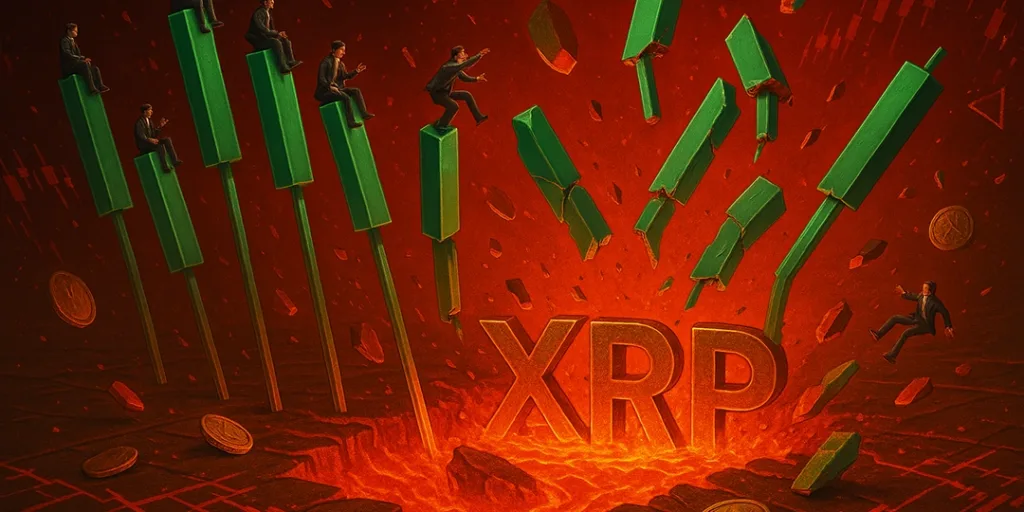
How an imbalance happens
- Traders crowd into the same bet, often using high leverage.
- Price moves the other way.
- Those positions hit margin limits, so exchanges force-close them into the order book.
- Those market orders move the price further, triggering more stops and liquidations.
- The cascade continues until risk is flushed out or big buyers/sellers absorb it.
Why it matters
- Volatility: an XRP liquidation imbalance magnifies the initial move.
- Liquidity shock: when order-book depth thins out, the same forced orders move the price farther. Depth can evaporate quickly during stress, especially in altcoins.
- Sentiment reset: funding rates often snap back toward neutral after an extreme, signalling a market “reset”.
How to spot XRP liquidation imbalance
- Liquidations by side (long vs short): If one side accounts for ~80–95%+ of XRP liquidations over 1–24 hours, that’s a clear XRP liquidation imbalance.
- Open interest (OI): A sharp OI drop during the move = forced deleveraging. A rise in OI while the price keeps moving = new positions chasing.
- Funding rate: Extended positive funding = crowded longs (risk of long wipeout); extended negative funding = crowded shorts (risk of squeeze).
- Order-book depth: If 1% depth collapses intra-day, expect bigger slippage and more violent follow-through when liquidations hit.
Live events that show XRP liquidation imbalance
- Aug 15–16, 2025: A market-wide flush wiped out over $1B in crypto positions; XRP fell from roughly $3.34 → $3.10 during the selling. That session featured heavy long-side liquidations in XRP—classic one-sided pressure.
- Aug 18–19, 2025: XRP spiked toward $3.10 before slipping back to the $3.00 area. A few minutes of extreme activity were noted, and then a brief “liquidity freeze,” conditions that can amplify an XRP liquidation imbalance if stops hit a thin book.
- Aug 14–15, 2025: A Bitcoin flash drop triggered about $577M in liquidations in one hour; within that window, XRP liquidations ran into the tens of millions. Other coverage the same week showed >90% of XRP liquidations were longs in a 24h span—textbook long-side skew.
These real-time windows are what an XRP liquidation imbalance looks like: one-sided liquidations coinciding with fast price moves and (often) thinner order books.
What to do with this information (beginner → advanced)
Beginner (spot only)
- Don’t chase a candle that just ran on someone else’s forced exit.
- If you must buy or sell, scale in/out with limit orders during cascades.
- Treat a visible XRP liquidation imbalance as a volatility warning, not a must-trade signal.
Intermediate
- Wait for the reset. After an extreme XRP liquidation imbalance, look for OI to stabilise, funding to drift back toward neutral, and price to hold a level on decent volume before fading or joining the move.
- Use liquidation heatmaps as zones, not exact lines.
Advanced
- Regime test: combine funding skew, OI delta, and depth. A true one-sided flush usually shows:
(a) funding snapping toward zero,
(b) OI down hard while price spikes/dumps, and
(c) depth thinning during the move, then refilling. - Execution: use post-only and laddered entries around areas with large liquidation clusters; avoid market orders mid-cascade due to slippage and potential ADL in extreme stress.
Common mistakes
- Thinking an XRP liquidation imbalance predicts direction hours in advance. It’s descriptive of who just got run over, not a crystal ball.
- Confusing normal volatility with a forced-order cascade. The tell is one-sided liquidations plus a simultaneous OI drop.
- Ignoring liquidity depth. Imbalances bite hardest when the book is thin.
Quick checklist
- Is liquidation flow one-sided (longs vs shorts)?
- Did OI fall during the move (forced deleveraging) or rise (new chasers)?
- Is funding extremely positive/negative? Is it snapping back?
- Did the 1% book depth shrink, hinting at bigger slippage?
- Any fresh catalysts (macro, listings, lawsuits, ETF chatter)? The CME futures listing is an example of a structural catalyst.
FAQs
1. What does ‘liquidation imbalance’ mean in the context of XRP?
A liquidation imbalance refers to a situation where there is a significant mismatch between forced sell-offs (liquidations) and available market liquidity in XRP trading. When too many positions are liquidated at once, the order book becomes unbalanced, leading to sharp price movements.
2. What causes liquidation imbalances in XRP markets?
Liquidation imbalances usually arise from excessive leverage, sudden volatility, or cascading stop-loss triggers. If traders are highly leveraged and XRP’s price moves quickly, many positions can be liquidated simultaneously, creating a chain reaction that overwhelms market depth.
3. How do liquidation imbalances affect XRP’s price?
When liquidations outweigh buy-side demand, XRP’s price may fall rapidly. Conversely, if short positions are liquidated en masse, a short squeeze can cause sharp upward price spikes. In both cases, imbalances amplify volatility and destabilize normal trading conditions.
4. How can traders protect themselves from liquidation imbalance risks?
Traders can mitigate risk by lowering leverage, setting conservative stop losses, and monitoring funding rates across exchanges. Diversifying trading strategies and tracking XRP’s on-chain and derivatives data can also provide early warning signs of potential imbalances.
5. Why is monitoring XRP liquidation imbalance important for investors?
Monitoring imbalances helps investors anticipate sudden volatility, understand liquidity stress points, and gauge broader market sentiment. Analysts often use liquidation data as a signal of market overheating or capitulation, which can inform entry and exit strategies.
Final word
Keep it simple: an XRP liquidation imbalance tells you which side just got forced out and how stressed the market is right now. Use it to manage risk first, and only then to look for opportunity once the dust settles.