

zkVM explained for people tired of trusting black boxes. “Trust me, bro” is no longer a system.
Here is a quiet truth about the internet. Most of the time, you are taking someone’s word for it. A server says it processed your data. A blockchain says a transaction happened. An AI says it gave you the right answer. You nod and move on.
Now imagine a world where every machine has to show its homework. That is zkVM explained. Not with mystery, but with a simple shift. Computers are no longer allowed to say “trust me.” They now have to say, “check this.”
Welcome to the age of verifiable compute blockchain systems, where answers come with receipts. And no, not the kind you lose after buying shawarma.
What is verifiable compute, and why should you care
Let us start with the bigger idea before we zoom into the fancy tool. What is Verifiable Compute? It is the ability to prove that a computation was done correctly without redoing the entire work yourself.
Think of it like this. You send your friend to calculate something very long and painful. They come back with the answer. Normally, you either trust them or redo the work yourself. Verifiable compute says there is a third option. Your friend brings back the answer, plus a tiny, easy-to-check proof that they did not cheat.
This idea has been around longer than crypto. Back in the 1980s, cryptographers started asking a strange question. Can you prove something is true without revealing everything behind it? That led to zero-knowledge proofs. Over time, researchers improved the idea until it became practical enough to verify entire computations.
So verifiable compute blockchain systems are not magic. They are decades from math and are finally getting a job.
zkVM explained without the headache
Now we zoom in on the star of the show. What is zkVM?
A zero-knowledge virtual machine is a system that runs a program and produces proof that the program ran correctly. Yes, that sounds like something written by someone who enjoys confusing people.
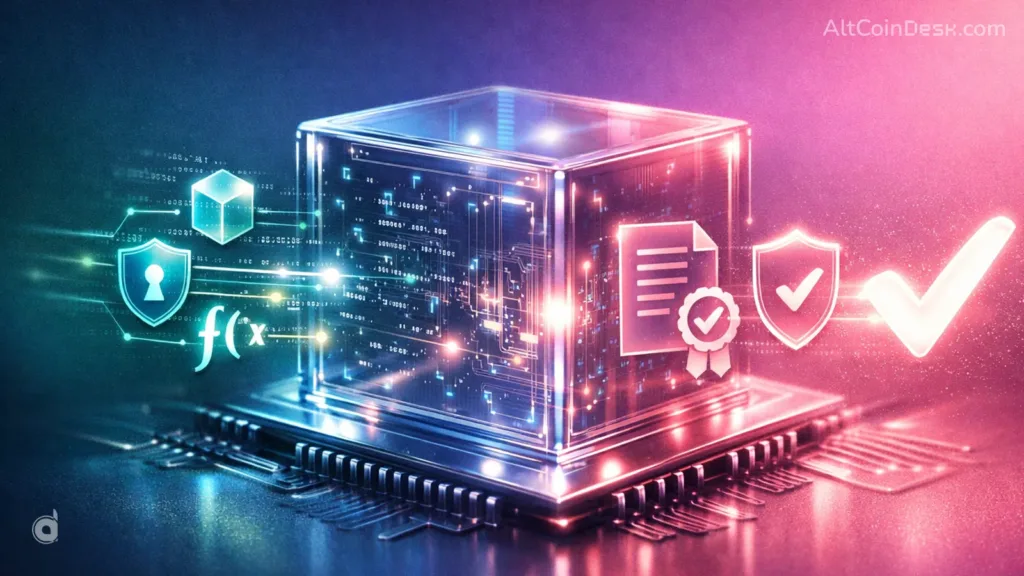
Let us simplify it. A normal computer runs code and gives you an output. A zkVM runs code, gives you the output, and also gives you a cryptographic receipt that proves the output is correct.
So if someone asks, “Did this program really run as claimed?” you do not argue. You hand them the receipt. That is zkVM explained in its simplest form.
And here is the twist. Many zkVM systems do not even care about hiding secrets all the time. Despite the name “zero-knowledge virtual machine,” a lot of real use cases focus on correctness, not privacy. The privacy part is optional.
So if you were wondering what zkVM is doing differently, the answer is simple. It turns execution into something you can verify, not just believe.
How a zkVM actually works without melting your brain
Let us walk through the process like a checklist.
- First, you write a program. Usually, in something normal like Rust.
- Second, the program is compiled into a format the zkVM understands. Often this is based on RISC-V, a clean and simple instruction set.
- Third, the program runs. But instead of just producing an output, it records everything it does step by step. This is called an execution trace.
- Fourth, a prover turns that trace into a cryptographic proof.
- Fifth, anyone can verify the proof quickly without rerunning the whole program.
That is it. No smoke, no mirrors. The heavy work happens once. The checking is cheap. Which is why blockchains love this idea. Instead of every node redoing everything, one party does the work and everyone else checks the proof. Efficiency finally gets invited to the party.
A short history that secretly explains everything
Let us compress forty years into something readable. In 1985, researchers introduced zero-knowledge proofs. This was the seed. The idea that you could prove something without revealing everything.
Later came interactive proofs and systems that made verification faster and smarter. Around 2008, researchers started thinking about outsourcing computation safely. The question became practical. Can normal people verify work done by others without supercomputers?
By 2013, systems like Pinocchio showed that verifiable computation could actually work in practice. Then came STARKs in 2018. These brought scalability and removed the need for a trusted setup in many cases.
And then the real shift happened. Instead of building custom proofs for each task, developers started building general-purpose systems. That is where the zero-knowledge virtual machine enters. Not as a theory, but as a developer tool. From a math paper to a software product. That is quite the glow-up.
SNARKs, STARKs, and other words that sound like snacks
Behind every zkVM is a proof system. Two main families dominate.
- SNARKs are small and fast to verify, but often require a setup step.
- STARKs are larger but more transparent and scalable.
Many modern zkVM systems combine both ideas. They might generate a proof using one method and then compress it using another. What matters for you is not the acronym. What matters is the outcome. Small proof. Fast verification. Honest computation. Everything else is just an engineering detail.
Why everyone suddenly cares about RISC-V
You will hear RISC-V mentioned a lot in zkVM explained conversations.
Here is why. RISC-V is simple, open, and predictable. It is like the plain white T-shirt of computing. Not flashy, but it works with everything. Because it is clean, it is easier to prove what happens inside it.
So many zkVM systems use RISC-V as their foundation. This allows developers to write code in familiar languages and still generate proofs. Less pain. More adoption. And yes, developers do care about less pain.
The numbers that tell the real story
Let us talk about reality for a second. Proof generation is still expensive. Some systems require gigabytes of memory. Some need powerful CPUs or even GPUs. Local setups often recommend at least 16 GB of RAM.
Benchmarks show interesting tradeoffs. Some systems produce smaller proofs but take longer to generate them. Others are faster but produce larger proofs.
Verification, however, is usually very fast. Often measured in milliseconds. That is the magic. Expensive once. Cheap forever after. It is like cooking a huge meal once and eating leftovers for days, except your leftovers are cryptographic proofs.

Where zkVMs are already changing things
The biggest use case today is blockchain scaling. Instead of every validator doing all the work, one prover does it, and everyone else verifies. This reduces costs and increases throughput. But it does not stop there.
zkVM explained is turning identity systems from claims into proofs, where you can prove something about yourself without revealing everything. It shows up in cloud computing, where you can verify outsourced work.
And now it is creeping into AI, where people want proof that a model ran correctly or that data was handled properly. Basically, anywhere trust is expensive, verifiable compute shows up.
The future feels slightly unfair
Here is where things get interesting. Ethereum is exploring deeper integration of proof-based systems. There are discussions about moving toward architectures that are easier to prove, like RISC V.
AI researchers are exploring verifiable pipelines, where not just outputs but entire processes can be proven. And zkVM systems are getting faster. New designs claim the ability to handle large workloads in seconds with enough hardware.
We are moving toward a world where “show me the proof” is not a challenge. It is a standard feature. And honestly, that might make the internet a little less chaotic. Only a little.
Conclusion: zkVM explained in one honest sentence
If you take nothing else from this zkVM explained guide, take this. Computers are learning to prove themselves. Verifiable compute blockchain systems are turning trust into something you can check. A zero-knowledge virtual machine is the tool that makes it practical for real software.
It is not perfect yet. It is still expensive. It still has tradeoffs. But it changes the rules. Because in a world full of black boxes, the most valuable output is not just an answer. It is an answer with proof.