



The loudest fight in US crypto policy right now is not about scams, speculation, or even consumer protection. It is about money quietly leaving the banking system.
The stablecoin yield ban has become the top 2026 priority for the American Bankers Association, and the reason is simple. Banks fear that if stablecoins are allowed to pay yield, trillions of dollars could move out of traditional deposits and never come back. This is not a theoretical worry. It is a funding panic.
Behind closed doors in Washington, banking lobbyists are pushing Congress to make sure payment stablecoins cannot pay interest, yield, or rewards, no matter who offers them or how they are structured. Their concern is that once digital dollars start behaving like interest-paying accounts, banks lose their grip on deposits. When deposits shrink, lending shrinks too.
Here’s why the US banks want stablecoin interest stopped before it starts.
Why the number $6 trillion matters
Earlier this year, Brian Moynihan warned that as much as $6 trillion could move out of banks if customers gain access to interest-paying stablecoins. That figure may sound dramatic, but it reflects how much US bank lending depends on cheap, stable deposits. From the banking perspective, a stablecoin yield ban is not anti-crypto. It is self-defense.
Banks rely on deposits to fund mortgages, small business loans, and credit lines. If customers can hold digital dollars that move instantly, settle globally, and pay yield, banks fear they will become less relevant as financial intermediaries. That fear has now hardened into policy. The stablecoin yield ban is designed to keep stablecoins firmly in the payments box, not the savings box.

What the law already says and why banks want more
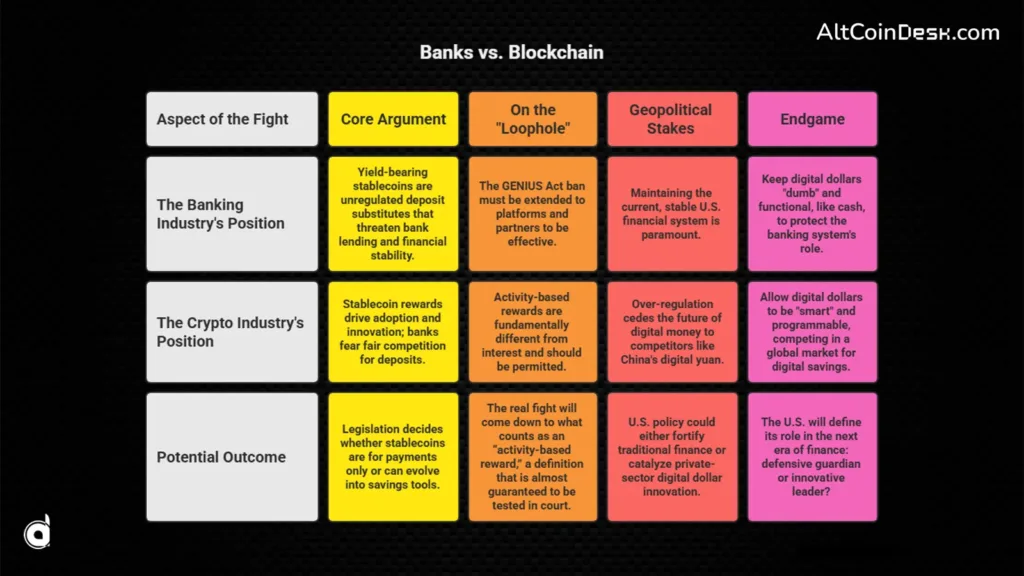
The GENIUS Act already prohibits stablecoin issuers from paying interest directly to holders. That part is settled. What banks are now focused on is what they see as a loophole. Even if issuers cannot pay yield, platforms, exchanges, or wallets could offer rewards tied to holding stablecoins. From a user’s point of view, the effect feels the same. Money sits in digital form and earns something extra.
Bank groups argue that this turns stablecoins into deposit substitutes, even if the yield does not technically come from the issuer. That is why the ABA is pushing for language that bans yield or rewards regardless of the platform. This is not a fight over wording. It is a fight over distribution.
The quiet war over who controls interest
There is a deeper story here that goes beyond crypto regulation. Interest has always been tightly controlled by the banking system. Banks decide who gets paid to hold money and how much. Stablecoins threaten that arrangement by separating money from the institution that traditionally controls it. The stablecoin yield ban is really about preserving that control.
Banks are not lobbying against innovation. They are lobbying against competition for interest. By blocking yield at every level, banks keep digital dollars from behaving like modern financial products. That is why this debate has become so intense, so fast.
Crypto executives push back hard
Crypto leaders see the issue very differently. Jeremy Allaire, the CEO of Circle, has dismissed the idea that stablecoin yield could trigger bank runs, calling it totally absurd. In his view, yield simply helps attract users and makes products more useful.
From the crypto side, banning yield looks less like safety and more like protectionism. If stablecoins are meant to compete with existing payment systems, limiting their features makes them less competitive by design. That argument is gaining traction outside the crypto bubble.
Is the US weakening the digital dollar?
The stablecoin yield ban debate is also starting to touch a geopolitical nerve. Anthony Scaramucci, founder of SkyBridge Capital, has argued that restricting yield on dollar-backed stablecoins could put the US at a disadvantage globally. Other countries are experimenting with state-backed digital money that offers incentives and programmability.
If US digital dollars are stripped of competitive features, they may lose ground in global digital finance. That raises an uncomfortable question. Is the US protecting financial stability, or is it protecting incumbents at the expense of innovation?
Why the timing is political
This push is happening now because Congress is actively working on crypto market structure legislation ahead of the midterms. When a legislative vehicle is moving, lobbyists rush to shape what goes inside it.
Banks already secured a ban on issuer-paid yield. Now they want to lock down the rest of the ecosystem before stablecoins gain more traction with everyday users. Once consumers experience yield-bearing digital dollars at scale, rolling them back would be politically difficult. This is why the stablecoin yield ban has jumped to the top of the agenda.
What happens next
If lawmakers side with the banks, yield and reward programs tied to stablecoins could be tightly restricted across the US market. Stablecoins would remain payment tools, not savings alternatives. If lawmakers leave room for platforms to innovate, the US may end up with a two-tier system where issuers are restricted, but distributors compete on incentives. Either way, the outcome will shape how Americans use digital dollars for years.
At its core, this is not a crypto story. It is a story about power, money, and who gets to decide how value moves in a digital economy. And behind every argument about safety and stability sits a very real fear. A fear that $6 trillion might walk out the door. That fear is why the stablecoin yield ban now defines the banking lobby’s fight for 2026.