

Tech startup VeryAI raised $10 million in a seed funding round in an endeavor to distinguish real users from AI-generated accounts with palm-scan identity verification. The goal of a palm-scan identity verification system “isn’t just to prove that a human exists somewhere—it’s to help platforms verify that a real person is present and acting authentically,” stated the VeryAI cofounder. Despite converting the images to hashes, an analyst raises concerns about privacy and data security.
VeryAI and Polychain raise $10 million
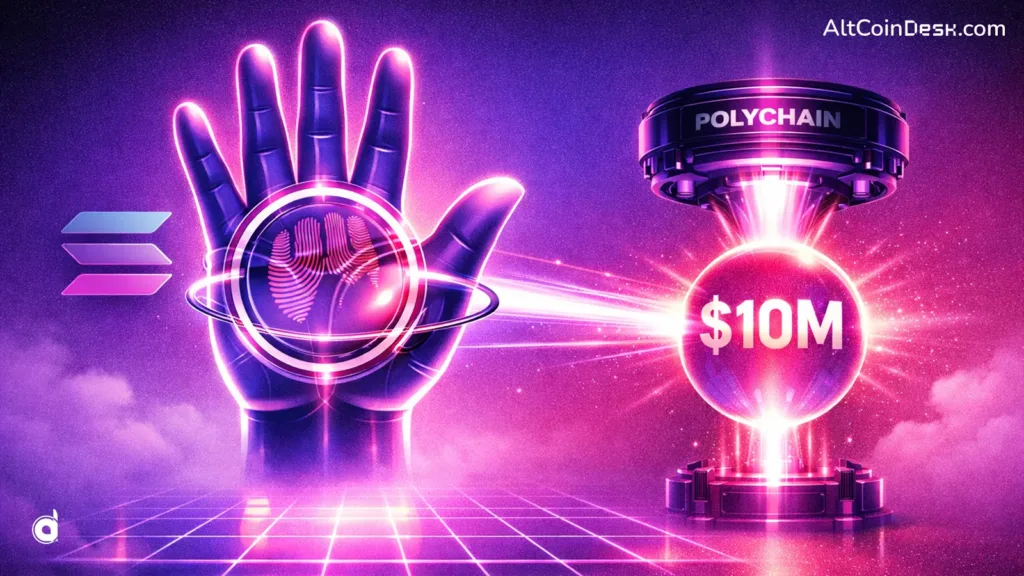
In an era where bots and artificial intelligence imitate a real user, the startup VeryAI has raised $10 million in a seed funding round in collaboration with Polychain Capital to launch a palm-scan identity verification system to distinguish the two: AI-generated accounts and real users.
Speaking to a prominent crypto media outlet, the CEO of Very AI stated, “We’re entering a period where the internet can no longer assume that every account, message, or video is created by a real person.” Furthermore, he stated that AI is powerful, but it also breaks many of the trust assumptions that the internet was built on.
The verification system records identity attestations on Solana, which will aid exchanges, fintech companies, and online platforms in combating the increasing risks from bots, deepfakes, and synthetic identities.
Once the system captures palm images through a smartphone camera, it converts them into encrypted biometric signatures used to confirm that a user is human without storing identifiable data. Why palm biometrics?
According to the company, palm biometrics are highly distinctive and less publicly exposed than facial features commonly used in identity checks. By converting the scans into irreversible feature representations rather than stored images, the company ensures that the original biometric data cannot be reconstructed.
The trilemma surrounding proof of personhood
Analyst Lavneet Bansal stated: “Proof-of-personhood systems have always struggled with a three-way trade-off between privacy, uniqueness, and scalability.”
He pointed out that projects like BrightID prioritized privacy but struggled with sybil resistance, while Worldcoin maximized uniqueness through iris biometrics but faced regulatory pushback globally because of the sensitivity of collecting biological identifiers.
Palm scans may lower the hardware barrier compared to the world’s specialized devices, but they are still biometrics. Even if stored as hashes, which raises similar questions around long-term privacy and data security.
Analyst Lavneet Bansal
As such, the real challenge for systems like VeryAI isn’t the cryptography or the blockchain layer on Solana; it’s whether platforms are comfortable relying on biometric infrastructure just to prove someone is human.