

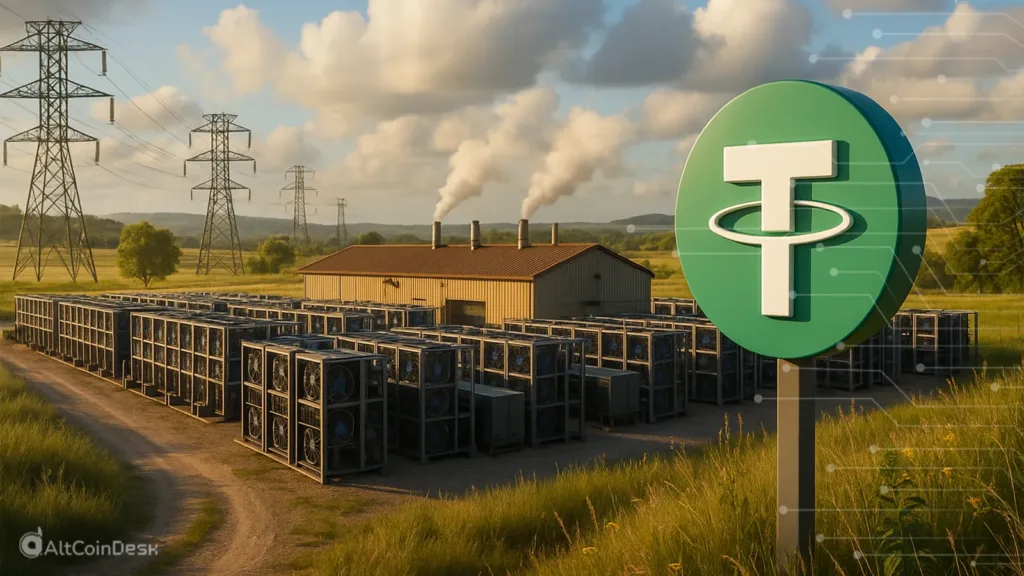

Energy concerns over crypto mining have long been a topic of discussion, especially among environmentalists. Even the cost of energy is also highly debated when it comes to crypto mining. Now, stablecoin issuer Tether has shut down its crypto mining operation in Uruguay, and the reason is quite clear: high energy cost.
Tether has confirmed the halt of $500 million crypto mining operation with Uruguay’s Ministry of Labor, and they have laid off nearly 30 workers.
Tether pulled the plug on $ 500 million mining project in Uruguay
When stablecoin giant’s massive $500 million crypto mining project met its end, it sparked some talks and concerns among crypto advocates. The mining operation that started in 2023 has just covered $100 million out of its $500 million investment.
In 2024, Tether had already discussed its concerns about high power tariffs with Uruguay’s government-owned power company or UTE, saying that a large-scale project needs a competitive and predictable tariff framework.
The mining venture, if completed, would have positioned Uruguay as a hub for technological infrastructure and renewable energy innovation.
However, there is one significant point to note. Tether’s concern over high electricity costs is very critical because it reportedly has to pay a debt of nearly $5 billion in power bills. This has led UTE to cut electricity to Tether’s crypto mining operations in September 2025.
Why is the energy cost high for crypto mining operations?
Crypto mining is not an easy process. To get a crypto mined, the miners have to go through complex calculations and procedures, which require high computational power and energy. But, wait, this is in the case of Proof of Work (PoW) consensus mechanism, as in Bitcoin and Litecoin.
Proof of Stake (PoS) methods used by Ethereum, Solana, and Cardano dramatically consume less energy compared to PoW. Here, miners do not have to deploy heavy machines; instead, ordinary servers can run validators.
So, as explained, PoW charges miners a lot of pennies for high energy consumption.
And, talking about Uruguay, several news reports show that the country has relatively high electricity charges when compared to other countries. This also adds to the reason why Tether has to shut down its crypto mining operations in the country.
Much of Uruguay’s electricity comes from renewable sources. However, when it comes to crypto mining, energy consumption is high, and they have to charge high tariffs. As such, Tether has to pay high tariffs, which are far higher than the profits they gain through mining.
For crypto supporters and lawyers, Tether’s cessation has caused frustration, questioning the country’s high electricity costs and bureaucratic games. The supporters emphasized the fact that the government is pushing out prominent crypto firms and their innovations.
Crypto firms that have shut down mining operations
Tether is not alone in this challenging race. Hut 8, a crypto mining firm affiliated with Eric Trump, closed its Drumheller bitcoin-mining site in Canada due to high energy costs and site issues.
Core Scientific is another example, where the company went bankrupt following a financial crisis related to high electricity costs and tumbling crypto prices. In several cases, companies like Bitfarms are restructuring their mining infrastructure to AI data centers due to economic and energy crises.
Eventually, it is quite true that heavy mining operations incur a high amount of electricity consumption. This rising consumption leads to high electricity prices, putting several crypto companies like Tether in pain.
Final solutions for a stable crypto mining
One core solution to tackle this issue is to move to regions where electricity is in excess (including renewable energy), and the rate is relatively low. Another solution is to repurpose waste energy; even cow dung or other animal waste can help generate biogas, which can be used as an energy source for mining crypto.