



Crypto communications strategy is not a marketing function. It is a leadership signal, and the industry has been ignoring it at its own risk.
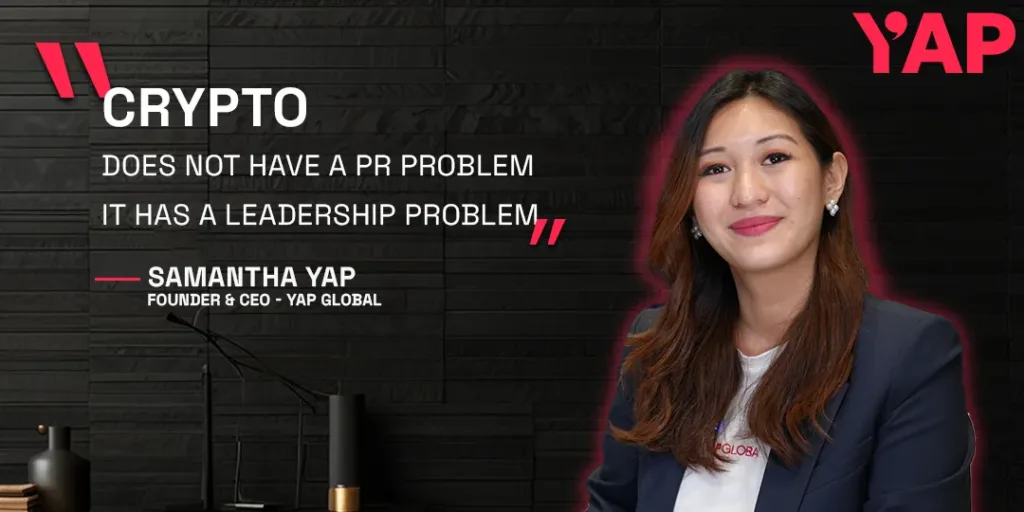
Crypto does not suffer from a publicity problem. It suffers from a leadership problem. That was the quiet but unmistakable message from Samantha, CEO and founder of YAP Global, during a recent conversation about why so many promising digital asset projects struggle to earn trust, even when their technology works exactly as promised.
At a time when skepticism, regulatory pressure, and public fatigue dominate the crypto narrative in the world, Samantha argues that the absence of visible founders has done more damage than bad headlines ever could. A weak or nonexistent crypto communications strategy leaves a vacuum, and vacuums are always filled by doubt.

When founders disappear, trust follows
YAP Global is an international public relations firm that works with digital asset and crypto companies to shape how their stories reach the media. Samantha founded the agency after years as a journalist, a background that deeply informs how she approaches reputation, leadership, and credibility.
She entered the crypto space in 2017 after reading the Bitcoin white paper. What fascinated her was not speculation, but structure. A peer-to-peer payment system, controlled by no single entity, challenged traditional ideas of money itself. Yet as the industry evolved, she noticed a recurring pattern.
Many founders built ambitious systems, then vanished from public view.
According to Samantha, founder visibility is not optional. It is a trust signal. In traditional technology companies, leadership presence reassures users, investors, and regulators. In crypto, founders often mistake decentralization for invisibility. That misunderstanding has fueled skepticism, transparency concerns, and ongoing credibility gaps.
A crypto communications strategy fails the moment leadership retreats behind code, white papers, or anonymous handles.
Journalism taught her why stories matter before crises begin
Before founding YAP Global, Samantha worked as a journalist. Early in her career, she left a stable broadcasting role to freelance abroad in Indonesia, hoping to become a foreign correspondent. The experience was difficult, uncertain, and at times discouraging. Yet it sharpened the exact skills she relies on today.
Freelancing taught her how stories are built under pressure, how editors think, and how narratives evolve long before headlines appear. Those lessons now shape how she advises founders to prepare before markets turn or crises emerge.
Many crypto teams approach public relations only when something goes wrong. Samantha sees this repeatedly. By then, the damage is already in motion. A real crypto communications strategy must exist before the first announcement, not after the first problem.
Reputation is leadership, not promotion
One of the most common mistakes Samantha sees is delaying communications hires. Founders prioritize engineering, funding, and product development while leaving reputation unmanaged. This approach ignores a simple truth. Reputation compounds just like technology does.
Leadership visibility builds familiarity. Familiarity builds trust. Trust reduces friction when markets tighten or regulators ask questions. When none of this exists, even strong projects struggle to be believed.
This lack of leadership presence has contributed directly to public skepticism, accusations of opacity, and the belief that crypto companies hide information rather than explain it. Transparency, Samantha emphasizes, does not require oversharing. It requires accountability.
A well-structured crypto communications strategy treats reputation as a leadership responsibility, not a marketing expense.
Why bear markets reward discipline and silence punishes hype
One of the more counterintuitive insights Samantha shared is that bear markets, not bull markets, are where reputations are actually built.
During bull cycles, media attention becomes crowded and shallow. Weak stories disappear quickly. Strong ones struggle to stand out. In contrast, bear markets create space. Journalists listen more carefully. Audiences ask deeper questions. Long-term narratives take shape.
This is when serious founders invest in clarity, not noise. They explain what they are building, why it matters, and who they are. Over time, this consistency creates credibility that carries into the next cycle.
A disciplined crypto communications strategy during quiet periods often outperforms aggressive promotion during hype phases.
Crypto does not need louder voices; it needs visible ones
Samantha describes herself as crypto agnostic, not a maximalist. Her focus is not ideology but structure. From her perspective, the industry’s credibility crisis stems from leadership gaps, not technical ones.
When founders disappear, trust erodes. When leadership remains visible, even during downturns, confidence stabilizes. The difference is not advertising spend. It is present.
The future of crypto adoption depends on leaders who understand that decentralization does not mean disengagement. A thoughtful crypto communications strategy aligns leadership, transparency, and long-term reputation into one coherent voice.
As Samantha puts it, the industry does not need fewer stories. It needs leaders willing to stand behind them, especially when no one is watching.