



The Bitcoin evangelist, Tony Yazbeck’s story begins not in a boardroom, but in a bed in Beirut, where he woke up one morning to find his future had vanished overnight.
“I went to bed believing I had a secure future,” Yazbeck recalls, his voice measured but firm. “I woke up with nothing.”
It was the collapse of Lebanon’s banking system, a sudden, brutal severance from his life savings, that propelled the cybersecurity expert into the heart of the Bitcoin revolution. Today, as the founder and CEO of The Bitcoin Way, he isn’t just teaching people about digital currency; he’s guiding them toward what he calls “an exit lifeboat” from a fragile global financial system.
The moment the system locked him out
“The moment they locked me out, I learned that having access to money is not the same as owning it. When you deposit money in a bank, it no longer belongs to you. You’re trusting someone else with your time and energy.”
Tony Yazbeck (Founder & CEO – The Bitcoin Way)
That harsh lesson became the foundation of his philosophy. At The Bitcoin Way, he and his team focus on three pillars: education, security, and self-custody. But the core message is even simpler: Bitcoin is money, not a speculative asset.
“Lebanon was not an isolated incident,” he insists. “The mechanics of fiat currencies are the same everywhere. Bitcoin is money not issued or controlled by any government or bank. The sooner people understand that, the better prepared they will be.”
The security mindset: You are your own bank
With a background in cybersecurity, Yazbeck, the Bitcoin evangelist, brings a sobering perspective to the conversation about digital asset protection. In an age of AI-powered scams, he believes security is no longer optional.
“Once you hold Bitcoin in self-custody, you are your own bank. That comes with personal responsibility,” he says. “But that responsibility should not be feared; it’s exciting. For the first time in history, individuals can truly own and secure their wealth.”
His approach is empowering rather than intimidating. The Bitcoin Way works one-on-one with clients, from tech novices to seasoned holders, to build security habits that become “second nature.” This extends to inheritance and succession planning, where Yazbeck emphasizes there is no “copy-and-paste” solution.
“We teach everyone involved the minimum skills to confidently secure Bitcoin. It’s not rocket science. Once these habits are normalized, people stop worrying and simply live their lives.”
Bitcoin vs. “crypto”: Why he draws a hard line
One of Yazbeck’s most passionate points is his distinction between Bitcoin and the broader cryptocurrency universe.
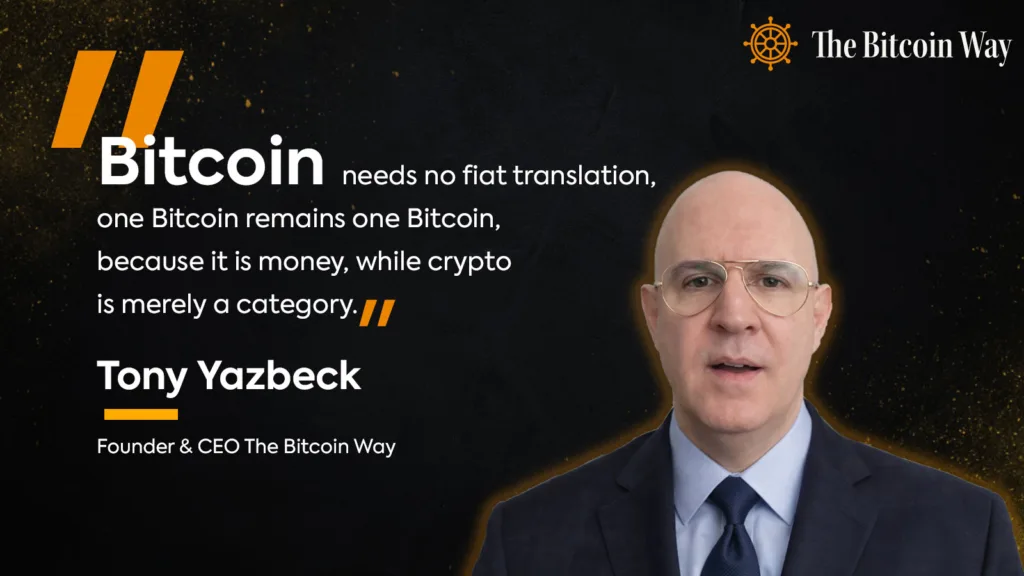
“Many people confuse Bitcoin with crypto. There’s a clear distinction: Bitcoin is money. Crypto is not,” he states bluntly.
If humans, corporations, or central entities control it, it cannot be trusted long-term. Bitcoin’s neutrality and decentralization give it the potential to become a global reserve currency.
He dismisses the idea that governments could shut Bitcoin down. “If that were possible, it would have already happened. Bitcoin has been under constant attack for over 16 years. Stopping Bitcoin is as unrealistic as stopping the sun from shining.”
The fiat blind spot and the path ahead
When asked about Bitcoin’s price volatility, Yazbeck reframes the question entirely. “We do not look at Bitcoin in fiat terms. Fiat price is a useless metric,” he argues. “One Bitcoin is one Bitcoin. It does not change. Fiat currencies trend toward zero. Measuring Bitcoin using fiat is misleading and causes panic.”
He believes we are still early in Bitcoin’s adoption curve, but the window is narrowing. “Institutions are racing to acquire as much as possible. If people don’t understand what they hold, they will be separated from it. Bitcoin represents a monetary renaissance we have never seen before.”
A life unattached
The man dubbed the Bitcoin evangelist, who emerged from Lebanon’s financial rubble, is visibly detached from material pursuits. “After losing everything, that version of me no longer exists,” he reflects. “What matters are memories, experiences, and the quality of relationships. Life is calmer when you’re not attached to material things.”
When asked what advice he’d give his 12-year-old self, he smiles. “Young Tony was very stubborn. If you told him to go right, he’d go left just to learn the hard way.” Today, he shares his experience without forcing action. “Some will avoid the wall, others will hit it. Everyone learns differently. All I can do is my part.”
Closing thought
Tony Yazbeck’s journey, from unbanked victim to unbanked pioneer, embodies the seismic shift Bitcoin promises. It’s not just a story about technology but about reclaiming sovereignty, one satoshi at a time.
As the Bitcoin evangelist puts it, “Since 2009, the legacy financial system has effectively become optional. The rest of the world just hasn’t realized it yet.”