
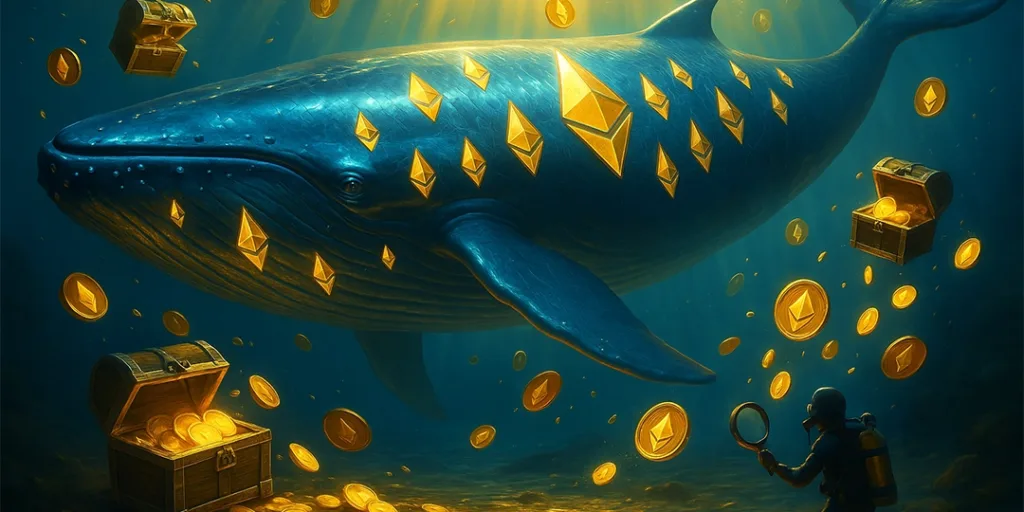

You open your phone and spot the headline: “Ethereum Whale Loses $32 Million in a Week.” It sounds dramatic. You imagine panic selling, crashing charts, and a market in freefall. But the reality? It’s far more interesting, and it reveals an important truth about how crypto works.
Last week, a single Ethereum wallet holding more than 65,000 ETH saw its value slide from $299 million to $266 million. That’s a $32 million drop. Yet the owner didn’t sell a single coin. No panic moves. No desperate trades.
The loss happened only because Ethereum’s price dipped, a so-called “paper loss.” It’s like seeing your house’s online estimate fall during a housing slump. The value changes, but the house is still yours. This is the curious case of the Ethereum whale who stayed calm while the market wobbled.

A diamond hand that is worth studying
In a single week in August 2025, an Ethereum whale, owner of wallet 19D5J8c…NWoZ1C, watched over $32 million vanish from their portfolio. As Ethereum’s price tumbled, its massive stash of 65,000 ETH shed value daily, culminating in an 11% loss.
While such a crash typically triggers panic selling and market-wide fear, this investor’s reaction was deafeningly silent. Blockchain data reveals a stunning truth: not a single ETH was sold. No desperate transfers to exchanges, no flight to stablecoins. Just calm, unwavering resolve.
This story isn’t about a loss; it’s a masterclass in conviction. It highlights the critical difference between a paper loss and a realized one. While others panicked, this whale simply held, demonstrating that true portfolio value isn’t measured in daily price swings but in long-term belief.

The psychology of inaction
The smartest crypto strategy? Sometimes it’s just to hold. Forget complex trades; the most sophisticated move can be the simplest: not selling. This Ethereum whale just demonstrated this perfectly. While many panic, this investor’s unwavering hold shows:
- Long-term confidence in Ethereum’s fundamental value proposition.
- Financial stability is sufficient to withstand temporary downturns.
- Strategic patience rather than reactive emotional decision-making.
- Understanding that paper losses only become real when positions are closed.
Sometimes, the best action is inaction.
The dark side of whale power: Rug pulls and manipulation
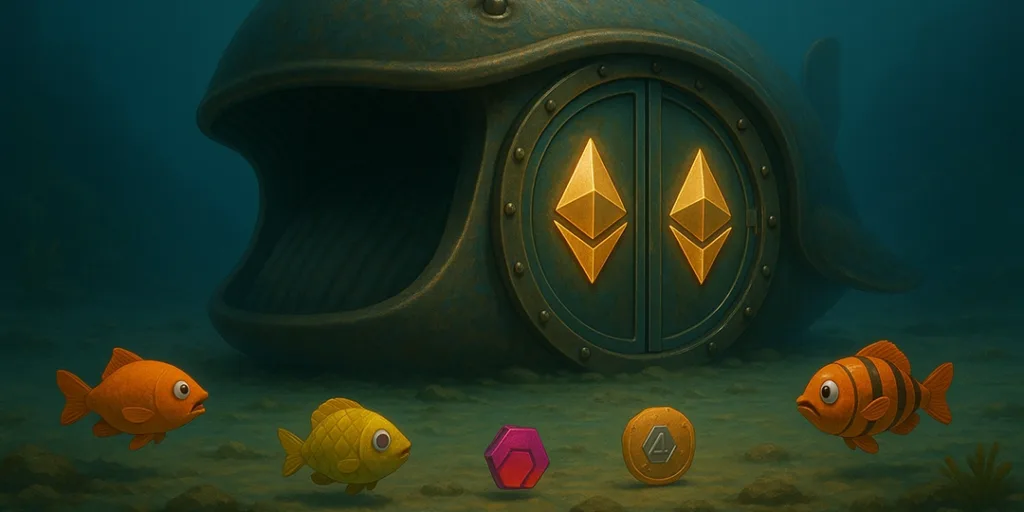
The crypto sea is vast, and not every whale is friendly. While some large holders are long-term believers, others are predators in disguise, orchestrating elaborate “rug pull” scams that vanish with investors’ millions.
The intent is what separates a hopeful whale from a wolf. True whales weather market storms, betting on a project’s future. Rug pull artists build a trap door from the very beginning.
Rug pull hall of shame: millions lost in minutes
History is littered with devastating exit scams that exploited trust and code:
- AnubisDAO (2021): $60 million drained from liquidity pools.
- Meerkat Finance (2021): $32 million lost through a clever contract hack.
- StableMagnet & Paid Network (2021): ~$27 million each stolen via malicious code and minting exploits.
How to tell a whale from a wolf
Don’t fear all big players. Focus on the fundamentals:
- The Whale (The Believer): Holds through volatility, invests in the ecosystem, and is transparent.
- The Rug Pull (The Scammer): Uses anonymous teams, promises unrealistic returns, and controls liquidity entirely.
Final takeaway
In the end, the story of this Ethereum whale reminds us that volatility doesn’t always equal catastrophe. Markets rise and fall, sometimes sharply, but real losses only happen when you sell. Whether you’re holding crypto, stocks, or even property, patience often proves to be the strongest strategy.
Always research a project’s team, audit history, and liquidity locks before you invest. In crypto, a healthy dose of skepticism isn’t just wise—it’s essential.