
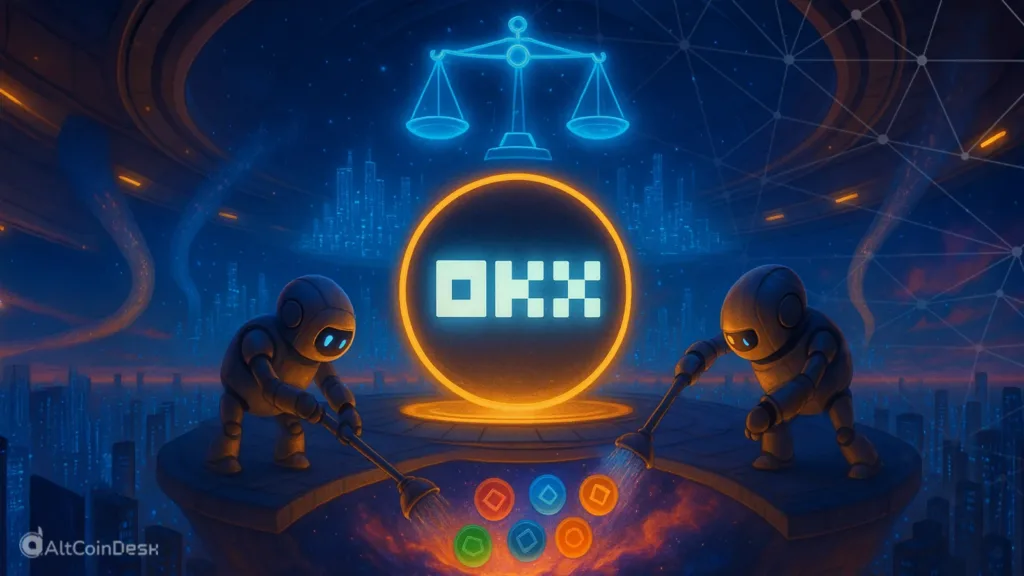

OKX just dropped a quiet bombshell for holders of five altcoins: say goodbye to trading ACA, CLV, FOXY, PSTAKE, and RACA on their spot market. As the OKX delisting plan proceeds, the clock is ticking to pull your funds off the exchange by March 2026. But for these tokens themselves, this isn’t just a minor inconvenience; it’s often the first, definitive step into a graveyard spiral. We’ve seen this story before, and it rarely has a happy ending.
This isn’t OKX spring cleaning on a whim. It’s part of a ruthless pattern. Back in October, they showed six other altcoins the door, including SLERF and AIDOGE. Before that, margin pairs got the axe in May and November, all under the banner of “improving market liquidity.” The writing is on the wall: exchanges are circling the wagons around “core assets.” If your token doesn’t pull its weight in volume, liquidity, or compliance, you’re getting cut.
The immediate fallout: A snapshot of the OKX delisted tokens

Let’s look at the casualties. What do these five have in common? They’re all on the ropes in a brutal market.
- RACA (Radio Caca) is clinging to a ~$13M market cap. Its modest volume masks dangerously thin order books, making it a playground for wild volatility.
- CLV (Clover Finance) is a ghost of its former self. Since its last major delisting, trading volume has evaporated, and its liquidity has utterly collapsed.
- ACA (Acala) tells a conflicting tale. A recent tiny bounce in volume can’t disguise a 25% monthly price nosedive, the very definition of weak, unconvincing demand.
- PSTAKE (pSTAKE Finance) and FOXY are arguably in the worst shape. Reliable data is almost nonexistent, which is a massive red flag itself. FOXY was already kicked off OKX margin trading last May. These tokens aren’t just struggling; they’re effectively off-grid.
Why OKX delisting is often a death sentence

Here’s why this delisting is usually a death sentence. For small-cap coins, losing a major platform like OKX isn’t a setback; it’s the trigger for an inescapable collapse.
The mechanism is brutal and straightforward. First, access crunches. The large, built-in trader base on OKX vanishes overnight, causing volume to implode. Next, confidence follows price off a cliff. The plummeting volume sparks sell-offs and scares away any remaining buyers.
Then, the dominoes fall. Those awful new metrics make the token fail the listing requirements of every other reputable exchange, leading to more delistings. Finally, it’s zombie status. The token ends up trading only in the shadows of obscure DEXs, with liquidity so thin you could trip over it.
We don’t have to guess. Look at history. When Bittrex delisted Mysterium (MYST), which relied on the exchange for over 90% of its trades, the token shed nearly half its value in a single day. The pattern repeated across their delistings. The data screams a clear warning: if a major exchange handling a significant chunk of your token’s volume drops you, a catastrophic price drop isn’t just likely; it’s virtually guaranteed.
Exchange hygiene: OKX cleaning its balance sheet for 2026
So why is OKX really doing this? Sure, lousy liquidity is the stated reason, but there’s a bigger storm brewing: the regulatory hurricane of 2026. Globally, major jurisdictions are rolling out comprehensive crypto frameworks. The OKX delisting wave looks less like housekeeping and more like a strategic retreat, battening down the hatches before the storm hits.
Exchanges are now forced to ask, “Which of these tokens could be a regulatory liability next year?” By preemptively culling tokens with weak fundamentals, ghost-town liquidity, or murky compliance status, OKX isn’t just cleaning house; it’s shielding its core business. This “exchange hygiene” is becoming the new industry standard. The wild west era of listing every speculative token is over. The future is about assets that can prove real utility, sustainable demand, and regulatory toughness.
What this means for crypto investors
What’s the takeaway for investors? The OKX delisting frenzy of 2025 teaches some hard lessons.
- The Rules Have Changed. Exchanges now worship at the altar of liquidity, volume, and compliance. Tokens that can’t meet these benchmarks are expendable, no matter how catchy their name once was.
- Don’t Be Fooled by a Mirage. Past performance or a strong community tale offers zero protection. When real liquidity dries up, the illusion of stability shatters in an instant.
- Diversify or Suffocate. Avoid heavy concentration in small-cap tokens that live and die by an exchange’s whim. This news is a blaring siren to always know your exit and never rely on a single trading venue.
The broader market is at a turning point. The speculative froth of past cycles is being scrubbed away by exchanges preparing for a regulated world. For ACA, CLV, FOXY, PSTAKE, and RACA, the path ahead is perilously narrow. For the rest of us, the message is crystal clear: prioritize quality and real liquidity. The era of easy listings and painless delistings is finished.