


Half of August is behind us, and just about 30-32 days remain until the next Federal Open Market Committee (FOMC) meeting, where all eyes will be on interest rate decisions. In the build-up to this poignant event, the signs seemed calm: the Consumer Price Index (CPI), which measures changes in the prices of everyday goods and services, came in softer than expected at 0.2%.
But the real shock was waiting in the wings. The Producer Price Index (PPI), which tracks price changes at the wholesale level and often hints at future inflation, smashed expectations. Forecasted between 0.0% and 0.2%, the PPI surged to 0.9%—a “shock and a half” that sent ripples through the crypto markets and rattled traders everywhere. The crypto market cap lost more than $100 billion with the arrival of the PPI data.
BTC dip is bearish on technical analysis, but analyst sees it as normal
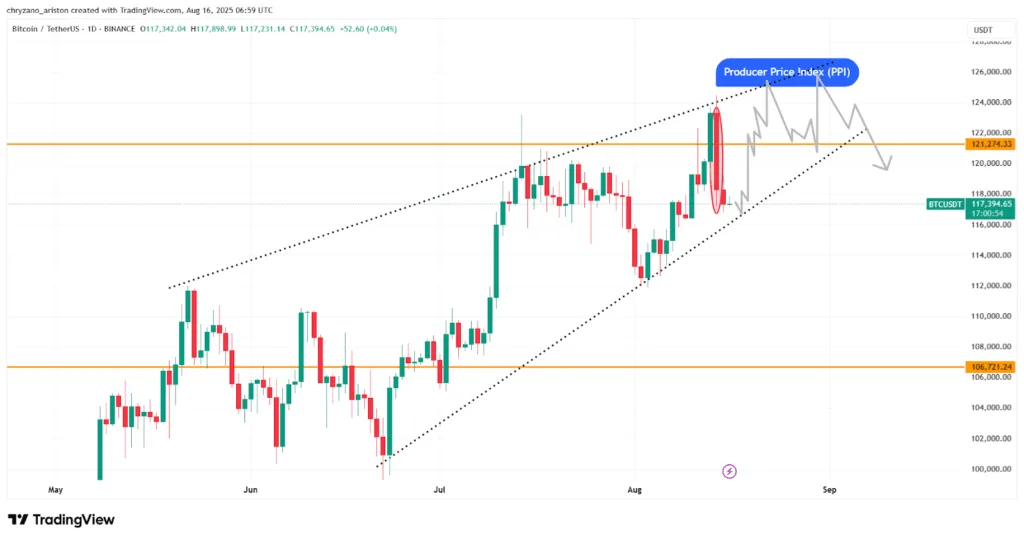
Bitcoin succumbed to the pressure of the PPI. However, even after a crash from $124K to $119K, it is still within bounds and is above the lower trendline of the bearish rising wedge. Inside a rising wedge, prices keep climbing, but each rally is weaker than the last, causing the trendlines to converge. This pattern often ends with a downside break as buyers lose steam and sellers take control. But the breakout might not be yet on the cards, as the pattern is not complete.
In contrast to the bearish technical analysis, the CEO of Wave Digital Assets, David Siemer, speaking to a prominent crypto media, stated, “The pullback is, in my view, simply a recalibration in an otherwise bullish trend,”. Siemer stated, the BTC crash is “equally normal” compared to how it rose with increased institutional acquisition, expectations of Fed rate cuts, and large ETF inflows.
What could be the reason for this contradiction?
When you look closely at the markets, technical analysis (TA) and Siemer’s views don’t contradict—they actually complement each other. Siemer highlights the recent pullback, which aligns perfectly with the rising wedge pattern. In this setup, prices often dip toward the lower trendline before rebounding, maintaining the structure of higher lows and continuing the upward trajectory toward the upper trendline. In other words, the pullback is a normal recalibration within a bullish larger trend, which turns out to be bearish after the breakout.
Ethereum ducks under Bitcoin and reduces the impact
Compared to Bitcoin’s massive shed in price, it would be safe to say, Ethereum was unharmed. ETH’s price dropped from $4.7K to $4.4K, when the PPI hit it. This dip did not even dump ETH back into the pattern broadening wedge.
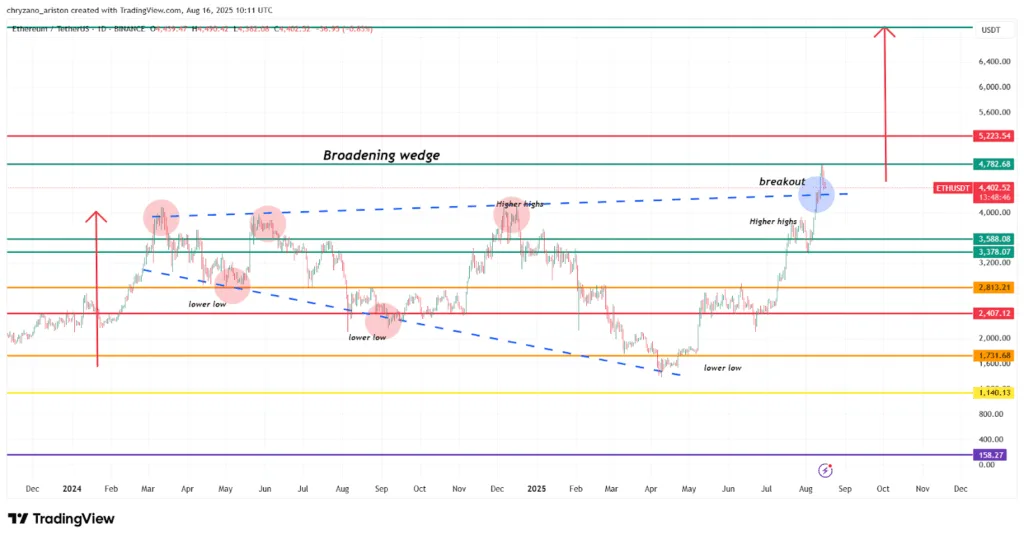
Why did ETH not fall as hard as Bitcoin?
Bitcoin suffered the biggest impact since traders were already pulling money out of it in anticipation of the altcoin season. The release of the PPI on top of money leaking out was like adding insult to injury. In contrast, the ETH futures market was booming with new contracts being opened. When new contracts on ETH futures are opened, the open interest (OI) increases, indicating that more money is flowing into Ethereum derivatives. This demands derivative provider acquire more ETH to honor the contract.
With more ETH being bought, the PPI data could not have a significant impact on the prices, as the fall was well cushioned by the futures contracts and institutional demand.
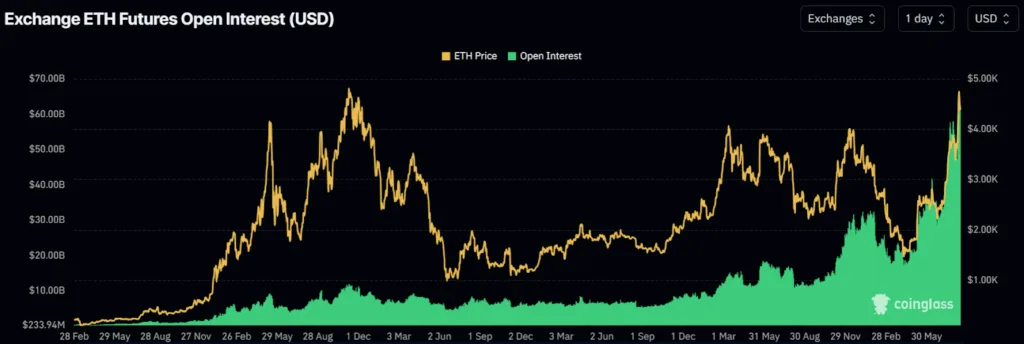
With such a bright outlook, Ethereum is set to go big. According to a long-term investor who goes by the pseudonym CryptoELITES, ETH is set to hit $13K.
The next FOMC is coming in another 32 days. With the meeting approaching, the question, “Will the Fed cut rates”? still begs an answer.
Fed rate cuts may be delayed
When PPI comes in higher, as it did last month, it often signals that production costs are rising, and these increases can eventually be passed down to consumers, pushing CPI higher in the following month. A higher CPI means inflationary pressures are still strong, which complicates the Federal Reserve’s decision-making. Since the Fed’s mandate is to keep inflation in check, persistent price growth makes it harder for policymakers to justify cutting interest rates, as doing so could fuel even more inflation
According to Reuters, “Investors still consider a regular-sized rate cut of 25 basis points as a likely outcome next month, but the odds of a cut dropped from nearly a 100% certainty to about 90% after the release of the producer prices data.” So, the Fed may hold the rates steady.