


Stablecoins are starting to flow back onto exchanges again, and it’s not something the market usually ignores. After a quiet stretch, the shift suggests traders may be getting ready to put capital back to work.
Binance stablecoin liquidity is making a comeback
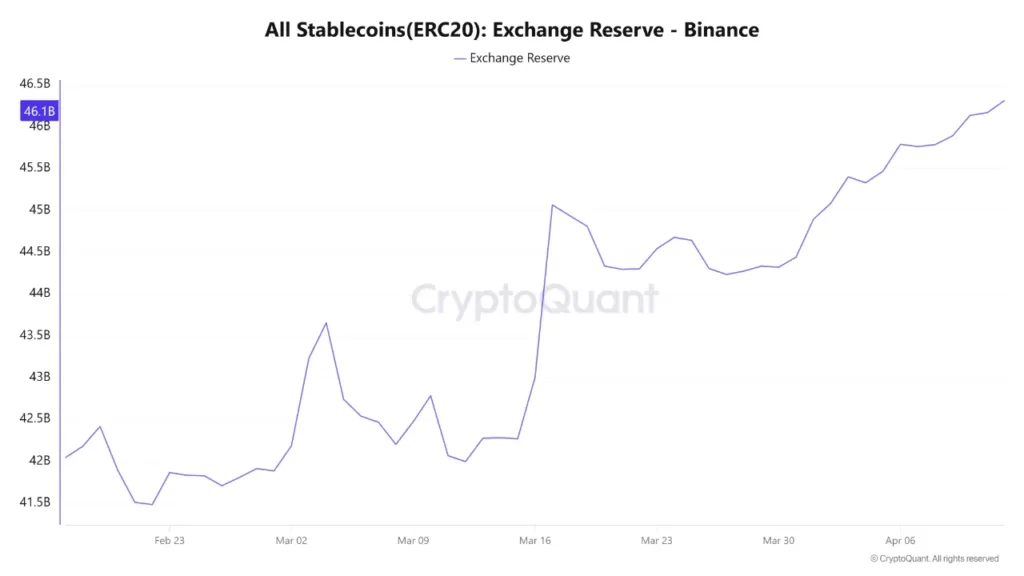
On Binance, ERC-20 stablecoin reserves have climbed to around $46.3 billion, the highest level since early February. That’s a solid rebound, especially considering how much reserves had dropped earlier this year. In total, about $5 billion in stablecoin liquidity has moved back onto the exchange since those February lows.
It’s still below the previous peak of roughly $51 billion seen in November 2025, but the direction is what matters here. When stablecoin balances on exchanges start rising, it usually points to one thing: money is moving back into position, waiting to be deployed.
Put very simply, more stablecoins sitting on exchanges means more potential buying power.
What this means for the market
Stablecoins like USDT and USDC are the backbone of most crypto trading pairs. When investors transfer them onto exchanges, it often signals intent – they’re getting ready to buy, not cash out. That could mean accumulating major assets like Bitcoin, or rotating into altcoins like ETH, SOL, if risk appetite surges.
There’s also a broader pattern to consider. Time durations where stablecoin reserves rise usually line up with more stable price action, and sometimes even the early stages of a move upward.
As a result, when more liquidity becomes available, dips are more likely to be bought, which can take some pressure off the downside.
The recent $5 billion inflow doesn’t guarantee a rally, but it does show a shift in behavior. Investors aren’t pulling liquidity out – they’re bringing it back in. That alone is a meaningful change from a sentiment perspective.
If this trend continues and reserves move closer to that $51 billion level again, it would suggest a larger pool of capital is building on the sidelines. And in crypto, that kind of “dry powder” doesn’t usually sit still for long.
For now, the signal is fairly straightforward – liquidity is coming back, and the market is starting to lean a bit more active again.