


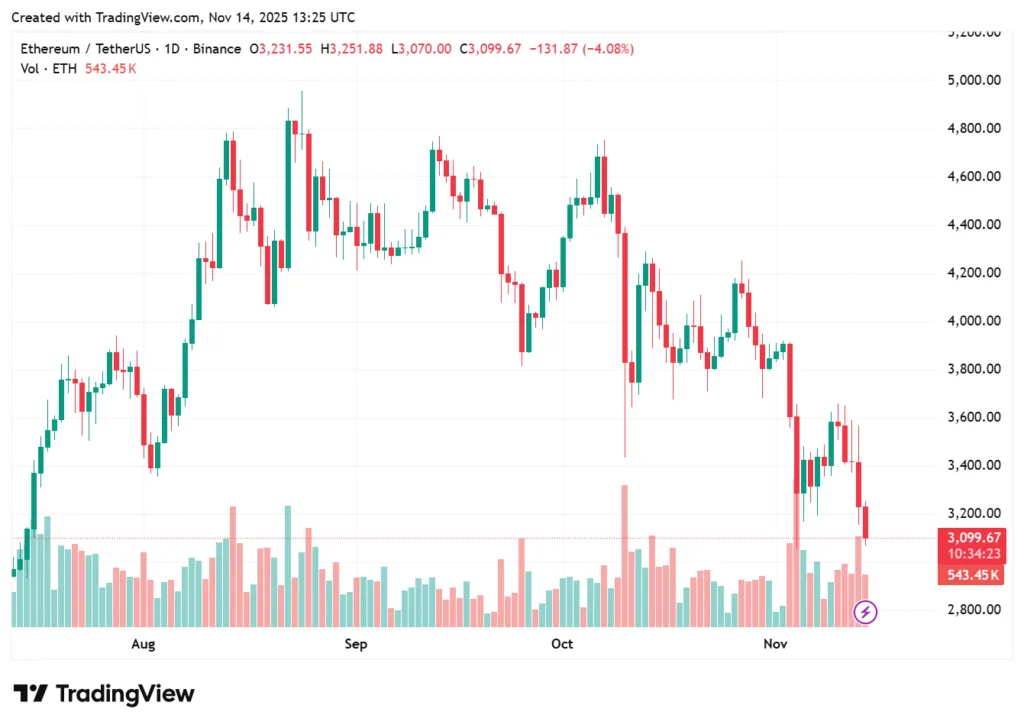
Today, Ethereum (ETH) – holding a market cap of $371 billion – saw one of the most brutal sell-offs of 2025. The digital asset tumbled by almost 10% over the past 24 hours, trading at $3,099 at the time of writing.
Ethereum faces $275 million liquidation
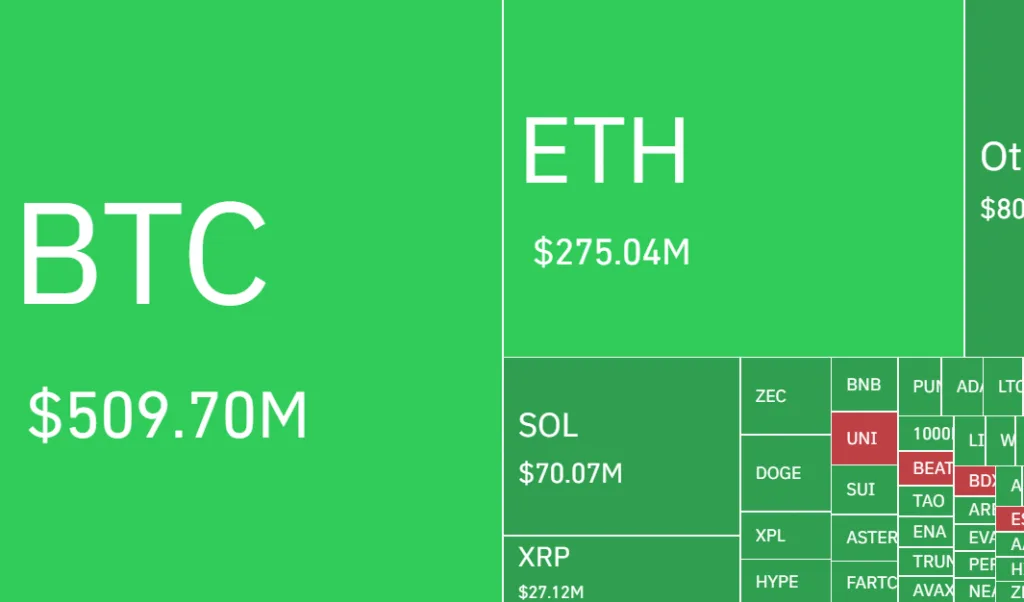
As Bitcoin (BTC) tumbled below $97,000 for the first time since May 2025, hundreds of thousands of ETH bulls got liquidated across different crypto exchanges. According to data from Coingecko, ETH liquidations topped $275 million over the past 24 hours, liquidating almost 249,000 traders.
For the uninitiated, liquidation occurs when a trader is forced to close their trading position because their collateral is no longer enough to cover the incurred losses. Liquidations take place to prevent the trader from getting into a negative balance.
Amongst the $275 million in ETH liquidations, $222 were long positions while $53 were short positions, indicating that the overwhelming majority of traders were expecting ETH to climb up before the market carnage.
In terms of exchanges, Bybit crypto exchange led the liquidations, witnessing total ETH liquidations worth $64 million. Interestingly, decentralized exchange (DEX) saw second-highest liquidations to the tune of $56 million.
Seasoned economist Donald Dean took to X, saying that ETH may not be completely out of the danger yet. He said Ethereum could drop to around the $2,800 – $3,000 range, which could be a good level to start picking up more ETH.
Can ETH stage a comeback?
While today’s beating might have dampened ETH bulls’ hopes for higher price for the digital asset, all hope is not lost yet. Ethereum is slated to undergo the highly-anticipated Fusaka upgrade on December 3, which can reignite bullish momentum for the cryptocurrency.
The Fusaka upgrade promises several major advancements for the Ethereum protocol, including the implementation of PeerDAS, and Verkle Trees, among others. Meanwhile, the amount of ETH being staked into the network continues to rise steadily, strengthening the digital asset’s fundamentals, and potentially leading to a ‘supply crunch.’