



Blockchain oracles don’t get nearly enough attention for something so fundamental to how crypto actually works. If you’ve ever wondered what is an oracle in blockchain and never got a straight answer, they’re simply the bridge between everything happening on-chain and everything happening in the real world.
Pull that bridge away, and a huge chunk of crypto stops working overnight. Once you understand what oracles actually do, where they can fail, and why the industry is still trying to solve them properly, you’ll have a much clearer picture of how DeFi really works under the hood.
What is an oracle in blockchain?
A blockchain oracle is a service that fetches real-world data and delivers it to a smart contract so the contract can do something useful with it.
Think of the blockchain as a sealed room. Incredibly secure, completely self-contained, but with no windows and no connection to the outside world. An oracle is the messenger that passes information through the door, verified and ready to use.
An oracle is not the data source itself. It doesn’t create the information. It collects data from outside sources, checks it, and brings it on-chain, meaning it’s delivered to the blockchain where the smart contract can use it. That distinction matters because it’s also where things can go wrong.
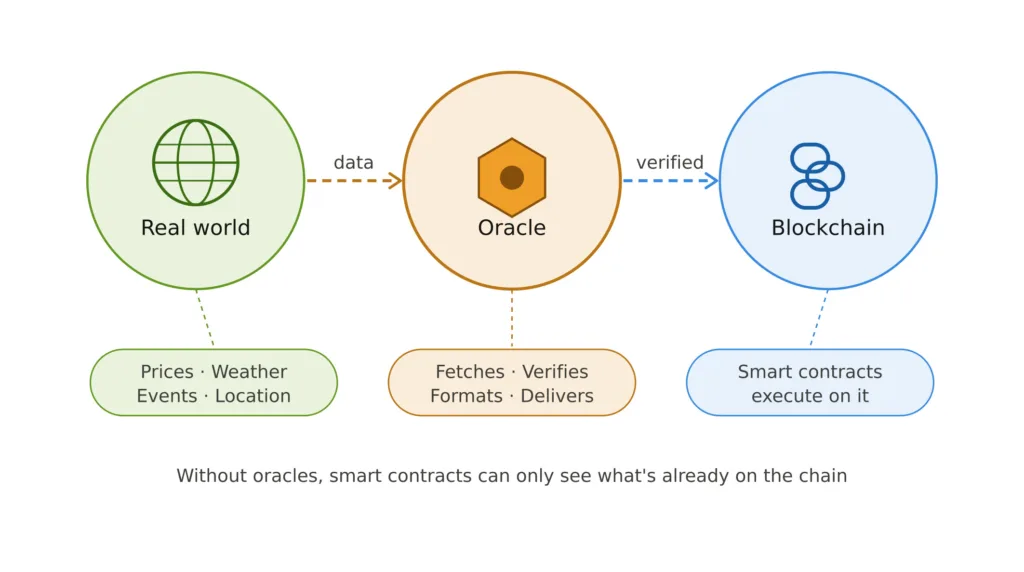
The reason blockchains need a separate layer for this comes down to how they actually work. Every node, which is basically every computer participating in the network, has to reach the exact same answer given the same input. That’s how consensus works.
If smart contracts could pull live data directly from the internet, every node would grab it at a slightly different millisecond and get a slightly different number. Consensus breaks. So external data has to come in through a controlled, agreed-upon channel, and that channel is the oracle.
How a blockchain oracle actually works
Flight delay insurance is a good way to picture it. You pay a small premium on a decentralized app, and the deal is simple: if your flight is delayed by more than two hours, you get paid automatically.
But here’s the thing. Your flight landing late is a real-world event. The blockchain has no idea it happened.
So the oracle goes out, grabs the flight data from an external tracking source, and brings it back in a form the blockchain can actually use. The smart contract checks it, sees the delay crossed the threshold, and sends the money to your wallet. No adjuster, no form, nobody approving anything on their end.
That’s the job. Get the data in, get it right, let the contract handle the rest.
The types of blockchain oracles
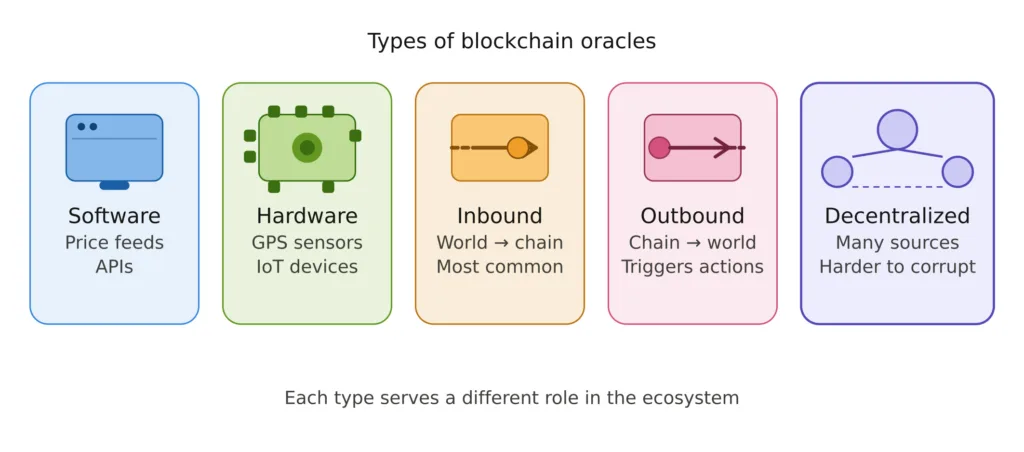
Not every oracle works the same way or pulls from the same places:
- Software oracles: Pull data from the internet, price feeds, exchange rates, weather data, sports results. Most common in DeFi.
- Hardware oracles: Pull data from physical devices like temperature sensors or GPS trackers connected to the real world.
- Inbound/outbound oracles: Inbound oracles bring data from the outside world into the blockchain. Outbound oracles send it the other way.
- Centralized oracles: Rely on a single data source, which means a single point of failure.
- Decentralized oracles: Pull from many independent sources and only report the agreed result, much harder to corrupt.
What is a crypto oracle used for in the real world?
Once you start looking, oracles turn up everywhere in crypto. Here’s where they’re actually doing the work:
- DeFi lending and borrowing: Deposit ETH on Aave, borrow against it, and oracles are quietly tracking what that ETH is worth in real time. Price tanks too hard, your collateral gets sold off to cover the loan before things go sideways. None of that happens without a live price feed coming in.
- Decentralized insurance: Flight runs two hours behind, oracle picks it up, money lands in your wallet. The whole thing settles without a single person signing off on it.
- Supply chain: Sensors ride along with a shipment the whole way, logging temperature and conditions. Oracle brings that data on-chain, and the payment goes through only if everything checked out.
- Sports betting and prediction markets: Game finishes, oracle reads the score, winner gets paid. Nobody types anything in, nobody has to do anything. It just resolves.
The oracle problem, the weak link nobody talks about
Blockchains are built to be trustless. No single person or company controls them. But oracles, by their nature, require a degree of trust. Something is feeding data into the system, and if that data is wrong, accidentally or deliberately, the smart contract has no way to know. It just runs on whatever it receives.
If you rely on a single centralized oracle, you’ve reintroduced the exact problem blockchain was built to solve. One source, one point of failure, one entity that can be manipulated. This tension is called the oracle problem, and it’s one of the most important unsolved challenges in the space.
Oracle in blockchain explained: what happens when it goes wrong
There are two ways oracles fail: by accident and on purpose.
Oracle malfunction: The accidental kind
In 2019, a bug in a price feed caused it to report the Korean Won at roughly one thousand times its real value. Synthetix, a derivatives platform, was pulling from that feed. An automated trading bot spotted the discrepancy and exploited it before anyone could react. The on-chain code did exactly what it was supposed to. The oracle just handed it completely wrong data.
Oracle manipulation: The deliberate kind
In October 2022, an attacker targeted Mango Markets, a decentralized exchange on Solana. He manipulated the price of a token that didn’t have much trading activity behind it, meaning its price could be pushed around with relatively little money. The oracle read that manipulated price as real and reported it to the protocol. The attacker borrowed against his now artificially inflated holdings and drained the protocol. The code never broke. The oracle was fed a lie, and the smart contract had absolutely no way to tell the difference.
Both cases show the same thing. When the oracle fails, the smart contract relying on it has no way to protect itself. And these aren’t isolated incidents. Oracle manipulation and malfunction continue hitting DeFi protocols regularly, with Venus Protocol and Aave both falling victim to similar exploits earlier this month.
How the industry is solving it: Chainlink, Pyth, and XYO
The answer to the oracle problem is decentralization, same as the answer to most problems in this space.
Chainlink is the most widely used oracle network right now. Rather than trusting a single source, it pulls data from dozens of independent node operators who all report separately. Only the result they agree on gets delivered on-chain, so one bad actor cannot corrupt the feed.
Pyth Network works differently. Instead of pushing data out on a fixed schedule, it lets applications request price updates only when they need them. The data comes straight from institutional trading firms and exchanges, which means faster updates and higher accuracy for anyone operating in fast-moving markets.
XYO Network is solving a completely different version of the oracle problem, location data specifically. It runs a network of physical Bluetooth and GPS devices around the world that verify where things actually are in real life. A smart contract that only releases payment once a package is confirmed delivered is exactly what XYO is designed for.
Takeaway
Oracles are the infrastructure layer that makes everything else in crypto actually work. DeFi, decentralized insurance, prediction markets, on-chain supply chains, none of it functions without a reliable way to bring real-world data onto the blockchain.
The oracle problem is not fully solved yet, and manipulation attacks still happen. But understanding how oracles work gives you a much clearer picture of where the real risks sit in any protocol you use. The blockchain is only as trustworthy as the data going into it, and now you know exactly where that data comes from.