

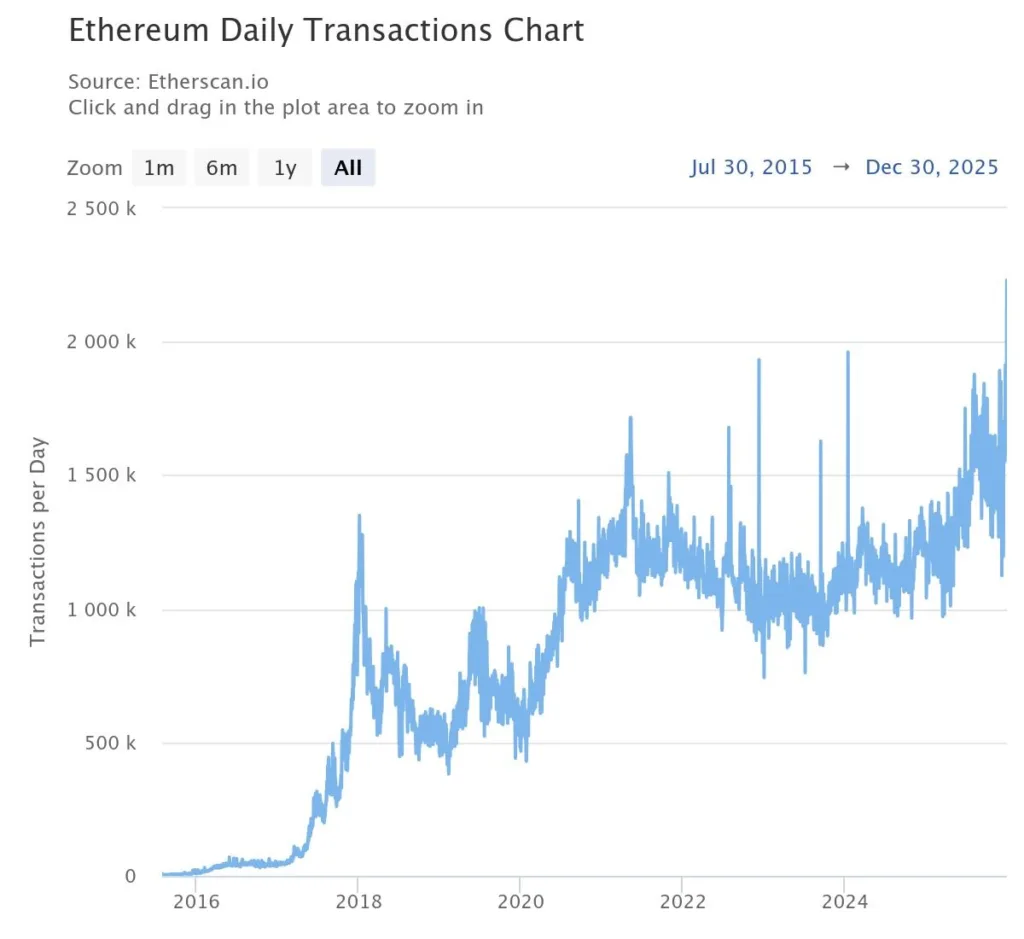
Ethereum broke through a psychologically important resistance level, as the daily transactions on its network hit 2.2 million. Analysts predict that a break above this level will see ETH reach $5,000 in the coming days.
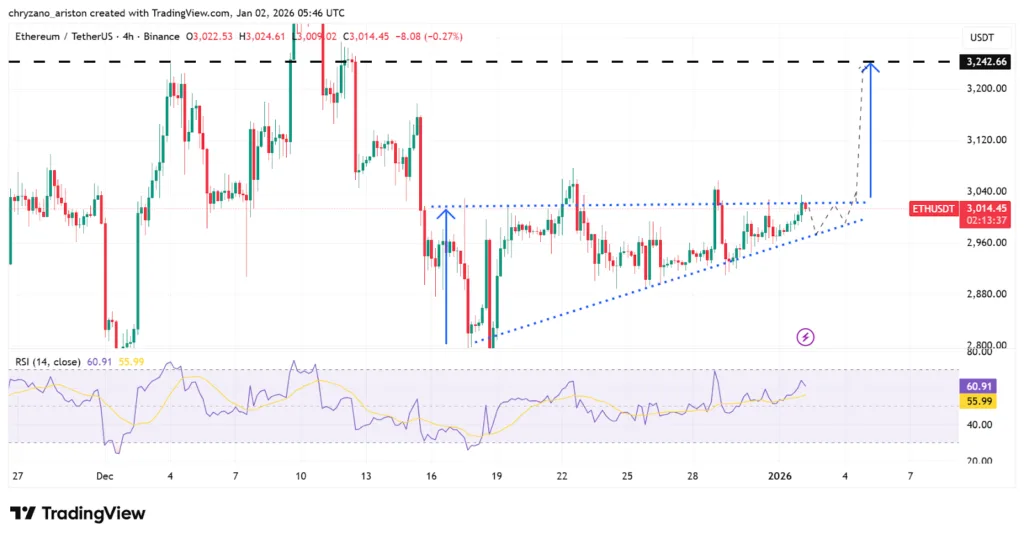
Ethereum broke above $3,000 with the dawn of the new year. During the last few days of 2025, the coin tested this level but was rejected. This is just the beginning of the uptrend, as there is bullish momentum forming on the technical front.
On the 4-hour chart shown below, the coin is forming the apex of the ascending triangle pattern, which produces a rally at the point of breakout. Once the pattern is complete, the coin will break and reach above $3,200.
What was behind this rally?
The spike in daily transactions was the main catalyst that fueled this rally. Daily transactions on Ethereum crossed above the 2 million level, touching 2.2 million, the highest in ten years, while the gas fees have fallen to nearly 17 cents on average. This record level of daily transactions comes after Ethereum went through a major upgrade.
The recent Fusaka upgrade focused on the consensus and the execution layer for better scalability, performance, and efficiency. The Peer Data Availability Sampling (PeerDAS) — gives the nodes the bandwidth to verify large data “blobs” used by Layer-2 rollups by sampling portions rather than downloading the whole database.
Furthermore, the upgrade also increased the block gas limit, which means the block could accommodate more data, which helps with the throughput.
A point to note is the gas fee dropping to an average of 17 cents. Usually when the network is clogged up with a lot of transactions, the gas fee goes up. The gas fee fluctuates based on the demand of the transactions lined up for validation. Back in 2022, ETH users paid about $200 per transaction.
Based solely on the technical formation, analysts predict that ETH will reach $5,000. However, there is a high probability that Ethereum will surpass $5,000, as there’s a protocol infrastructure improvement upgrade (Glamsterdam), which is scheduled for the first half of 2026.