
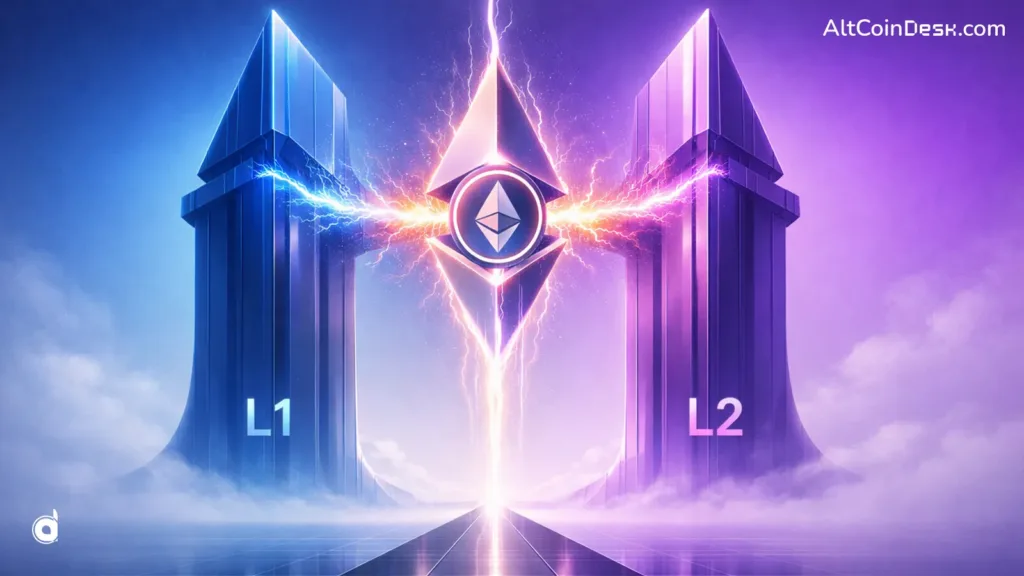

The Ethereum Foundation announced on February 17, 2026, the setup of a ‘Platform Team’ to merge Ethereum’s layer 1 (L1) and layer 2 (L2) into a single rational platform.
“L2 adoption reinforces Ethereum’s core properties and ETH, and L1 growth provides a more powerful foundation for L2s,” the official report stated.
Ethereum’s architecture
The Ethereum blockchain works in two layers. Layer 1 is the base layer, the main Ethereum chain that handles security and settlement and maintains decentralization. At Layer 2, Ethereum uses roll-ups like Arbitrum, Optimism, and ZKSync to process transactions faster while reducing fees.
The foundation views this move as a roadmap to the goals of 2026. The emphasis remains on achievable advances rather than aspirational milestones. Providing a strong platform that will position Ethereum as the best to support users, apps, and all the organizations building on Ethereum.
Why was the platform team created?
The ‘Platform Team’ is assigned to work towards building an L1 and L2 merger model, which would serve as a coherent platform in place of many semi-connected chains. The initiative’s aim is to combine the security of L1 with the throughput and UX benefits of L2. This way, they aim to reduce the gas fees and shorten inclusion latency.
A rise in Layer 2 (L2) activity settling on Layer 1 (L1) suggests a healthy connection where L2 benefits L1 and vice versa. This initiative could provide faster transactions, smarter wallets, interoperability, and quantum-resistant security to their varied users with different necessities.
The Research and Development stated, “We are excited to get Platform off the ground and accelerate many key initiatives together with the broader community,” in their report.
What changes in practice for users, builders, and L2s?
Users can expect gradual benefits, including wallets and decentralized applications (dApps) delivering predictable fees, with better security cues and more straightforward transitions across Layer 2 solutions (L2s).
Builders will benefit from easier-to-use tools for handling transaction proofs, accessing data, and connecting different networks. With clear guidance, building on Ethereum gets easier to understand and reduces the auditing overhead, while also leaving room for the L2 network to focus on latency, privacy, and higher capacity.
For L2 rollups, working together on standardized decentralization levels and more reliable proofs can reduce overall network risk.
According to the report, teams like Arbitrum could benefit from shared expectations on ‘proofs and bridging,’ cutting down on repeated work while still allowing each team to follow its roadmap.