

Ethereum reached the block gas limit of 60 million, up from 45 million, following the Fusaka upgrade. With the latest network upgrade, the prices are poised for a spike. If ETH surges as it did during the previous upgrade –Pectra, it will reach $7,800.
On December 3, Ethereum’s Fusaka upgrade was activated on its mainnet. The upgrade will enhance the network’s scalability by increasing the block gas limit from 45 million to 60 million. This increase in the block gas limit increases Ethereum’s transaction capacity. However, it’s not just the scaling issues that this upgrade focuses on; it’s more than that. It has two major technical improvements, PeerDAS and Verkle Trees.
PeerDAS, which is Peer-to-Peer Data Availability Sampling, is a mechanism where the Ethereum nodes sample small parts of rollup data instead of downloading the entire blob.
With the upgrade, the roll-up can publish 8 times more data inside the block on Ethereum. This means that Rollups can increase their Transaction Per Second (TPS) while lowering the fees. More throughput means lower cost per user because block space is cheaper.
Verkle Trees: This is a special way of organizing blockchain data. Verkle Trees compress data proofs into smaller pieces that are easier and faster to check.
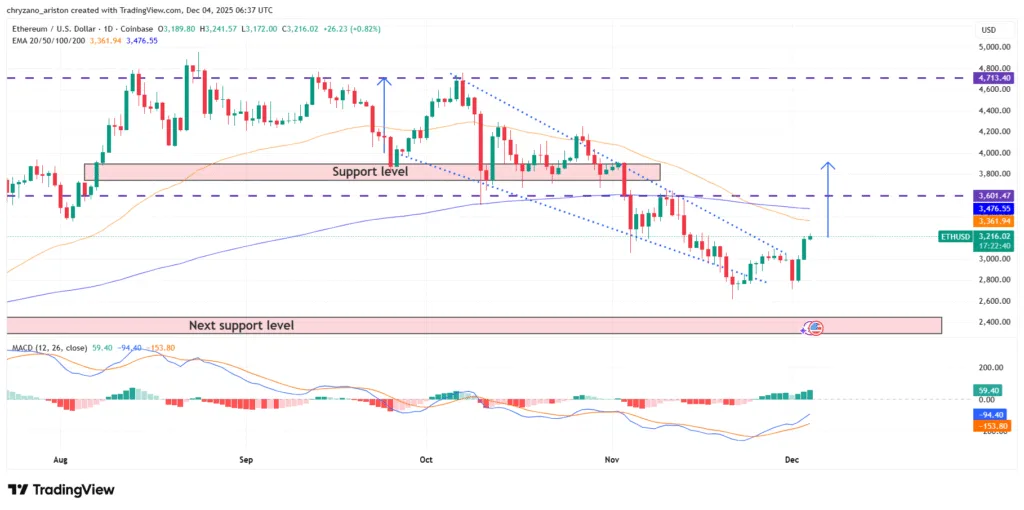
As the upgrade hit the mainnet, Ethereum prices broke out from the falling wedge. A break-out from a falling wedge usually results in a spike that is almost equal to the height of the falling wedge at its widest. Given that ETH’s breakout is conventional, the coin could hit $4,000.
On the technical side, the MACD line, which is in the negative zone, is heading upwards, and it is coming close to the zero line. Once it crosses above the zero, the bullish momentum will be confirmed.
However, upgrades don’t necessarily abide by the technical laws on the charts. So here’s what could happen. Crypto netizen who reflected Ethereum’s behavior after the Pectra upgrade stated that it could hit as high as $7,800, given that it follows the same trajectory.