


Ethereum mainnet has overtaken all layer-2 solutions taken together in terms of daily active addresses. Latest data from Token Terminal shows that Ethereum eclipsed major layer-2 blockchains such as Base, Arbitrum One, Optimism, and others in January 2026.
Ethereum mainnet surpasses all layer-2 blockchains
According to fresh data from Token Terminal, the total number of daily active addresses on the base Ethereum layer has surged past the total daily active addresses on leading layer-2 blockchains.
For the uninitiated, layer-2 blockchains are secondary networks built on top of Ethereum to make transactions faster and cheaper by processing activity off the main chain. However, they still rely on Ethereum’s security, settling final results back on the mainnet.
The following chart from Token Terminal confirms the change in trend, with the number of transactions reaching as high as 1 million. The change in pattern can be attributed to various factors, including the most recent December 2025 Fusaka upgrade on the Ethereum blockchain.
To recall, the Ethereum Fusaka upgrade introduced several technological advancements into the leading smart contract protocol. For example, it reduced the gas fees significantly, in addition to making the exchange of data between layer-2 and the base Ethereum network further economical.
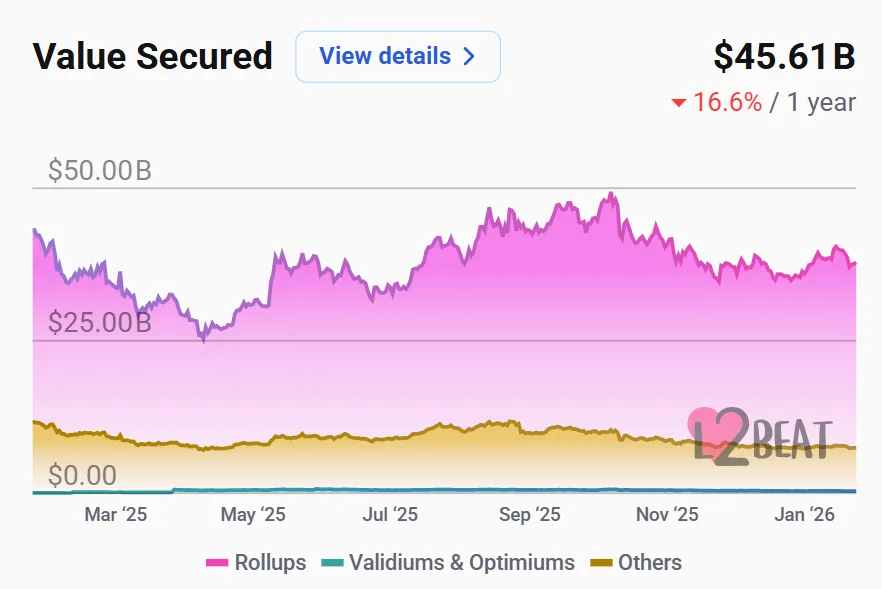
Data from Ethereum layer-2 analytics platform L2BEAT shows that the total value of assets secured across such networks currently hovers slightly above $45 billion. However, this figure is down 16% on a year-on-year (YoY) basis.
That said, there might be more than what meets the eye. Recent on-chain investigation by blockchain researcher Andrey Sergeenkov found that the primary reason behind heightened on-chain activity on Ethereum is the surge in address poisoning attacks.
Is ETH ready for a surge?
Although the Ethereum blockchain is more active than ever, the surge in activity has so far failed to translate into positive price action for ETH. However, it might not take too long for fortunes to turn around for the top smart contract token.
Data from the past 10 years shows that whenever ETH has declined in Q4 of a year, it has experienced strong gains in Q1 of the following year. Similarly, ETH supply on major exchanges recently hit a decade low, raising the possibility of a ‘supply crunch-induced’ price appreciation.