
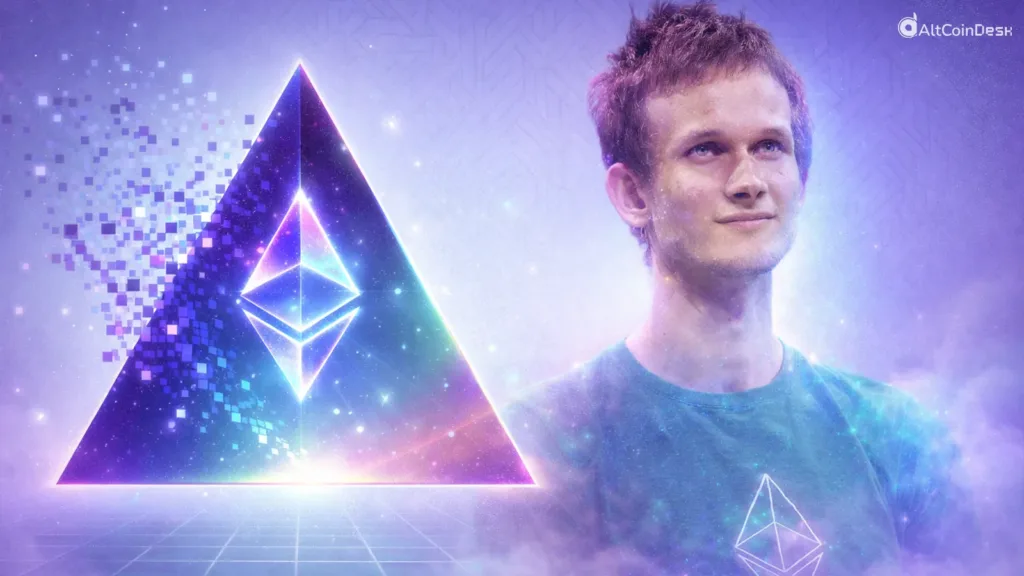

Vitalik Buterin, the co-founder of the Ethereum protocol, recently announced that the smart contract platform has finally solved the blockchain’s long-standing trilemma. Buterin attributed the success to zero-knowledge Ethereum virtual machines (zkEVMs) and peer data availability sampling (PeerDAS).
Buterin says Ethereum’s trilemma problem solved
In a recent X post, Buterin remarked that with the help of PeerDAS and zkEVMs, Ethereum’s long-standing Achilles heel—the trilemma problem—has essentially been solved. He noted that Ethereum now offers a high bandwidth, consensus, and remains decentralized, exactly as envisioned during its inception.
For the uninitiated, the so-called trilemma problem has troubled blockchains since the beginning of the Bitcoin network. Essentially, it had always been a challenge to ensure a blockchain is decentralized, secure, and scalable, all at the same time.
Typically, compromising one of the three dimensions was necessary to ensure the smooth operation of the other two. For example, if a blockchain is decentralized and secure, it would not be scalable. Similarly, if it is secure and scalable, it would not be decentralized.
However, with the introduction of PeerDAS and zkEVMs, Ethereum can now be all three at the same time—decentralized, scalable, and secure. Buterin stated that these upgrades make Ethereum a powerful, decentralized network.
The trilemma has been solved—not on paper, but with live running code, of which one half (data availability sampling) is *on mainnet today*, and the other half (ZK-EVMs) is *production-quality in performance today* – safety is what remains.
Vitalik Buterin, co-founder, Ethereum
To recall, PeerDAS was a part of Ethereum’s highly anticipated Fusaka upgrade. PeerDAS lets Ethereum nodes verify data availability by sampling small data chunks instead of downloading everything, enabling much higher scalability.
In the same vein, zkEVMs use zero-knowledge proofs to verify transactions quickly without re-examining them. To learn more about zero-knowledge proofs, check out AltCoinDesk’s detailed article here.
What to expect over the next few years?
Buterin went on to discuss what the next few years might look like for Ethereum. In 2026, Ethereum will be able to handle more transactions per block. He added that Ethereum will also see its first operation zkEVM node in 2026.
Between 2026 and 2028, Ethereum will further fine-tune the mechanisms of gas fees and data storage to safely support even higher network capacity. Finally, between 2027 and 2030, Ethereum will rely heavily on zmEVMs to verify blocks, helping it scale further.
The final important point Buterin made was pertaining to distributed block building. He stated that instead of one entity putting together an entire block of transactions, Ethereum aims for a future where block creation is spread across multiple participants.
Such a mechanism will help Ethereum in that it will reduce the risk of censorship and manipulation. At the same time, it will also make the process of transaction inclusion fairer globally.