
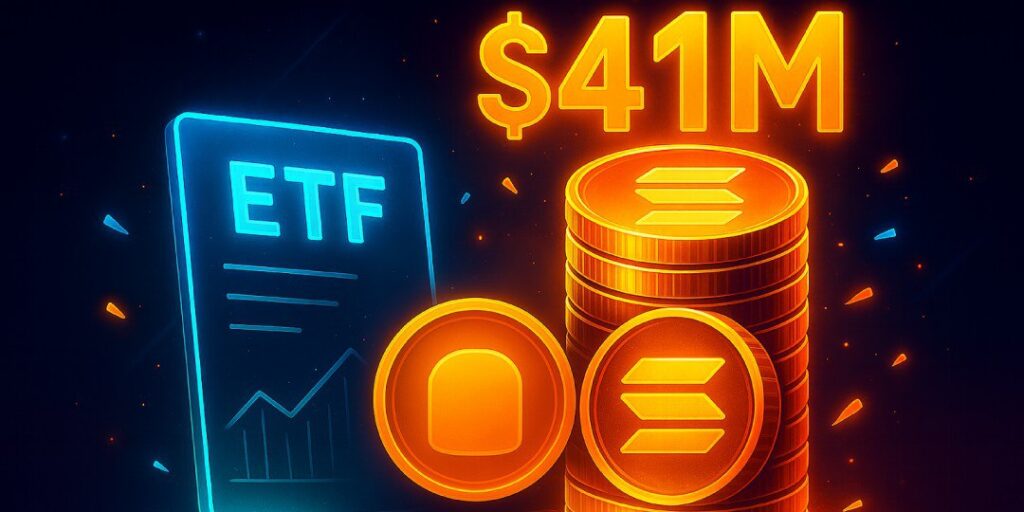

Solana is back in the spotlight, and this time it is Wall Street doing the looking. The newly launched REX-Osprey SOL + Staking Fund (SSK) pulled in $41 million in net inflows in its first week, one of the fastest starts for any altcoin-linked fund this year. In a market that has felt oddly quiet since Bitcoin ETFs stole the show, that number landed with a thud loud enough to wake up altcoin traders.
The reaction was immediate. SOL pushed past $159, and the familiar question resurfaced across crypto timelines and trading desks alike: Is this how an altcoin season begins?
Why this Solana ETF is not your usual ETF
SSK is not just another wrapper that holds tokens and calls it a day. The fund actively stakes its Solana holdings on the network, earning roughly 6–8% annually. Those rewards flow directly to shareholders, giving investors something Bitcoin and Ethereum ETFs simply cannot offer: yield.
Greg King, CEO of REX Shares, summed it up neatly by saying the fund lets “Wall Street earn blockchain rewards without touching a wallet.” That idea appears to be resonating. In just days, SSK’s assets overtook leveraged Solana products like SOLT and SOLZ, a sign that investors are leaning toward steady yield rather than turbocharged speculation.
A regulatory breeze at Solana’s back
The timing is not accidental. On July 7, the SEC released new guidance designed to speed up crypto ETF approvals, potentially cutting review timelines to around 75 days. Notably, Solana was mentioned as an asset that could qualify under the updated framework.
Issuers were reportedly asked to resubmit filings by July 31, far earlier than expected. That quiet nudge has fueled speculation that the SEC is clearing its desk faster than usual and that Solana could be one of the first beneficiaries.
Why $41m actually matters for SOL
On paper, $41 million looks tiny next to the roughly $50 billion sitting in Bitcoin ETFs. In Solana’s ecosystem, though, it packs more punch than it appears.
At current prices, the fund effectively pulls about 260,000 SOL out of circulation. Keep that pace up, and SSK absorbs the equivalent of a full day of Solana DEX trading volume roughly every two weeks. Analysts have likened the effect to a smaller, quieter version of the old Grayscale bid, steady buying that creates a floor under the market. Bloomberg ETF analyst Eric Balchunas flagged the fund’s rapid growth in a post that quickly made the rounds.
More fuel in the Solana engine
The ETF is not doing the heavy lifting alone. Several developments are lining up in Solana’s favor:
- Firedancer testnet is now live on devnet, promising validator performance that could be up to 10x faster.
- Retail access is expanding, with Robinhood rolling out US wallet support and Shopify piloting Solana Pay.
- Projects are migrating back, with names like Clockwork and Helium Mobile leaving Ethereum Layer-2s for Solana, pushing active addresses to a 3-month high.
Put it all together, and some analysts are openly floating the idea that SOL could revisit its March high near $205 if ETF inflows stay strong through Q3.
The fine print still matters
This is not a risk-free story. The SEC could still take a harder stance on SOL in future enforcement actions, even while approving ETF structures. Solana’s past network outages remain a talking point for institutions, and if staking participation surges, yields could compress. A drop toward 4% would make SSK less distinctive and less attractive.
So… is alt-season knocking?
One ETF and $41 million will not flip the switch on a full altcoin season. But it does prove something important: institutions are willing to buy regulated, yield-bearing exposure to altcoins, not just Bitcoin.
Back in January, Bitcoin ETFs rewired market psychology almost overnight. SSK is now testing whether Solana can play a similar role for the rest of the market. The next few weeks matter. If the SEC follows through on its accelerated timeline, July could be remembered as the moment Solana graduated from “Ethereum rival” to the first altcoin Wall Street was comfortable putting into an ETF wrapper. If that happens, the ripple effects may reach far beyond SOL.