


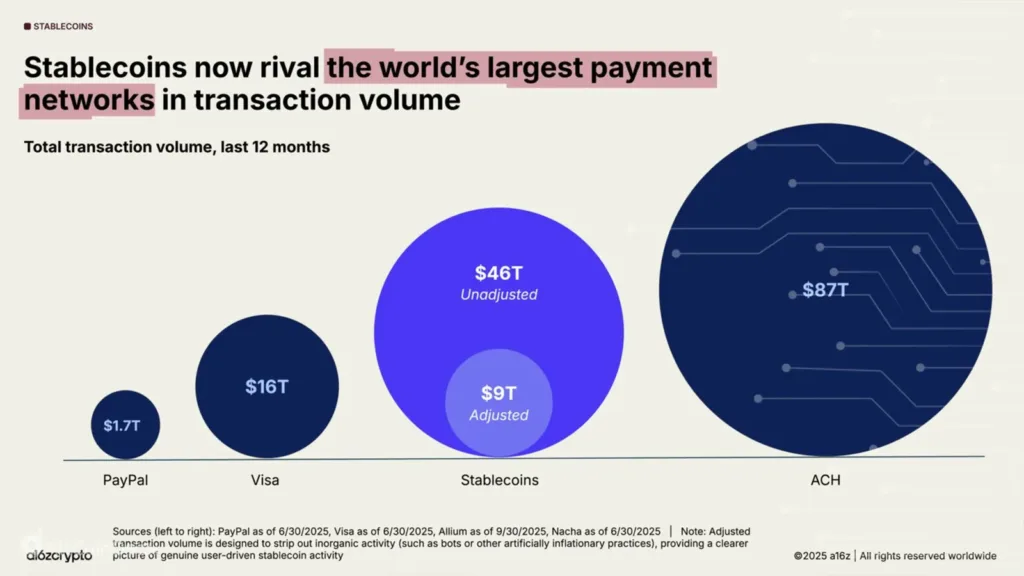
Stablecoins are no longer just a crypto curiosity. Venture capital firm Andreessen Horowitz (a16z) reports that they processed an adjusted $9 trillion in transactions over the past year—a volume more than five times that of PayPal and over half of Visa’s.
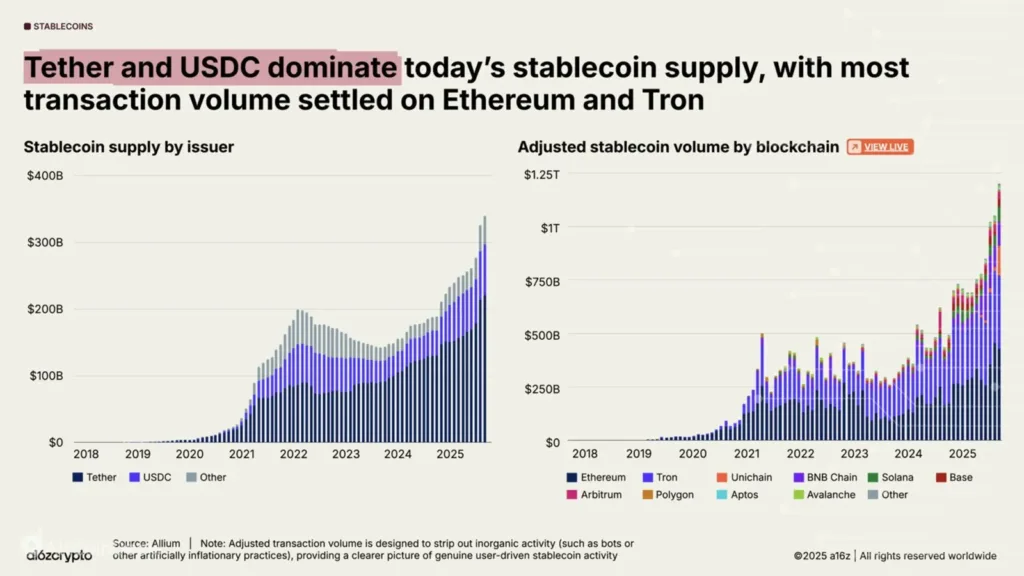
This is not hype; it marks a turning point where stablecoins are proving their real-world utility. September 2025 alone saw nearly $1.25 trillion in monthly transactions, demonstrating that their growth is increasingly driven by everyday financial activity rather than speculative trading.
Speed and efficiency transforming cross-border payments
The main factor driving this growth is the ability of stablecoins to make cross-border payments quicker and cheaper. Compared with traditional banking networks, transactions take place almost instantaneously, and fees are very low, up to 95% being the maximum reduction.
The importance of this is especially felt in emerging markets where currency fluctuations and inflation turn stablecoins into reliable instruments for facilitating remittances and inter-business transfers. The likes of the recent partnership between Circle’s USDC and Thunes—the global payment network— are now opening up a world of instant payments to local bank accounts and mobile wallets in more than 130 countries, linking the blockchain tech with the traditional finance infrastructures effortlessly.
The Tether-Circle divide: Two paths, one market
The market is dominated by two issuers: Tether (USDT) and Circle (USDC), which together account for 87% of total supply. USDT thrives in crypto-native markets, thanks to its deep liquidity, while USDC appeals to U.S. institutions through regulatory transparency and BlackRock-managed reserves. This bifurcation reflects a maturing ecosystem where each stablecoin serves distinct audiences and regulatory needs.
Beyond payments: Stablecoins as financial building blocks
Stablecoins are also becoming the backbone of decentralized lending and other on-chain credit markets. Their programmability—essentially “money with an API”—enables developers to automate payroll, streamline B2B settlements, and create global, 24/7 lending systems. This open, composable nature is why major tech-forward companies are increasingly integrating crypto solutions into their operations.
Balancing opportunity and risk
The fast-paced development of stablecoins brings along some challenges to the financial system. The widespread use of such coins could lead to the traditional banking system losing its primary source of funding, and the loss of trust in one of the major stablecoins could cause a digital “run” to happen. Regulators are responding with new rules, such as the U.S. GENIUS Act and the EU’s MiCA directives, which aim to strike a balance between innovation and financial stability.
Stablecoins have ceased to be just a fringe experiment. They are by now the biggest players in the global payments arena, laying down the scale for others to follow, and even getting involved in the finance of the U.S. Treasury. They are also changing the way money flows in a world where digital banking is the first option. Their future acceptance will depend on the combination of creativity, adoption by the institutions, and intelligent regulation.