

We often look at the world of memecoins and see what appears to be pure, unadulterated chaos. We see coins based on nothing more than a typo or a politician’s pet, and we see their values rocket and collapse in a matter of hours. It’s tempting to dismiss all of it as simple gambling: a digital lottery.
But I’m here to tell you that beneath that chaos, there is an elegant, cold, and calculating mathematical mechanism.
Bonding curve simplified
This mechanism, often used by platforms like Pump.fun, is called a bonding curve. And if you want to understand why these assets move with such violent speed, you must first understand the architecture of the engine that powers them.
A bonding curve is not a “chart” in the way we think of a stock chart, which records a history of human trades. A bonding curve is a predetermined mathematical formula that dictates the price of a token based on its current supply.
The formula in its simplest form is Price = Function (Supply).
That’s it. The price is not set by a “seller” or a “buyer” in a traditional marketplace. It is set by a rule.
The mechanics: How the automated system works
The entire system is run by a smart contract, which is just a fancy name for a piece of code that lives on the blockchain and runs itself without a human operator. Think of this smart contract not as a marketplace, but as a specialized vending machine.
You don’t buy from another person. You go to this “vending machine” (the smart contract) and put in your “money” (like SOL or ETH). The machine doesn’t give you a token from its inventory; it creates a brand new one just for you, right on the spot. This is called “minting.” The price it charges you is the next price on its internal bonding curve. The money you paid is then stored inside the machine, forming a “liquidity pool.”
When you sell: The process is a perfect reverse. You give your token back to the vending machine. The machine destroys it (this is called “burning”) and gives you back the corresponding amount of money from its internal pool, based on the current spot on the curve.
This process is what makes it an Automated Market Maker (AMM). There’s no waiting for someone to “fill your order.” The contract is always ready to buy and always ready to sell, at the price dictated by the curve.
The psychology: Why the exponential curve is king
This is the most critical part. The creators of these systems had a choice. What kind of formula should they use?
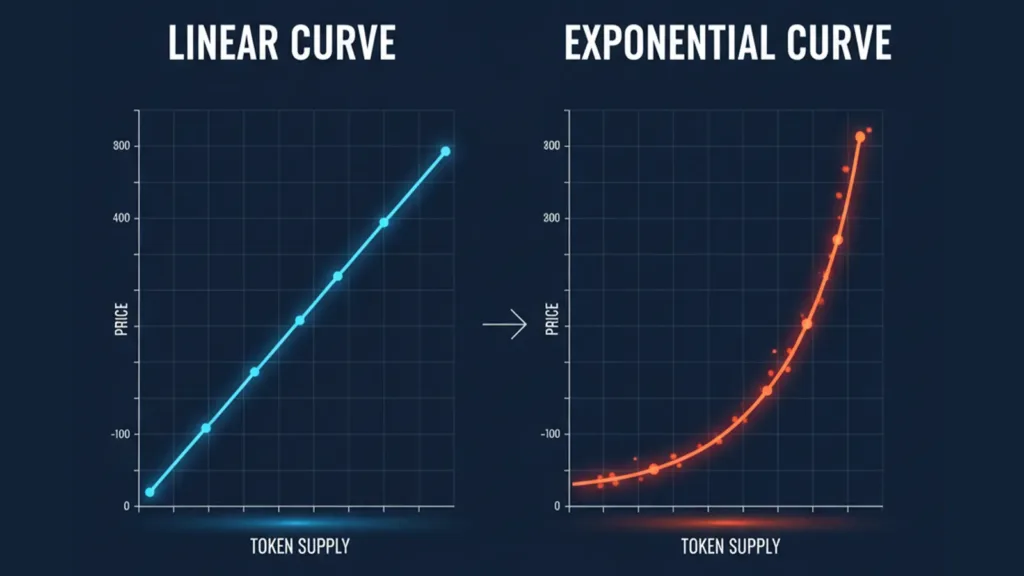
They could have used a simple linear curve. For every 1,000 tokens sold, the price goes up by $0.001. It’s a straight, predictable, 45-degree line. But linear curves are boring. They don’t create “hype” because the 10th buyer and the 10,000th buyer experience a similar, unexciting change.
Instead, the entire memecoin ecosystem is built on the exponential curve.
Look at that shape. It starts nearly flat, almost horizontal. Then, slowly, it begins to curve upwards, steeper and steeper, until it goes nearly vertical — what we call “parabolic.”
This shape is not an accident. It is a masterpiece of psychological engineering.
Phase 1: The “flat zone”: When the supply is tiny (at the far left of the graph), the price is almost zero. You can buy millions of tokens for $10. This is designed to reward the very first people in the door aggressively. They take the initial risk, and they are incentivized to go out and “market” the coin, because…
Phase 2: The “acceleration zone” (The ‘pump’): As more people buy, the supply increases, and we move along the X-axis. Notice how the curve doesn’t just rise – it accelerates. The price for the 10,000th buyer is significantly higher than for the 9,000th. This is what creates FOMO (Fear Of Missing Out). Observers see the price “going parabolic” and feel an intense pressure to buy now before the price escapes them. Each new buyer financially rewards every single person who bought before them.
Phase 3: The top: The price eventually goes so vertical that it becomes prohibitively expensive for new buyers to join. The momentum stalls.
Perfect engine for speed
This system is brilliant because it provides instant liquidity. You never have to “find a buyer.” The machine is always there, ready to buy your tokens back.
But this is also what makes it so dangerous. The curve is a two-way street.
When people get scared and start to sell, the vending machine swaps their tokens, the total supply shrinks, and the price moves back down the exact same curve. And because the curve is exponential, the collapse can be just as fast — or faster — than the ascent.
The bonding curve has no concept of “value.” It doesn’t care about the team, the art, the community, or the “utility.” It is a pure, unfeeling mechanism that links price only to supply.
So, when you look at this world, don’t just see the chaos. See the engine. It’s a fascinating piece of game theory, designed to automate and incentivize the creation of hype itself. Understanding this mechanism is the first, and most critical, step to understanding the market it has created.