


Although the crypto market failed to live up to bulls’ expectations in 2025, especially the altcoins, one particular niche saw exponential growth in terms of adoption and market cap – stablecoins. Stablecoin transaction volume reached a record high of $33 trillion in 2025.
USDC leads stablecoin growth in 2025
According to data from Artemis Analytics, the total global stablecoin transaction volume hit a high of $33 trillion last year. Of the total, $18.5 trillion worth of transactions were processed by Circle’s USDC stablecoin, while Tether’s USDT stablecoin recorded transactions worth $13.3 trillion.
USDC’s numbers have made it the most used stablecoin in 2025, stealing the attention from the USDT stablecoin in terms of usage, despite having a smaller market cap of $74.8 billion. USDT is currently the third largest cryptocurrency by reported market cap, worth $186.9 billion.
One key trigger that accelerated the usage of stablecoins in 2025 was the Donald Trump administration approving the Growing Emerging Novel Innovation & Utility in Securities (GENIUS) Act, which brought much-required clarity to stablecoin regulations in the US.
The GENIUS Act has simplified the process for crypto projects to carry out their operations without any legal uncertainty in the US. It also encourages innovation in DeFi by providing clearer guidelines for token offerings, investor protection, and compliance requirements.
USDT is still the king
While USDC stablecoin ran past USDT in terms of volume of transactions in 2025, the latter remains the leader in almost all other key stablecoin parameters.
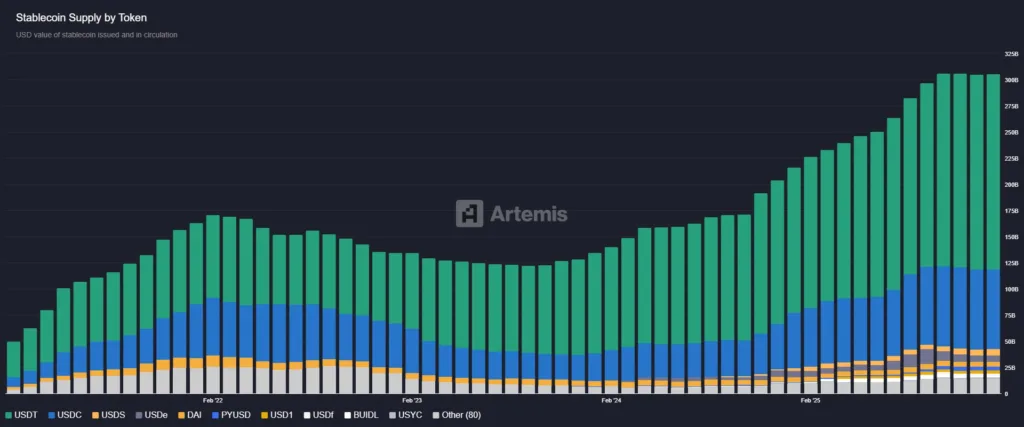
Fresh on-chain data shows that of the total stablecoin supply worth $305 billion, USDT’s share hovers at almost $187 billion, compared to USDC’s $76 billion.
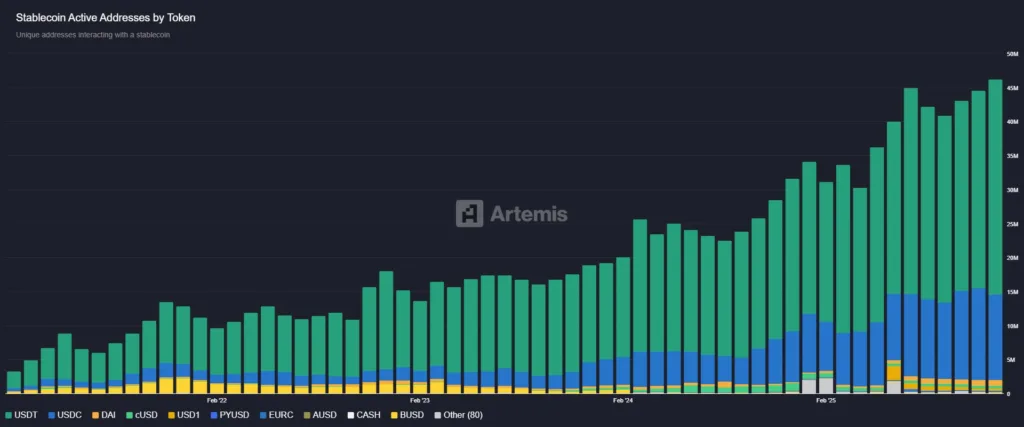
When it comes to unique wallet addresses interacting with a stablecoin, USDT reigns supreme. In December 2025, 31.6 million unique crypto wallet addresses interacted with USDT, compared to USDC’s 12.6 million wallets.
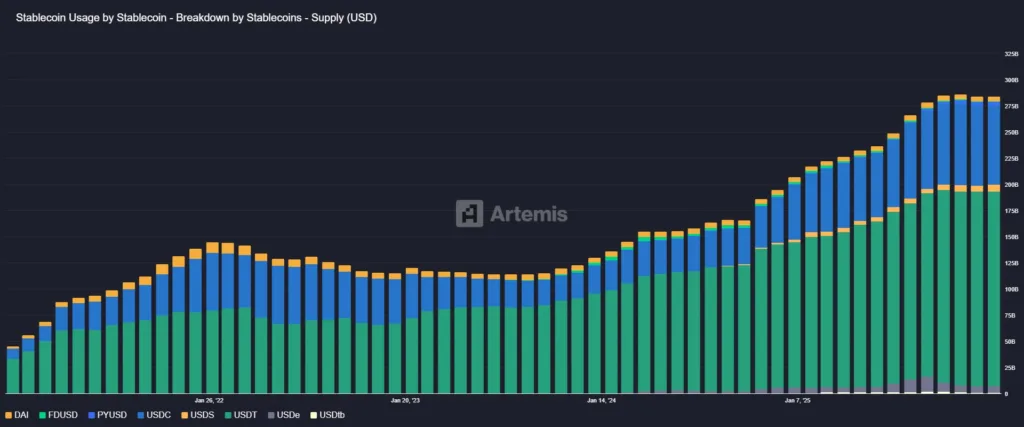
However, one parameter where the numbers appear somewhat different is the stablecoin supply on different smart contract platforms. The following line chart shows the USDT stablecoin supply plateauing since September 2025, while USDC supply continues to rise.
That being said, it will be fascinating to see what 2026 has in store for stablecoins. With the growing popularity of privacy cryptocurrencies, it won’t be a surprise to see decentralized stablecoins like DAI take the spotlight from its centralized counterparts like USDT and USDC.