
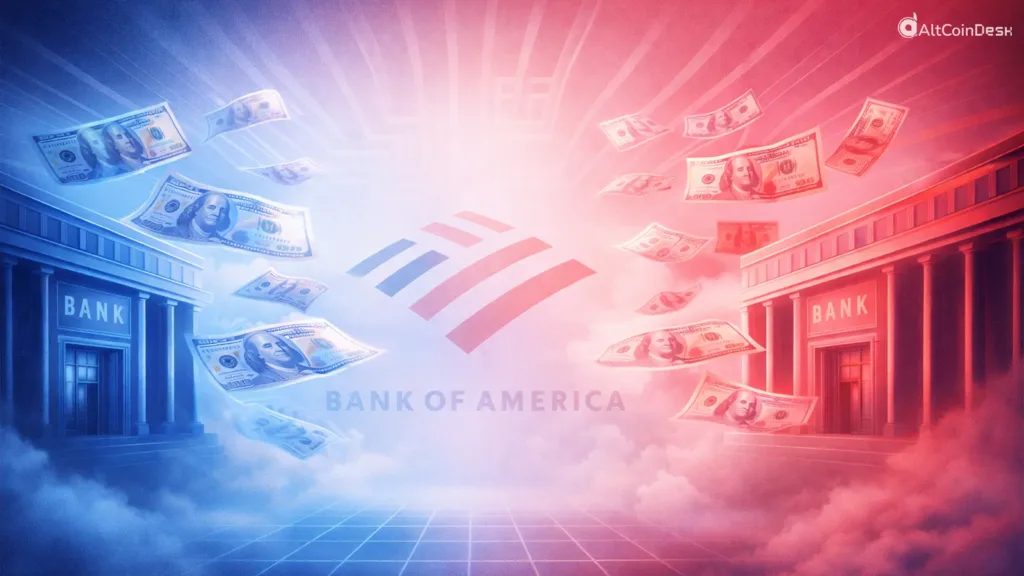

Advisors at Merrill, Bank of America Private Bank, and Merrill Edge can now suggest allocating a small slice of your portfolio, between 1% and 4%, to digital assets. This exposure mostly comes through popular spot Bitcoin exchange-traded funds (ETFs) from the likes of BlackRock and Grayscale.
Historical skepticism toward crypto reshaping
Cryptocurrency faced caution and backlash, looked upon as a threat to the traditional financial methods built over trust and safety. Bank of America’s initial stand was the same.
The change of stance began when stablecoins were first introduced to the financial world in 2014. These fiat currency-pegged digital assets gradually served as a measure against the volatile markets.
By 2018, Bank of America included cryptocurrencies in its annual U.S. Securities and Exchange Commission (SEC) filings as a competitive risk, as they understood that failing to adapt could harm their business, revenues, and profits.
This was also the time period when Bank of America, J.P. Morgan Chase, and Citigroup announced that they are no longer allowing customers to buy cryptocurrencies using credit cards.
Gradual embracement and recognition of potential
By 2021, Bank of America witnessed the shifting perspective around cryptomarkets. Reports portrayed banks as describing decentralized finance (DeFi) as more disruptive than Bitcoin due to its efficiency in lending and trading.
An October 2021 report noted Bitcoin, alongside non-fungible tokens (NFTs) and other digital assets, had become “too large to ignore.” In 2022, the regulatory bodies took back the 2018 ban on credit card use for trading cryptocurrencies.
2025 witnessed regulatory developments accelerating change within the financial system. According to a recent report, Bank of America CEO Brian Moynihan said that the U.S. banking industry will embrace cryptocurrencies for payments if regulators allow it.
Mid-year, BTC gained more popularity, and later, stablecoin discussions intensified, with Bank of America noting their scalability challenges and potential.
Ethereum and Solana treasury companies
Beyond Bitcoin and Ether, 2025 saw a major expansion of ETFs tied to alternative digital assets, including Solana, XRP, Dogecoin, and Chainlink.
Ether ETFs showed positive flows for nine out of the 12 months, even when Bitcoin ETFs showed a drop, totaling just under $10 billion. The summer saw significant market growth following the passage of the GENIUS Act.
This new law made the rules for dollar-backed stablecoins much clearer, essentially giving U.S. banks and financial firms the signal to create and hold these regulated digital dollars.
With the official announcement of Bank of America now starting to advise clients to allocate up to 4% of their portfolio to Bitcoin and the broader crypto market, crypto investors look upon it as a sign of digital assets steadily becoming part of mainstream investment strategy.