


Dubai Harbour was already humming by sunrise on Day 2 of the Future Blockchain Summit x Fintech Surge 2025, co-located with Expand North Star. The crowd seemed bigger, bolder, and louder — founders pacing with laptops, angel investors comparing notes, and panels that stretched from capital allocation to social impact.
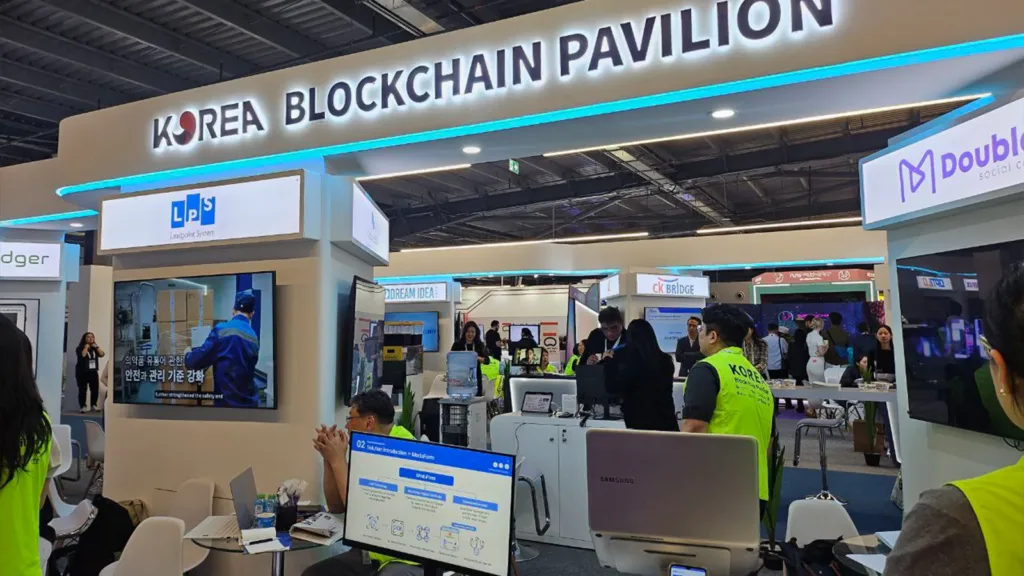
The air was thick with ambition. Rows of startups pitched everything from tokenized supply chains to blockchain-based passports, while curious investors roamed the floor, jotting names and scanning QR codes. Between the booths, you could find cultural pockets — Brazilian metaverse projects beside Korean DeFi platforms — and bursts of creativity: a reflex challenge stand, a live Islamic calligraphy artist, and a mascot snapping selfies with anyone who’d stop.
The day balanced blockchain with human purpose — a duality that defined this year’s summit.
Institutional capital and the new calculus of risk
The morning began with the Breakfast Briefing | Institutional Capital in the Age of Digital Assets – Risk, Returns, and Realignment, a panel that pulled together the architects of digital finance’s next chapter.

The discussion dived deep into how traditional finance (TradFi) is integrating decentralized finance (DeFi) — not as a trend, but as a technological shift demanding serious investment. “There’s a heavy, necessary focus that has to be done on the technology,” Heather noted, setting the tone for the debate.
Muhammed Yesilhark framed it sharply: “One aspect is to get rid of rent-seekers and parasites. Blockchain technology is a technology revolution to stop that.”
That sentiment echoed across the panel — blockchain not just as a monetary system, but as a purge of inefficiency.
Chris Keshian expanded the lens: “Blockchain is a fundamental reorientation — a full new schema. There’s a monetary thesis and a technology thesis.”
He drew a clear contrast between crypto markets and venture capital: “Outside of Bitcoin, there’s a long tail of assets. Unlike traditional VC, we have full liquidity — if you see a project doing poorly, you can cut that. In VC, it’s written down to zero.”
Together, their perspectives painted a maturing landscape: blockchain as both a financial mechanism and a governance model, where capital flows are faster — but accountability sharper.
The RWA investor playbook: Yield in a tokenized world
Midday brought The RWA Investor Playbook – Where Are the Yields, What Are the Risks?, a fireside chat between Stephan Lutz, CEO of BitMEX, and Serena Sebastiani, PwC’s Senior Director and Virtual Assets Lead.
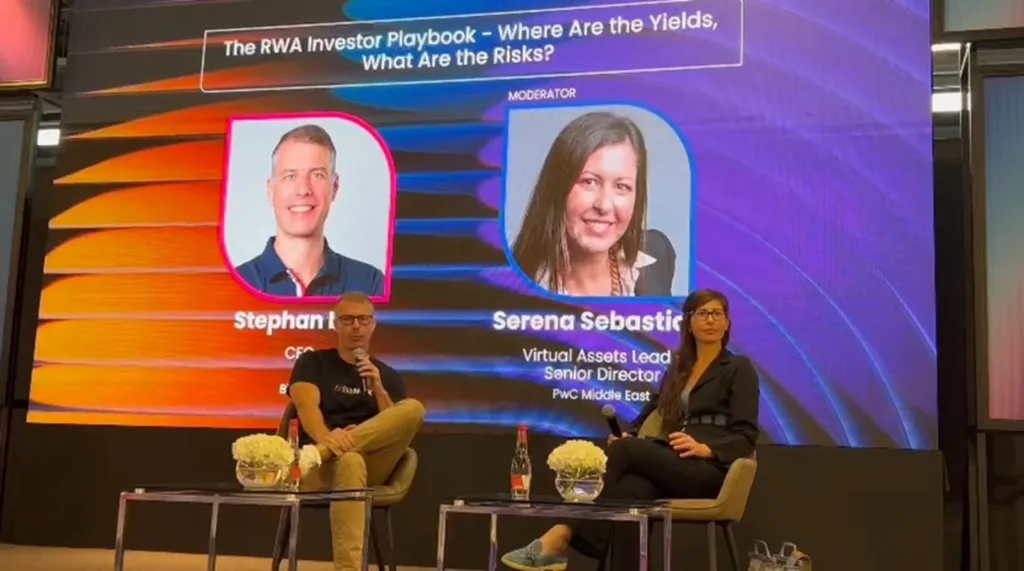
The talk addressed one of the industry’s biggest frontiers — real-world assets (RWAs) on-chain. Both speakers tackled liquidity, institutional access, and credibility in tokenization.
Stephan Lutz outlined the crux of the problem: “The issue with RWAs is liquidation. Once it gets trustworthy, it will explode.”
He described how perpetual swaps — a BitMEX hallmark — are designed to make non-tradable assets tradable, bridging traditional illiquid markets with digital rails. “The question,” he said, “is what’s the metric for success — and which project to tokenize first?”
Serena Sebastiani added that trust and regulation remain the critical bottlenecks: institutional players want exposure but not uncertainty. For investors, it’s a delicate dance between yield and risk, innovation and credibility.
The tone was sober but optimistic — a sense that RWAs might soon be blockchain’s most valuable asset class, if the industry can prove it deserves the trust.
Beyond the panels
Outside the halls, the energy was contagious. Rows of startups pitched angel investors on modular blockchains and on-chain compliance systems. Booths displayed prototypes of data-sharing models for ships and new cryptographic frameworks for global passport verification.
Everywhere you looked, someone was solving — or trying to solve — blockchain’s next big problem. Some built, some brainstormed, some danced with mascots.
Day 2 captured the pulse of an industry maturing — one that’s learning to balance risk with reward, speed with safety, and innovation with inclusion.
And as the sun set over Dubai Harbour, the crowd lingered — hopeful, caffeinated, and still talking about the future.