


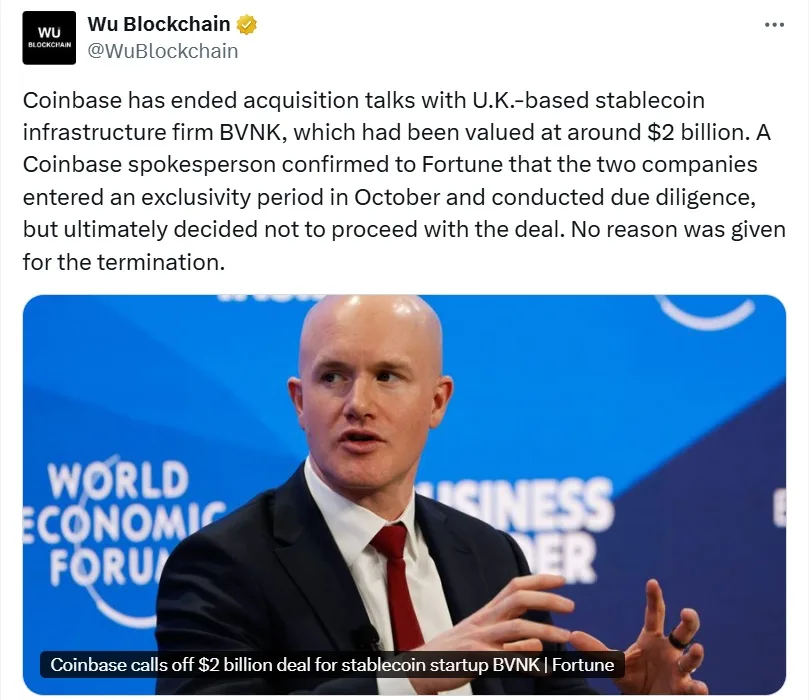
The canceled $2 billion Coinbase BVNK deal ends what could have been the largest stablecoin acquisition to date, forcing both fintech and crypto players to rethink the speed of their ambitions.
The Coinbase BVNK deal was set to redefine how traditional finance and blockchain infrastructure interact. Valued at nearly $2 billion, it would have been the largest stablecoin-related acquisition in history, almost doubling Stripe’s $1.1 billion purchase of Bridge earlier this year. But instead of expansion, Coinbase chose caution, announcing it would abandon the BVNK takeover plan and “mutually not move forward” with the London-based fintech.
The collapse of this high-profile deal reflects more than hesitation. It captures the mood of an industry realizing that regulation, not risk appetite, now dictates timing. The Coinbase BVNK deal was months in the making, with both parties entering exclusivity in October to finalize terms and complete due diligence. Yet, as compliance costs rise and stablecoin oversight tightens across the U.S. and U.K., the world’s largest crypto exchange may have decided it was safer to pivot than to purchase.
Stablecoins and the regulatory crossroads
BVNK specializes in stablecoin payments and cross-border settlements, enabling businesses to move funds instantly using dollar-pegged tokens. Its infrastructure, backed by Coinbase Ventures, Haun Ventures, Tiger Global, Visa Ventures, and Citi Ventures, had become one of the most sought-after assets in the financial-technology sector.
If completed, the Coinbase BVNK deal would have nearly doubled Stripe’s earlier Bridge acquisition, marking the moment when stablecoins transitioned from speculative tokens to global settlement rails. Instead, the decision to walk away underscores how the stablecoin economy has entered its regulatory era.
Recent policy drafts from Capitol Hill and the U.K. Treasury have added new layers of licensing, reserve verification, and custodial rules. For an exchange like Coinbase, already managing the majority of USDC circulation, another billion-dollar integration could trigger lengthy antitrust and compliance reviews on both sides of the Atlantic.

Strategic pause or missed opportunity?
Coinbase’s choice to cancel the Coinbase BVNK deal appears less like a defeat and more like a strategic restraint. With ongoing market volatility, rising operational costs, and shifting U.S. laws, the company is likely preserving cash for smaller, more regulatory-friendly acquisitions or in-house development through its Base layer-2 ecosystem.
For BVNK, the future remains bright. Its technology stack, linking banks, stablecoin issuers, and payment networks, still makes it a prime acquisition target. With Coinbase stepping aside, firms such as Mastercard or Visa could return to the table, seeing stablecoins not as competition but as the next-generation payment infrastructure.
In that sense, the deal’s collapse might actually raise BVNK’s valuation. Investors often flock to firms that prove desirable enough to attract multiple suitors. As the global race to integrate stablecoins into mainstream finance accelerates, BVNK’s independence could make it even more valuable.
What it means for the global crypto economy
At a broader level, the Coinbase BVNK deal collapse illustrates the maturity phase of crypto finance. The era of unregulated growth is ending, replaced by a methodical pursuit of compliance, partnerships, and institutional credibility.
For the U.S., it signals how American exchanges must now balance innovation with legislative reality. For the rest of the world, particularly Europe and Asia, it presents an opening; jurisdictions with clearer rules may soon become the preferred destinations for stablecoin settlement startups.
Coinbase’s decision reflects a simple truth: in 2025, being first no longer matters if you can’t be compliant. The company may have walked away from a record-breaking acquisition, but in doing so, it preserved its regulatory goodwill and optionality for the next phase of blockchain finance.
The Coinbase BVNK deal may have died quietly, but its implications will echo through the halls of both fintech and policy for years to come.