
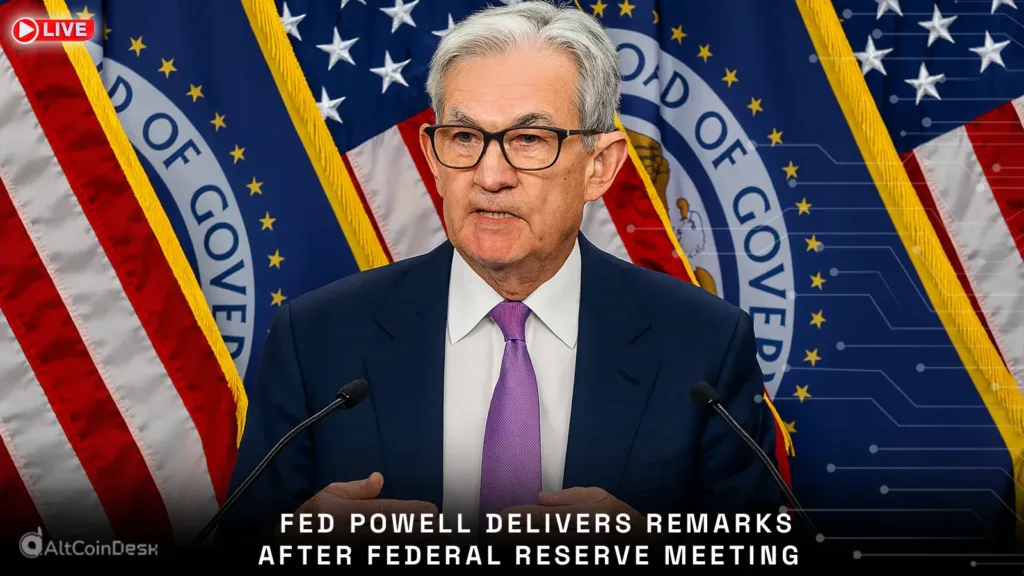

Federal Reserve Chair Jerome Powell struck a balanced but cautious tone today following the latest FOMC meeting, emphasizing that a December rate cut “is not a foregone conclusion.” The Fed lowered its policy rate by 25 basis points to a target range of 3.75%–4.00%, marking another step toward a neutral stance, but stopped short of signaling an extended easing cycle.
Powell confirmed that the Fed will conclude balance sheet reduction by December 1, freezing its securities holdings at current levels and reinvesting maturing mortgage-backed securities into treasury bills to shorten portfolio duration. The move effectively ends the multi-year quantitative tightening phase that trimmed over $2.2 trillion from the Fed’s balance sheet.
Inflation vs. employment: A delicate tradeoff
While inflation has eased sharply from its 2022 peak, it remains “somewhat elevated” near 2.8%, driven by tariff-related price increases in goods. Powell stressed that core inflation excluding tariff effects sits closer to 2.3–2.4%, suggesting that underlying price pressures are now moderate.
However, Powell acknowledged “two-sided risks,” with inflation risks still tilted upward and employment risks now increasing. He noted that the labor market is cooling gradually, but without signs of a sharp downturn. Job openings remain stable, layoffs are low, and consumer spending, particularly among higher-income households, continues to prop up economic growth.
“There’s no risk-free path for policy,” Powell said. “We’re navigating between downside risks to employment and upside risks to inflation.”
Shutdown data gaps and the “driving in fog” analogy
A temporary government data shutdown has delayed key indicators, creating what Powell described as “a fog” in real-time economic monitoring. The Fed is relying more on private datasets (Adobe, PriceStats, ADP) and anecdotal evidence from the Beige Book to assess conditions.
“If you’re driving in fog, you slow down,” Powell said, hinting that uncertainty itself could justify a pause in December, even if no major shift occurs in the economy.

AI boom and market sensitivity
Powell dismissed the idea that the AI infrastructure investment surge reflects loose policy, noting that such spending is “not particularly interest-sensitive.” However, he acknowledged growing discussion within the Fed about tech-driven productivity and the potential for speculative excess if rates fall too quickly.
Financial stability questions also arose after reports of rising subprime auto loan defaults and uneven consumer resilience, which Powell described as a “bifurcated economy” where lower-income households are pulling back while wealthier consumers continue to sustain spending.
Key takeaways
- The Federal Reserve rate cut: 25 bps to 3.75–4.00% (as expected).
- Next move: The December cut is uncertain and depends on data flow and labor trends.
- Inflation: ~2.8% headline; tariff-driven goods inflation rising.
- Labor market: Cooling but stable; no mass layoffs reflected in claims yet.
- Balance sheet: Runoff ends Dec 1; portfolio reinvestments shift to Treasuries.
- Tone: Neutral to cautious, the Fed acknowledges split views internally.
Federal Reserve rate cut and crypto markets
Powell’s “driving in fog” remark will likely define the post-meeting narrative. Markets, which had priced in a Federal Reserve December cut as a near certainty, may need to recalibrate.
For crypto markets, the tone is slightly hawkish-neutral, signaling that liquidity will not flood back immediately, but financial conditions may stabilize as QT ends. With inflation anchored and the economy cooling, risk assets like Bitcoin and Ethereum could find medium-term support, especially if rate certainty returns by Q1 2026.