
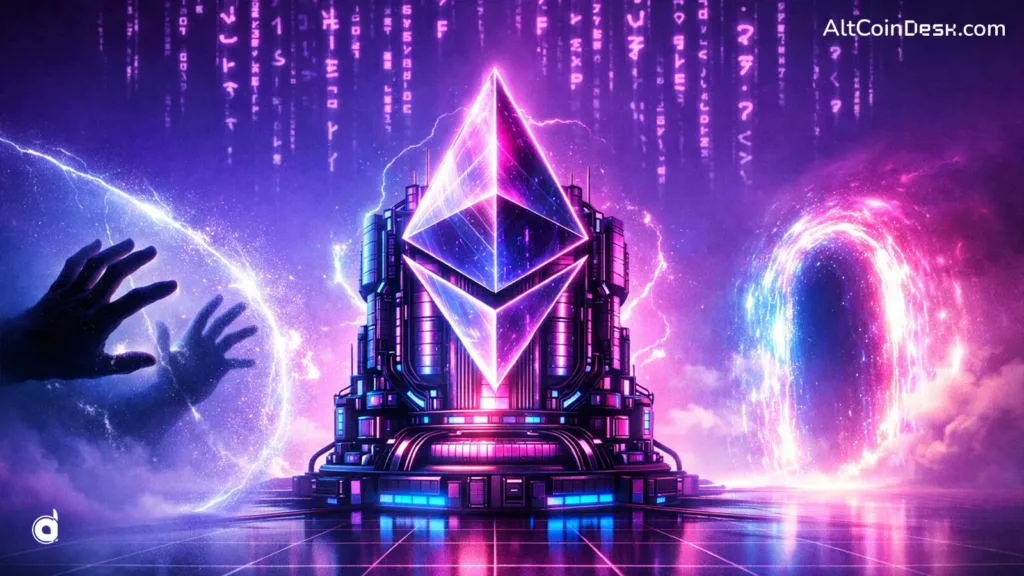

Blockchain is built with the core intention of avoiding middlemen and blocking government bans on transactions. To make this feature more rigid, Ethereum co-founder Vitalik Buterin is introducing a “cypherpunk-principled non-ugly Ethereum” to improve censorship resistance, enhance privacy and scalability, and simplify the consensus mechanism.
What did Vitalik mean by the cypherpunk principle?
Literally, the word cypherpunk denotes a person who strongly believes that cryptography should be implemented to safeguard privacy and freedom. Vitalik Buterin proposed this idea in a response given to an X comment that stated Vitalik should allow the original Ethereum to die slowly and “rebuild it as a cypherpunk chain from first principles.”
In essence, Vitalik Buterin wants Ethereum to stick to the original ideals of decentralization and enhance privacy and scalability without breaking the existing principles. For this purpose, Vitalik divided the features of the new design into three main categories.
Censorship resistance – improve censorship to prevent anyone from filtering or blocking transactions.
Zero-knowledge (zk) prover friendliness – optimize Ethereum for ZK technology (prove a transaction is valid without showing all the details).
Consensus properties – simplify and strengthen the proof-of-stake consensus mechanism used in the system.
How will the cypherpunk principle be implemented?
As the Ethereum executive noted, he proposed introducing a bolt-on layer, which is similar to integrating a major extension to the existing network. This will allow Ethereum to develop in a smoother and more capable way without affecting the current system.
Vitalik’s ambitious plan may take nearly five years to complete; it may be less than that with the help of AI technology.
“Then, in 5 years (or maybe way sooner with AI coding and verification, who knows), we have an open pathway to turn the existing system into smart contracts written in the language of the new system if/when we want”, said Vitalik.
FOCIL: A part of Ethereum’s planned cypherpunk upgrade
FOCIL (Fork-Choice Enforced Inclusion Lists) is a proposed upgrade responsible for redicng transaction censorship. Due to government pressures or external forces, validators (block producers) may ignore certain transactions or delay them. Validators are the individuals who choose which transactions should go into which blocks.
However, if FOCIL comes into practice, validators must include valid transactions that were ignored or delayed earlier. This is a major upgrade for Ethereum as it aims for a completely neutral, decentralized, and resistant to censorship approach.
In December 2025, Ethereum underwent the Fusaka upgrade to improve long-term network scalability and data availability. Ethereum’s The Merge upgrade is the most significant one, as it shifted Ethereum’s consensus mechanism from proof-of-work (PoW) to proof-of-stake. This helped the platform to enhance the efficiency of validators and reinforce decentralization.