



The team behind Curve Finance has accused the PancakeSwap DEX of using its code without complying with the required licensing terms.
According to Curve, the disputed code relates to the StableSwap mechanism, which is designed to facilitate efficient trading between stablecoins and other tightly pegged assets and is currently used in PancakeSwap Infinity, the platform’s latest version.
The Curve team stated on X that PancakeSwap could avoid potential legal issues by reaching out for proper licensing and collaboration, adding that doing so would also allow PancakeSwap to benefit from Curve’s expertise in maintaining the safety of users’ funds.
In another statement, the team behind Curve Finance explained the importance of integrating the swaps feature while emphasizing the need for in-depth knowledge of the StableSwap protocol. The team used the Saddle Finance hack in 2022 and the $116 million hack of Balancer in 2025 as examples of what could go wrong.
The developers of PancakeSwap said they plan to contact Curve to discuss the matter, to which the Curve team replied that it would be better for both sides to cooperate and build together. At the time of publication, requests for comment sent to both teams had not received a response.
The situation underscores the cybersecurity and legal challenges facing the DeFi sector as protocols continue to build new products and expand functionality.
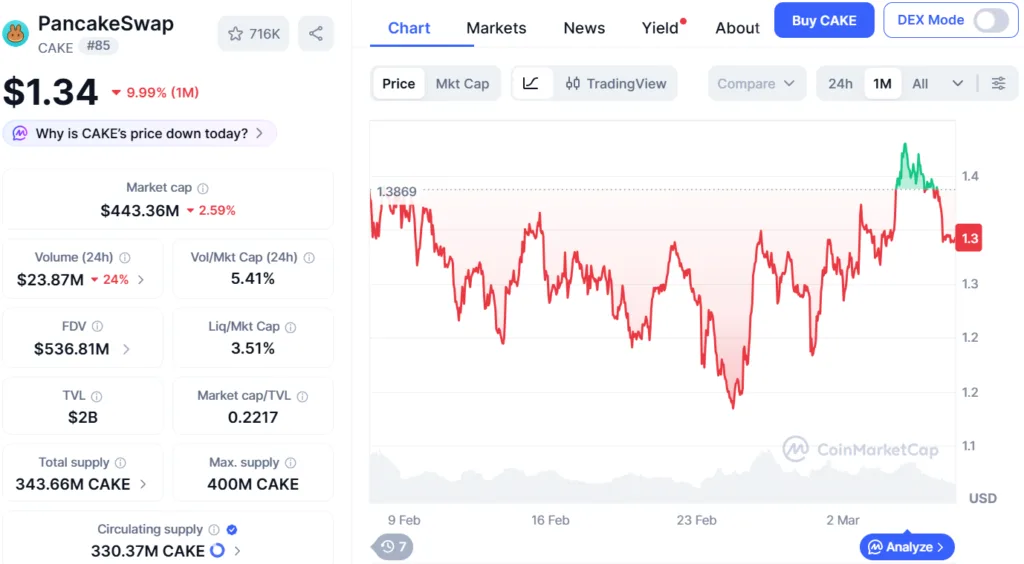
Meanwhile, CAKE prices have been on a roller coaster ride during the past month. With the prevailing geopolitical tension, CAKE prices crashed from as high as $1.30 to $1.10 before recovering once again to $1.30
PancakeSwap launched PancakeSwap Infinity on Arbitrum and BNB Chain in April 2025, introducing one-click cross-chain swaps that allow users to transfer digital assets between different blockchain networks.
The upgraded DEX also rolled out “hooks,” a system of smart-contract plug-ins designed to customize liquidity pool parameters. These plug-ins enable features such as dynamic fee models, customized rebates for liquidity providers, and on-chain limit orders that automatically execute once predefined conditions are met.