


As the U.S. Senate Agriculture Committee unveils its 155-page draft to regulate digital commodities, the message is clear that Capitol Hill targets crypto not just to tame it but to finally define it.
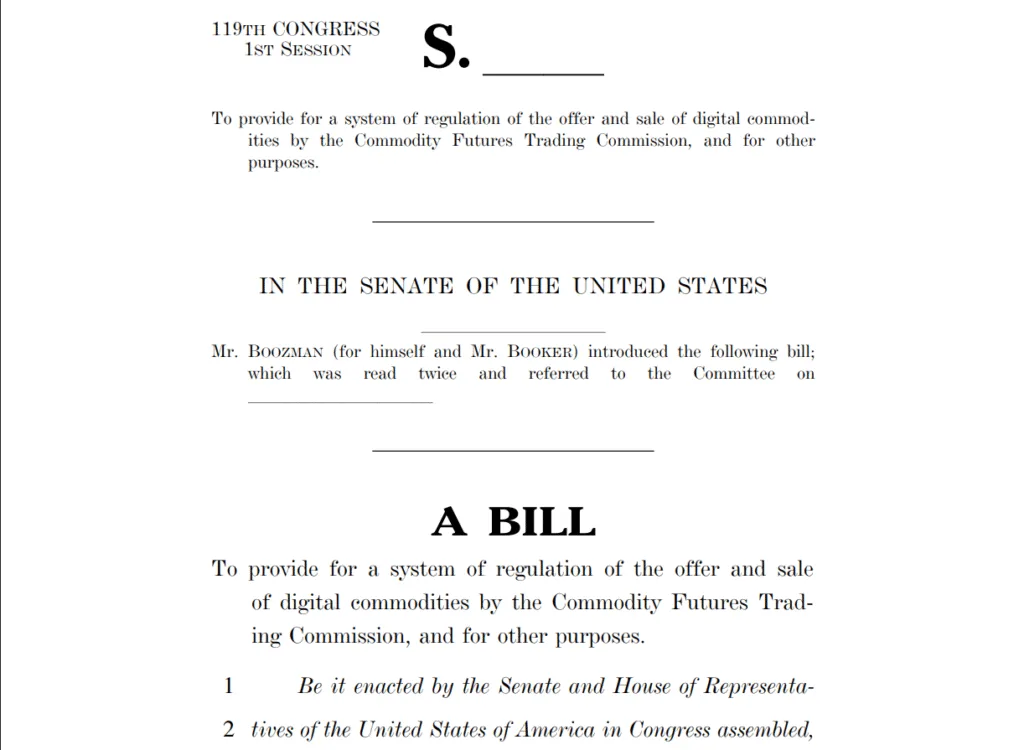
The U.S. Senate Agriculture Committee, led by Senators John Boozman and Cory Booker, released a sweeping 155-page discussion draft that could fundamentally reshape how cryptocurrencies are traded, defined, and governed. This time, it’s not just rhetoric; it’s regulation in motion.
The bill gives the Commodity Futures Trading Commission (CFTC) the primary oversight role for most cryptocurrencies, shifting jurisdiction away from the Securities and Exchange Commission (SEC). It introduces legal definitions for “digital commodities,” mandates registration for crypto intermediaries, and outlines how brokers, dealers, custodians, and exchanges must operate under federal supervision. In short, Capitol Hill targets crypto by redrawing the map of who’s in charge and how the industry must behave.
Capitol Hill targets crypto: A regulatory revolution in motion
For years, crypto has lived in legal gray zones, too new for old rules, too volatile for slow regulators. The Agriculture Committee’s draft is the most serious attempt yet to bridge that gap. It would treat decentralized coins like Bitcoin and Ethereum as commodities, not securities, meaning they fall under CFTC jurisdiction. That distinction could determine the survival of entire ecosystems.
Under this plan, crypto exchanges would register like commodities platforms, brokers would need compliance licenses, and custodians would be required to segregate client assets, a move designed to prevent another FTX-style collapse. The bill also proposes a retail market advocate to represent ordinary investors and a framework for handling insolvency in digital markets.
But perhaps the most significant development is what the draft doesn’t say. Bracketed placeholders remain for DeFi, non-custodial developers, and smart-contract infrastructure, unresolved questions that will decide whether innovation thrives or suffocates. It’s a recognition that crypto’s architecture is still too fluid for rigid classification, yet too influential to ignore.

Why the world is watching
The phrase “Capitol Hill targets crypto” reverberates far beyond Washington. Global regulators, from Brussels to Singapore, have been waiting to see how the U.S. defines its digital-asset stance. If America treats decentralized networks as commodities, the ripple could redefine how exchanges and wallets operate globally.
For the European Union, which recently launched its MiCA framework, this U.S. move could signal a convergence of regulatory standards that make cross-border compliance simpler. For Asia and the Middle East, where Web3 hubs like Dubai and Singapore have already licensed digital-asset platforms, the draft bill could serve as validation that crypto is maturing into a regulated asset class.
However, the bill’s complexity raises a paradox. In trying to clarify crypto, the U.S. may inadvertently centralize it, placing the CFTC at the heart of a system designed to be decentralized. The world’s innovators are watching to see if Washington can regulate without restraining.
The global stakes of Capitol Hill’s crypto ambition
This isn’t just a policy shift; it’s a declaration that digital assets are no longer a speculative sideshow. The U.S. is acknowledging that the blockchain economy deserves structured oversight, not sporadic enforcement. If done right, this could attract institutional capital, stabilize prices, and legitimize Web3 in the eyes of cautious regulators.
But if the balance tilts too far toward bureaucracy, it could drive innovation offshore, to nations more comfortable with experimentation. The next few months will determine whether the Senate can turn this draft into durable, inclusive law.
For now, Capitol Hill targets crypto not as an enemy, but as a frontier. Whether that frontier becomes a foundation or a fence will depend on how the world responds to America’s boldest regulatory experiment yet.