

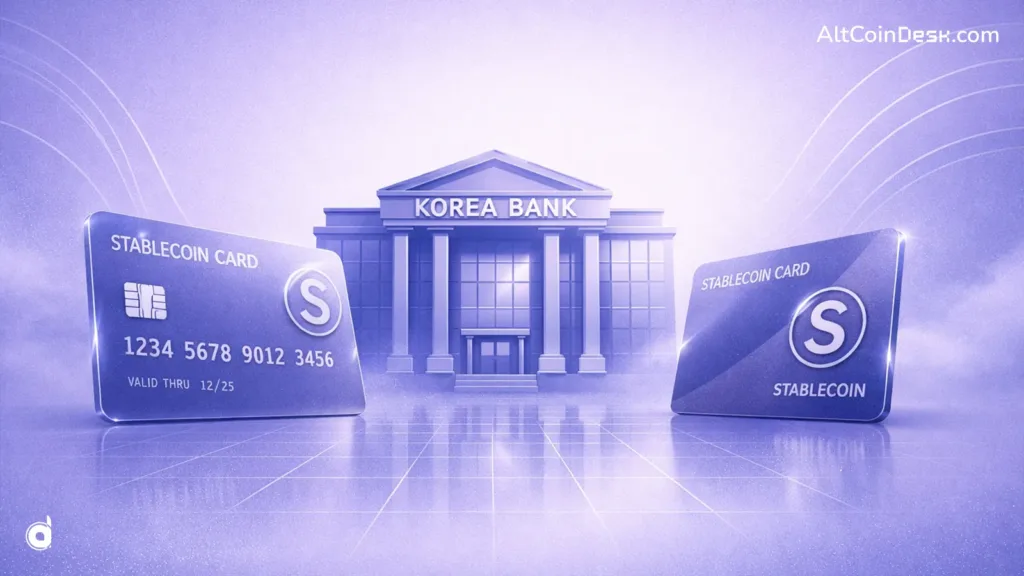

KB Kookmin Bank, South Korea’s largest lender and part of KB Financial Group, has taken an early step into digital payments, being among the first to file a patent for a stablecoin credit card to provide a hybrid payment method that blends with the advantages of credit cards.
This development reflects the support that local regulators and lawmakers have demonstrated for the won-stablecoin initiative, as the design focuses on making stablecoins a part of everyday use cases through existing credit cards.
The official reports also mentioned the entities permitted to issue stablecoins, such as the Bank of Korea and the Financial Services Commission. These entities have reportedly agreed that issuance would be centered on a consortium inclusive of licensed banks.
What’s the stablecoin credit card about?
The patent links a blockchain-based e-wallet address to a customer’s credit card, where the user benefits from the digital wallet and the credit card combined within a single service.When paying, the stablecoin in the wallet is first spent, and in cases of insufficiency, it is covered with the credit card automatically.
A KB Kookmin Card official said to the media, “This is meaningful in laying the groundwork to make digital assets easier and safer to use. We will review how to apply it with financial consumer protection as the top priority, taking into account the regulatory environment and market conditions.”
KB Kookmin Card is expected to be the bridge between traditional financial infrastructure and blockchain technology. This way, stablecoins will establish themselves as a practical payment method that does not require an in-depth understanding of crypto.The technology was also seen as being applicable for expanding both domestic and global payment systems, including the use of digital assets.
Crypto rise in South Korea
KB’s patent application comes at a time where ongoing regulatory developments have been surrounding stablecoins and the wider crypto market in South Korea.
South Korea, as of 2026, has officially lifted the ban on corporate investments in cryptocurrencies, a step closer to the expansion of crypto. Under President Lee Jae Myung’s policy push, the forthcoming “Digital Asset Basic Act” framework is aimed at establishing a local won-pegged stablecoin market.
The Digital Asset Basic Act, often referred to as Phase 2 legislation, imposes licensing, reserve, and disclosure requirements on stablecoin issuers and aims to stabilize and align South Korea with the global regulatory trends.
Banks pivoting to crypto
Recently, the Hong Kong branch of Standard Chartered entered a joint venture with Animoca Brands and Hong Kong Telecommunication Limited, or HKT, to begin the issuance of a Hong Kong dollar-backed stablecoin.
Following anticipation of favorable U.S. regulations, Bank of America is preparing to launch its own dollar-backed stablecoin.
PayPal completed its first-ever business transaction using its USD-backed stablecoin (PYUSD). The stablecoin market has seen increased activity, as more banks are pivoting to crypto and blockchain, integrating them into daily life.