
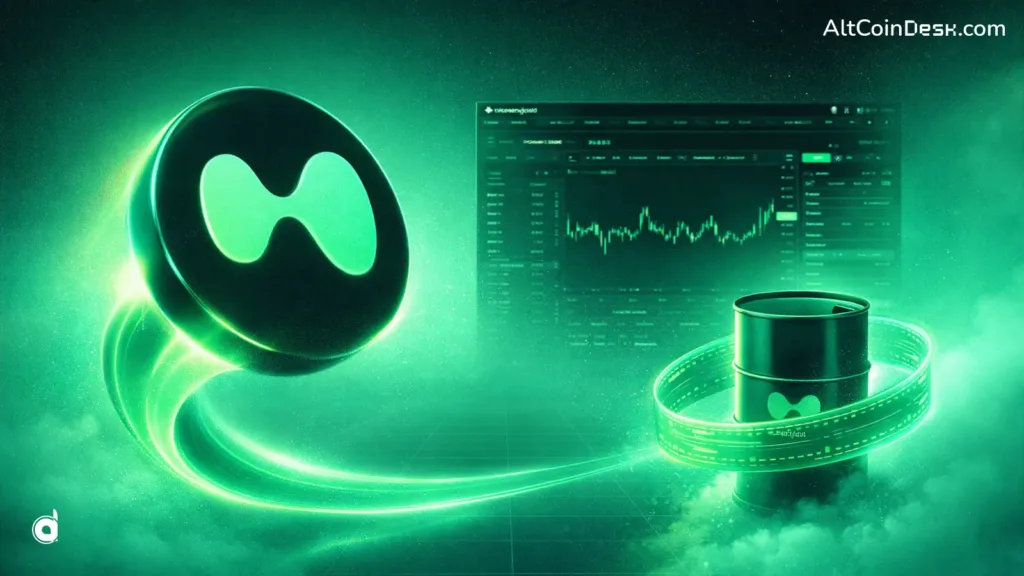

As geopolitical tension shut traditional markets, crypto traders turned to 24/7 oil contracts, sending trading volume past Ethereum and igniting a rally in Hyperliquid’s native token.
It was a Sunday night, and Wall Street was dark. But in the Middle East, tensions were flaring. Missiles had flown. The Strait of Hormuz, a passageway for a fifth of the world’s oil, suddenly looked fragile. In a traditional brokerage account, you were stuck. You had to wait for the New York opening bell on Monday morning to react. But on Hyperliquid, a blockchain-based trading platform, the lights never go out.
By the time the sun rose in London, traders had already moved over a billion dollars’ worth of positions on tokenized oil trading contracts. They weren’t buying barrels of physical crude. They were trading perpetual futures tied to West Texas Intermediate prices, settled in the USDC stablecoin. And they did so much that this single market flipped Ether, the second biggest cryptocurrency by market cap, to become Hyperliquid’s second most traded asset.
This wasn’t just a blip in the crypto casino. It was a signal that the game had changed.
The “black gold” rush on the blockchain
Let’s look at the numbers, because they show how quickly activity accelerated. In the days leading up to the geopolitical shock, Hyperliquid’s crude oil perpetual contract typically recorded daily trading volume in the tens of millions of dollars.
As tensions escalated, that figure surged past $1.2 billion within a 24-hour window, according to market trackers. At its peak, the contract briefly traded more volume on the platform than Ether, making it Hyperliquid’s second most active market after Bitcoin. Open interest across the platform’s permissionless futures markets also climbed to record levels, reflecting how rapidly traders moved to gain round-the-clock exposure to oil price swings.
This explosion in tokenized oil trading happened because the product fills a gap traditional finance leaves wide open: time. When the U.S. and its allies struck Iranian targets, oil benchmarks in the traditional world were closed for the weekend. They would have to “gap” up on Monday morning, leaving traders unable to manage risk. Hyperliquid, however, offered a price discovery mechanism immediately. The contract surged, pricing in the shock long before the CME opened.
What are they actually trading?
It is really important to understand what this is not. This is not a digital barrel of oil you can take delivery of. You cannot show up to a pipeline in Cushing, Oklahoma, with a blockchain receipt.
What traders are using is a perpetual swap. It is a derivative contract that lets you bet on the price of oil going up or down without ever owning the underlying asset. It settles in USDC, a digital dollar. Think of it like a futures contract that never expires, allowing traders to hold positions for as long as they want, 24 hours a day.
Because of this, when oil surged past $100 a barrel on the news, the liquidation cannons fired. Reports confirmed that short sellers, those betting the price would fall, were “wiped out” as the contract moved violently against them, losing tens of millions in the process. It was a brutal reminder that while the market never sleeps, the risk never rests either.
The HYPE flywheel
So, what does a sudden mania for tokenized oil trading have to do with the price of HYPE, the native token of the Hyperliquid chain? Everything.
Hyperliquid is structured so that its success feeds its token. Roughly 97% of the trading fees generated by all this oil volume flow into something called the “Assistance Fund.” This is an on-chain address that automatically takes those fees, goes into the open market, buys HYPE tokens, and permanently destroys them.
It is a deflationary engine. More volume equals more buybacks. More buybacks mean less supply. By early March, data showed that the Assistance Fund had already bought back and destroyed over 41 million HYPE, representing over 4% of the total supply, valued at roughly $1.35 billion. During the oil spike, the platform’s revenue jumped over 60% week over week. In a single recent period, the platform was burning nearly 49,000 tokens a day while only minting around 26,000 for staking rewards, meaning the supply is shrinking in real time.
Traders noticed. As the oil news broke, HYPE rallied roughly 10%, outperforming the top 100 cryptocurrencies, many of which were stagnant or down. Some prominent market commentators expressed bullish long-term expectations, suggesting the token could hit $150 by August 2026, betting on Hyperliquid becoming the go-to venue for macro trading.
From memecoins to macro assets
This shift feels seismic. For years, decentralized exchanges were mostly for trading volatile cryptocurrencies against each other. Now, the top markets on Hyperliquid include crude oil, Brent oil, silver, gold, and even equity indices.
Market analysts say the platform is becoming one of the first places where meaningful on-chain trading of real-world asset exposure is taking place.
The infrastructure was laid months ago. In late 2024, Hyperliquid airdropped 310 million HYPE tokens to early users in one of crypto’s largest community distributions. By early 2026, they had launched native staking and the HIP-3 upgrade, which allows anyone to create a market for almost anything by staking 500,000 HYPE as a security deposit. The oil contract existed long before the bombs dropped. The conflict just provided the stress test.
To sum up, what tokenized oil trading proves
For the average person, the takeaway is simple. The lines between Wall Street and the blockchain are blurring fast. When the next global event happens on a Friday night, traders no longer have to wait. They go to Hyperliquid.
The recent surge in tokenized oil trading proved that there is massive demand for round-the-clock exposure to traditional assets. Whether this momentum holds when oil prices cool down is the big question. But for now, Hyperliquid has positioned itself not just as a crypto exchange, but as the first truly global, always-open macro trading desk. And as long as the volume keeps flowing, the HYPE token burning in the background will keep attracting attention.