
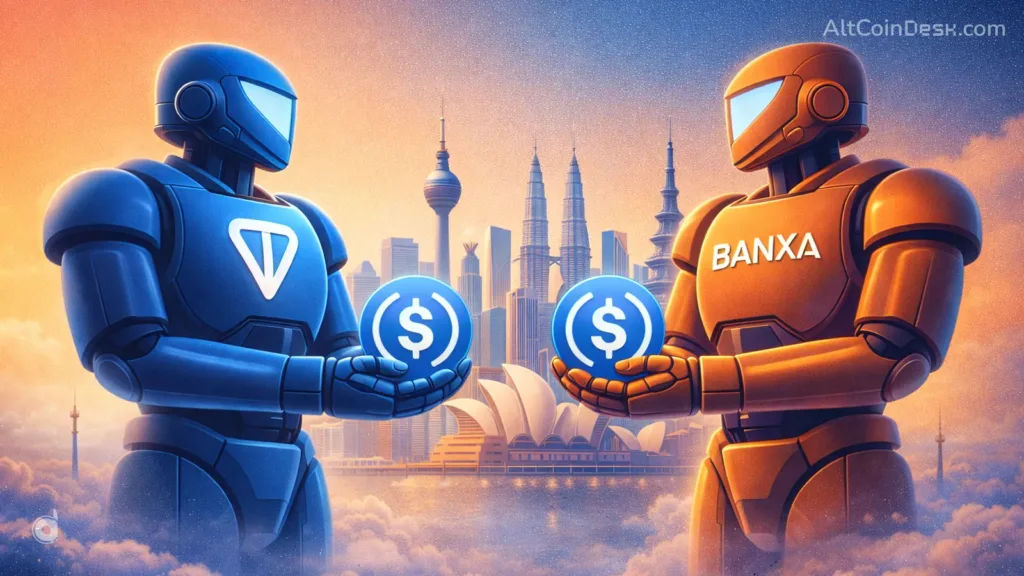

TON Foundation on 17th of February announced partnership with Banxa, a subsidiary of the OSL Group, aimed at bringing regulated stablecoin infrastructure to merchants across the Asia-Pacific (APAC) region.
Payments backbone for APAC merchants
The partnership plans to transform the TON blockchain into a practical, operational payments layer for real-world commerce. By integrating Banxa’s global fiat-to-crypto on and off-ramp rails with TON’s high-speed infrastructure, the partners are targeting thousands of SMEs that currently struggle with the high costs and slow speeds of traditional cross-border settlements.
The collaboration was described as a reflection of the organization’s emphasis on developing TON-based use cases that deliver long-term commercial utility, according to Nikola Plecas, Vice President of Payments at TON Foundation.
It was further noted by Plecas, a former Visa executive, that efforts are being made to transition the network from a speculative asset into a settlement layer prepared for global enterprises.
The deal leverages OSL Group’s institutional-grade network and Banxa’s portfolio of over 40 global licenses. Just after OSL’s acquisition of Banxa in January 2026, the group has placed itself as a licensed go-to solution for securing digital transactions across the U.S., Europe, and APAC.
Sean Moynihan, COO of Banxa, noted that the partnership combines TON’s massive scalability with compliant payment rails, allowing any company to benefit from the efficiency of stablecoins.
The “Everything App” shift
The partnership is followed by the launch of TON Pay, a new SDK that allows Telegram’s 1.1 billion users to send USDT and Toncoin with sub-second finality and fees under $0.01. While TON Pay targets consumer-scale transactions, the Banxa partnership extends that same efficiency to the B2B and SME sectors.
As traditional finance (TradFi) continues to struggle with the red tape of legacy systems, the on-chain economy is accelerating. By making a licensed bridge between fiat and digital assets, TON is betting that the future of APAC trade won’t just be digital, it will be decentralized and compliant.