

For the first time in human history, we might not have to guess if a video is real. It will just know and prove it. Brevis launches a new media authenticity verification system that could reshape how the internet proves what is real.
Something strange has happened to the internet. We used to ask whether a shocking photo or video was real. Now the first reaction is often suspicion. That change is not paranoia. It is the result of extremely convincing deepfakes created by modern AI.
From fake war footage to fabricated political speeches, synthetic media has become so convincing that even experts struggle to tell what is real. This is why media authenticity verification is starting to look like one of the most important technology ideas of this decade.
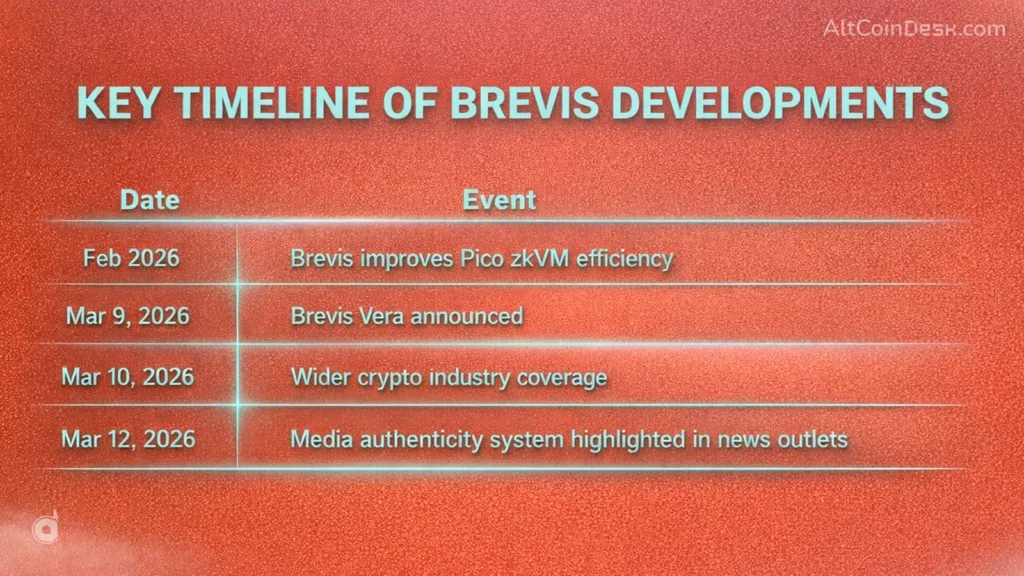
In March 2026, a company called Brevis introduced a system known as Brevis Vera. Instead of trying to detect fake media, the system lets images and videos cryptographically prove where they originated. The shift may seem small, but it completely changes how people think about trust online.

Detection was always a losing game
For years, tech companies tried to solve deepfakes with detection tools. These systems use artificial intelligence to analyze a video or image and guess whether it might be fake. The problem is simple. AI generators learn quickly. Every time a detector improves, the generation models adapt. It becomes an endless race.
Brevis argues that the answer is not better detectors. The answer is media authenticity verification that allows genuine media to prove where it came from. Think about it like a digital passport for images and videos. Instead of asking whether a file looks suspicious, the file itself carries a record of its history.
How Brevis Vera actually works
Brevis Vera works in three stages, and the process is surprisingly straightforward.
Step one: capture
A photo or video is recorded using a device that supports the C2PA standard, a global initiative backed by organizations such as Adobe, Microsoft, Intel, and the BBC. The device attaches a cryptographic signature proving that the file came from a real camera and has not been altered.
Step two: editing
Normally, editing breaks authenticity records. Cropping, resizing, or compressing an image can remove the proof. Brevis solves this using its Pico zero-knowledge virtual machine, known as a zkVM. This system generates mathematical proofs that confirm an edit was legitimate without exposing the private editing details.
For example, the proof can show that a photo was cropped or color corrected while still confirming it came from the original capture.
Step three: verification
When the content is published, platforms can display a Vera-certified badge showing a verified chain of history from camera to screen. Anyone can inspect the proof and confirm the media is authentic. This is where cryptographic media verification becomes powerful. It replaces guesswork with mathematics.
The company behind the technology
Brevis is not a traditional media company. It is a zero-knowledge computing firm focused on cryptographic infrastructure. The team has spent years building technology that proves computations without revealing sensitive data. That approach comes from the blockchain world, where zero-knowledge proofs already secure privacy-focused applications and advanced scaling systems.
Brevis is now applying the same technology to media authenticity verification, turning the concept into something practical for journalism, social media, and digital evidence. While Brevis is still relatively young, the company operates in an ecosystem supported by major investors and developers building privacy-focused blockchain infrastructure.
Why this could become a $100 billion industry
The real story here is bigger than Brevis. Experts increasingly believe that content authenticity infrastructure could become a massive industry. The reason is simple. Every part of the digital world needs trust.
Newsrooms need to verify war footage. Courts need to confirm digital evidence. Insurance companies need proof that accident photos are real. Social networks need to find ways to mark content as verified.
There is a risk to elections. In the first few months of 2026, AI-made videos of political candidates and government officials pretending to be them were seen in a lot of places. These events show what scholars call the “liar’s dividend.” When deepfakes exist, bad actors can dismiss real evidence as fake. Media authenticity verification flips that narrative. Authentic content can prove itself.
Where blockchains and social media fit in
Blockchain technology may play a supporting role. Early experiments already used blockchains to timestamp files, proving when something existed. Brevis expands that concept by verifying the entire history of a file, not just its timestamp.
Social media platforms could also integrate authenticity systems directly into feeds. Instead of endless arguments about what is fake, users could see clear indicators showing whether a video carries verified provenance.
In that world, deepfake verification technology becomes a normal part of the internet infrastructure.
The challenge ahead
There is one major obstacle. Adoption. For media authenticity verification to work everywhere, cameras, editing tools, and platforms must all support the standard. Older photos and videos cannot be verified retroactively.
But the direction is clear. As synthetic media spreads, trust will become the most valuable digital resource. Brevis Vera may only be an early step, but it hints at a future where the internet does not guess what is real. It proves it. And that future may define the next major technology industry.