


Every few months, like clockwork, someone clears their throat and asks the same question with a straight face: Is crypto legitimate?
It usually comes wrapped in concern, sometimes skepticism, and often fatigue. As if the last decade and a half were a long rehearsal, and we are all still waiting for a signal from the balcony that says, “Yes, this is real now.”
Here is the uncomfortable truth. Crypto does not need that question anymore. It answered it by existing.
Legitimacy is not a vibe; it is a footprint
When people ask, “Is crypto legitimate?” What they are really asking is whether it has been approved by the same systems that defined legitimacy for the last 50 years. Banks, regulators, rating agencies, and institutions that prefer predictability over experimentation.
But legitimacy is not a feeling. It is a footprint.
Crypto settles trillions of dollars in value every year. It operates global payment rails that never close. It secures financial systems with cryptography so strong that governments recruit from the same talent pool that builds it. It is audited, taxed, debated in legislatures, and studied in universities.
At this stage, questioning crypto’s legitimacy is like standing in front of the internet in 2001 and asking if email will really replace fax machines.
The world has already moved on. Some people just did not notice.
You are confusing volatility with validity
One reason this question refuses to die is price. Crypto prices move fast, sometimes violently, and that volatility gets mistaken for weakness. This is a category error. Markets are volatile. Infrastructure is not.
The dot-com era was chaotic. Companies collapsed, valuations evaporated, and headlines screamed about bubbles bursting. Yet the internet itself kept expanding quietly underneath the noise, rewiring commerce, media, and communication while everyone argued about stock charts.
Crypto is doing the same thing. Tokens come and go. Projects fail. Speculation overshoots reality. Meanwhile, the underlying networks keep producing blocks, settling transactions, and enabling financial activity that was previously impossible or prohibitively expensive.
Legitimacy is not about price stability. It is about whether a system continues to function under pressure. Crypto does.
The real question people are afraid to ask
When someone asks, “Is crypto legitimate?” It often means something far more personal.
“Do I understand this well enough to trust it?” That is a human question, not a technical one.
Money has always been a shared belief system. Gold worked because we agreed it mattered. Paper money worked because governments enforced it. Digital bank balances work because institutions promise to honor them.
Crypto disrupted that pattern by replacing institutional trust with verifiable rules.
Bitcoin is not a currency. It is a global, decentralized settlement network.
Andreas Antonopoulos, Bitcoin educator
That distinction matters. Crypto does not ask you to trust a bank, a company, or a government. It asks you to verify the rules for yourself. That shift feels uncomfortable because it removes familiar intermediaries and replaces them with responsibility. Discomfort does not mean illegitimacy. It means change.
Legitimacy follows use, not approval
History is unkind to technologies that wait for validation before becoming useful. The printing press was not legitimate until it was unstoppable. The internet was not legitimate until it was unavoidable. Smartphones were not legitimate until everyone had one. Crypto crossed that line quietly. People use it to move money across borders in minutes. Developers use it to build financial applications without permission. Institutions use it to tokenize assets, experiment with settlement, and reduce friction in legacy systems.
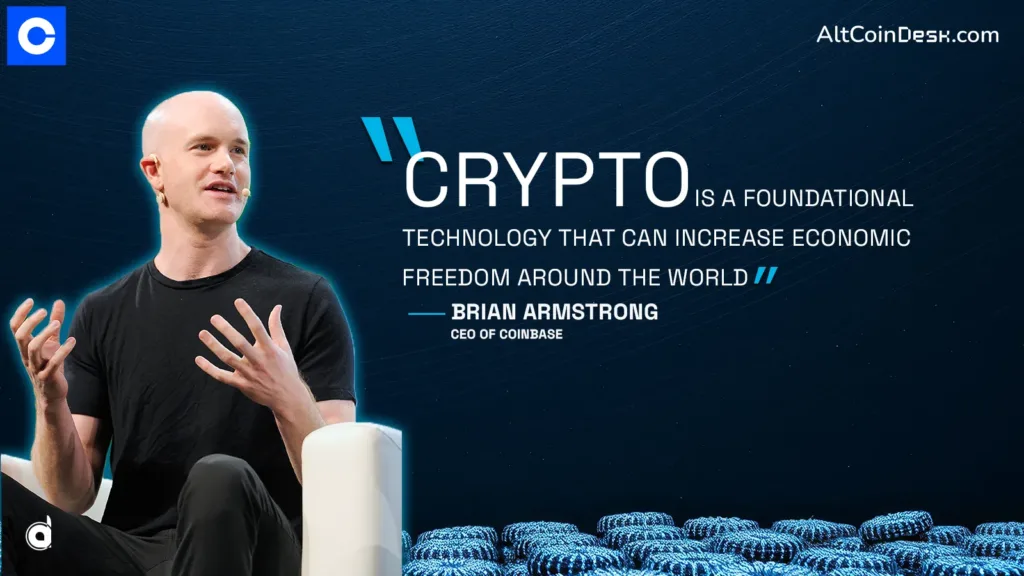
When Brian Armstrong, who runs Coinbase, talks about crypto as a foundational technology that expands economic freedom globally, he is not making a hype-driven claim or defending a speculative trend. He is describing crypto the way engineers and policymakers talk about infrastructure, something designed to operate at scale, underpin systems, and quietly enable activity across borders and markets. That framing matters because it places crypto in the same category as the internet or payment networks, technologies that reshape how value moves rather than experiments waiting for validation.
Governments can regulate it, debate it, or resist it. None of that changes the underlying reality. The technology works, and people keep using it. Legitimacy follows adoption, not permission slips.
Stop framing the debate backwards
Asking if crypto is legitimate in 2026 is like asking whether the internet is serious enough for business. The framing is outdated.
The useful conversation now is not if crypto is legitimate, but which crypto systems are resilient, which designs scale without breaking, and which incentives actually align users, builders, and security.
Those are grown-up questions. They require nuance, trade-offs, and the acceptance that not everything labeled “crypto” deserves equal trust.
Some systems are robust. Others are fragile. Some are transparent. Others are extractive. This is no different from traditional finance, where legitimacy does not automatically extend to every bank, fund, or product simply because the system exists. Crypto does not need blanket approval. It needs discernment.
Is crypto legitimate? The quiet irony no one mentions
Here is the irony critics rarely acknowledge.
Crypto is questioned precisely because it exposes how much of traditional finance depends on trust without verification. Closed ledgers. Opaque risk. Promises are enforced after the damage is done rather than systems designed to prevent failure in the first place.
Crypto flipped that model. It made verification the default and trust optional. That is not a lack of legitimacy. That is an architectural choice. You do not have to like it. You do not have to use it. But pretending it is still an experiment waiting for validation misses the point entirely.