


One of the most frequent criticisms directed at the Bitcoin community is centered on its proof-of-work (PoW) consensus algorithm. Specifically, the verbal attack is toward its high environmental cost compared to Ethereum’s proof-of-stake consensus algorithm, which doesn’t require any mining hardware to consume energy to solve complex mathematical problems.
At Day 1 of Bitcoin MENA 2025 at Abu Dhabi, UAE, Auradine CSO Sanjay Gupta dismissed this criticism, saying that the so-called environmental cost argument associated with Bitcoin’s PoW mechanism is largely misunderstood.
AltCoinDesk had a conversation with Gupta about Bitcoin mining in 2025, Auradine’s efforts to make it more environmentally friendly, and other topics.
The evolution of Bitcoin mining infrastructure
Mining is as important to Bitcoin as a heartbeat to a human body. Bitcoin’s network difficulty and hash rate have increased at a significant rate over the past few years. This has led to miners regularly upgrading their hardware infrastructure.
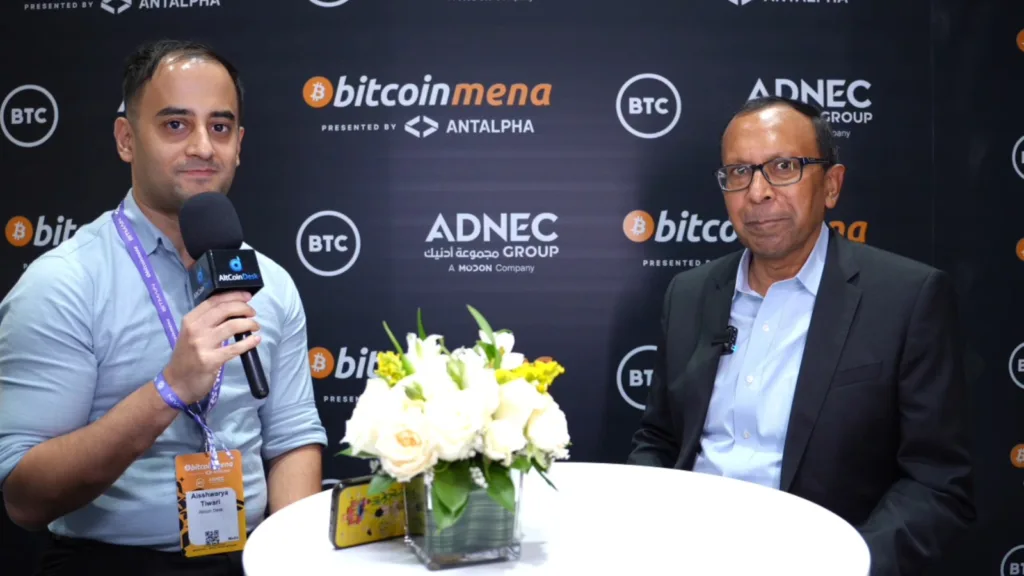
When I joined Auradine around three years ago, the global hash rate was somewhere between 100 and 150 exahash. Today, it’s around 1,000 exahash, or one zettahash.
Sanjay Gupta, CSO, Auradine
Besides the rising network difficulty and global hash rate, Gupta emphasized the significance of geographical factors, operational efficiency, and energy sourcing in shaping the state of Bitcoin mining as we know it today.
What makes the Middle East stand out among other geographies?
When asked why the Middle East is emerging as a leading geographical region when it comes to Bitcoin mining, Gupta said it is no accident. He called it a result of alignment between proactive regulations, power availability, and ecosystem development.
The moment you have different ecosystem players operate off each other, that helps in the creation of the industry in the area. So overall, it’s been great for the area of data centers overall, and Bitcoin data centers in particular.
Significant chunk of Bitcoin mining already runs on renewable energy
The conversation then steered toward the most frequent point of contention when it comes to Bitcoin mining, its high energy usage. This argument received significant attention when Elon Musk halted accepting BTC as payment for Tesla automobiles back in May 2021.
However, Gupta cleared the air by saying that a significant amount of Bitcoin mining already runs on renewable energy today. He added that most miners act as flexible energy consumers through demand-response mechanisms.
He added that Auradine has developed a proprietary technology called EnergyTunes, enabling Bitcoin miners to adjust energy consumption within seconds. It allows them to scale power usage up or down based on grid conditions, helping stabilize energy networks.
No regulatory edge for PoS networks
When asked if PoS networks like Ethereum may get a regulatory edge or preferential treatment by regulators around the world, Gupta said he hasn’t seen any such case.
We’ve not seen any indication that PoS is getting preferential treatment. PoW drives an extraordinary level of security, and that’s a big reason why Bitcoin has never been hacked.
Sanjay Gupta, CSO, Auradine
Gupta emphasized that energy consumption should not be singled out. He mentioned that AI data centers consume an enormous amount of energy as well.
Greater clarity under Trump regime
While there has been a noticeable change in regulatory stance toward the digital asset industry under the Donald Trump administration since his presidential victory back in November 2024, Gupta said that the hostility was already on its way out.
There’s much more clarity on the regulatory framework. So, there are different regulatory acts that have been outlined to ensure that the rules of the game are clear.
Sanjay Gupta, CSO, Auradine
Gupta highlighted that even prior to the current administration, there was already a notion of Bitcoin being defined as a commodity and not a security. At the time, this gave some regulatory clarity to the industry.
Since then, the clearance of important acts – such as the CLARITY Act – has made the overall regulatory environment clearer. He added that recently, there’s been more mainstream acceptance of the crypto industry in the economic fabric of the US.
He alluded to the fact that several exchange-traded funds (ETFs) now hold BTC, in addition to pension funds, investment firms, and other institutions. Indeed, spot BTC ETFs in the US now hold more than $112 billion in total net assets, according to the latest data.
Closing thoughts
To conclude, Gupta’s remarks are very timely, as they reinforce a clear distinction that often gets lost between PoW and PoS consensus algorithms – energy efficiency cannot be a trade-off for security.
While altcoins like Ethereum may leverage PoS to offer varied token use cases, Bitcoin’s PoW still reigns supreme as arguably the most resilient blockchain consensus algorithm in existence.