



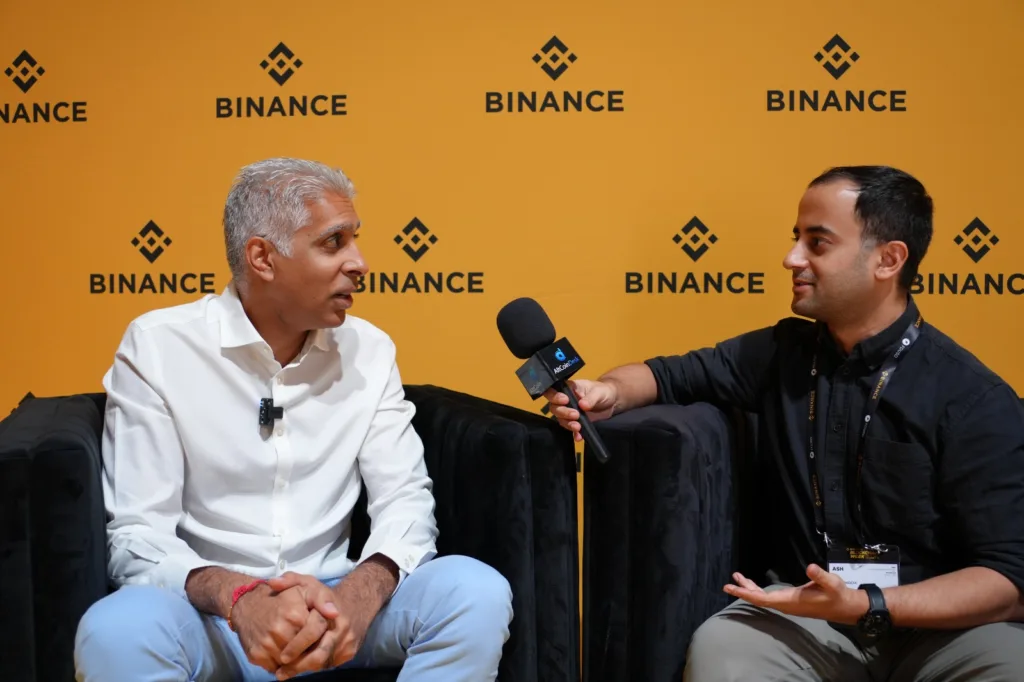
On Day 2 of Binance Blockchain Week 2025, in Dubai, UAE, AltCoinDesk got the opportunity to interview Dr. Anish Shivdasani, Head of Digital Assets – Digital, AI, and Entrepreneurship Practice at Roland Berger.
In this conversation with Dr. Shivdasani, AltCoinDesk tried to view digital assets from a consulting perspective, ranging from the most common misconceptions among institutional investors, the second-order effects of crypto exchange-traded funds (ETFs), areas of convergence of blockchain technology and AI, and a lot more.
Most corporates still don’t understand crypto
When asked what the biggest misconception institutional investors still possess when it comes to digital assets, Dr. Shivdasani said that most of them still don’t understand the emerging asset class.
They still think that it’s highly speculative, no purpose, no use case, gambling, risky, and irrelevant for their business. For the most part.
Dr. Anish Shivdasani, Head of Digital Assets, Roland Berger
While we are seeing some degree of adoption of digital assets among corporations, such as Strategy accumulating Bitcoin and BitMine’s strong Ethereum purchase over the past few months, the overall penetration of digital assets on Wall Street is still relatively tiny.
Second-order effects of crypto ETF approval
Dr. Shivdasani dubbed the US Securities and Exchange Commission’s (SEC) Bitcoin and altcoin – such as ETH, XRP, and Solana – ETF approval a “huge catalyst” for institutional inflows.
He said that buying and holding cryptocurrencies directly is still quite complicated for institutional investors. However, ETFs are SEC-regulated and are an instrument that is well understood by institutions.
He added that Bitcoin surging above the $100,000-$120,000 price level is largely influenced by crypto ETF approval. Recently, 21Shares’ 2x SUI ETF got listed on Nasdaq, giving investors easy access to another altcoin with strong demand.
Stablecoins reach product-market fit in 2025
Besides the ETF approval, Dr. Shivdasani emphasized the rising adoption of stablecoins as the “next big catalyst” that indicates the evolution of digital assets from experimentation to serious enterprise strategy.
Stablecoins were always used for crypto trading. But now, we’re starting to see a decoupling between stablecoin market cap and crypto market cap. Stablecoins are now being used for payments, savings. It’s a convenient inflation hedge.
Dr. Anish Shivdasani, Head of Digital Assets, Roland Berger
He noted the high rate of adoption of stablecoins in Latin America, Africa, and Turkey, evident from the large number of people choosing to take salaries in stablecoins such as USDT. Dr. Shivdasani also highlighted that it’s become a lot cheaper to use stablecoins, especially on low-latency blockchains like the Tron network.
As soon as the GENIUS Act came into play, that legitimized stablecoins. Now you’re going to start to see a huge flurry of activity.
Dr. Anish Shivdasani, Head of Digital Assets, Roland Berger
What makes for successful tokenomics?
Dr. Shivdasani said that the biggest mistake crypto projects make is trying to get rich quickly off a token. “That’s the worst thing you can do,” he added.
He noted that there are two most important principles for people who are building altcoin-based products. First, build a product that people actually want to use. Second, while designing tokenomics, there needs to be sustained demand for the token.
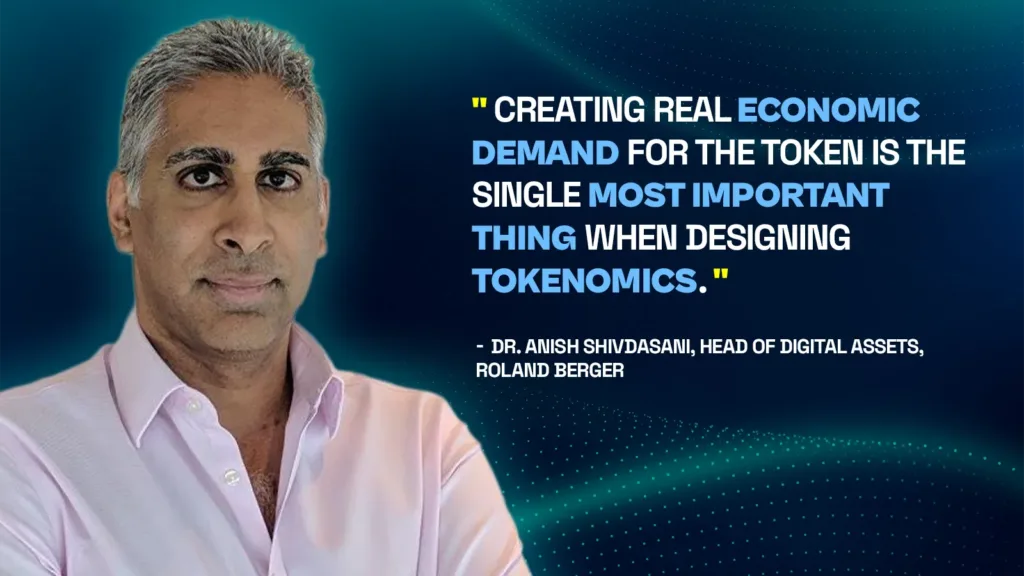
He cited examples of Solana, ETH, and BNB, saying that these coins are used when users use the underlying blockchain network. As a result, there is always demand for these coins as long as there is network activity. This also reflects in their huge market caps.
If you’re going to run an app on Solana, you’re going to pay in SOL. If you’re going to use stablecoins on Solana, you’re going to pay in SOL. Why is Tron one of the most important blockchains right now? Because most of the USDT is on Tron.
Dr. Anish Shivdasani, Head of Digital Assets, Roland Berger
Convergence between AI and blockchain
Answering the question of any meaningful convergence between AI and blockchain, Dr. Shivdasani said that most of it is “just narrative.” He added that most of the projects working on the so-called decentralized AI are nonsense.
However, he added that the area where there are most synergies between blockchain and AI is Bitcoin mining. He remarked that Bitcoin mining companies and AI datacenters share a lot of similar infrastructure, such as access to cheap power, infrastructure, and others.
What you’re starting to see is Bitcoin mining companies expanding or pivoting into AI datacenters, where they’re retrofitting their datacenters with GPUs. They’re able to take advantage of all the necessary ingredients that they enjoyed using Bitcoin mining, and repurposing that toward AI infrastructure.
Dr. Anish Shivdasani, Head of Digital Assets, Roland Berger
Closing thoughts
Dr. Shivdasani’s remarks give real insights into how consultants view the new asset class of digital assets. While crypto adoption has made some strides through Strategy and BitMine, a significant portion of institutions still view it as speculative.
However, the approval of regulated financial products like ETFs reflects the maturity of digital assets, and confirms that regulators are slowly but steadily starting to take note of cryptocurrencies as something more than magic internet money.
Finally, Dr. Shivdasani’s comments on what makes a project’s tokenomics successful are a reminder that token demand remains non-negotiable for digital asset projects that intend to stay in the industry for a meaningful period.