



On-chain analysis has been a topic of conversation in the crypto space since the industry’s inception. Glassnode, Nansen, and Arkham are some of the leading names in the analytics game, but why is this important?
For blockchain enthusiasts, data is the most pivotal tool for trading with transparency and for verifying multiple factors influencing them, such as inflows and outflows, indicating a bullish and bearish market.
Binance Blockchain Week provided a platform for pioneers to discuss the current state and future possibilities of on-chain analysis.
“Previously, getting quality inflation data and real economic data was very labor-intensive for research firms. With incentives to be right, collective intelligence now updates probabilities constantly,” said Nicki Lee, the Research Lead at Opinion Labs.
Bubblemaps at Binance Blockchain Week 2205 – A forward-looking view
According to Nicholas Vaiman, Bubblemaps is an on-chain analytics platform designed to make on-chain data accessible, convenient, and playful. Following his panel discussion, he explains how real-time on-chain intelligence and AI-driven analytics will transform how we approach trading strategies and market advantage.
“Traditional analytics—especially if you’re like me and a fan of OSINT—can feel intimidating. You’re often staring at endless tables of transactions that are overwhelming to interpret,” Vaiman said.
Bubblemaps changes that, offering a simple, visual way to understand token ownership. The project uses graphics of bubbles that represent every ownership of a token on the blockchain, making it easy to track all the details about the tokens.
One-on-one with Nicholas Vaiman

“Let me show you an example. On the screen behind me is the Bubblemap for Uniswap, which is one of the biggest governance tokens on Ethereum—the token behind the Uniswap DEX.”
Each bubble represents a wallet. The bigger the bubble, the more UNI that wallet holds. And if two bubbles are connected, it means those wallets have sent funds to each other.
Naturally, the next set of questions raised are: Why are they interacting? What patterns are they forming? What’s the story behind those clusters?
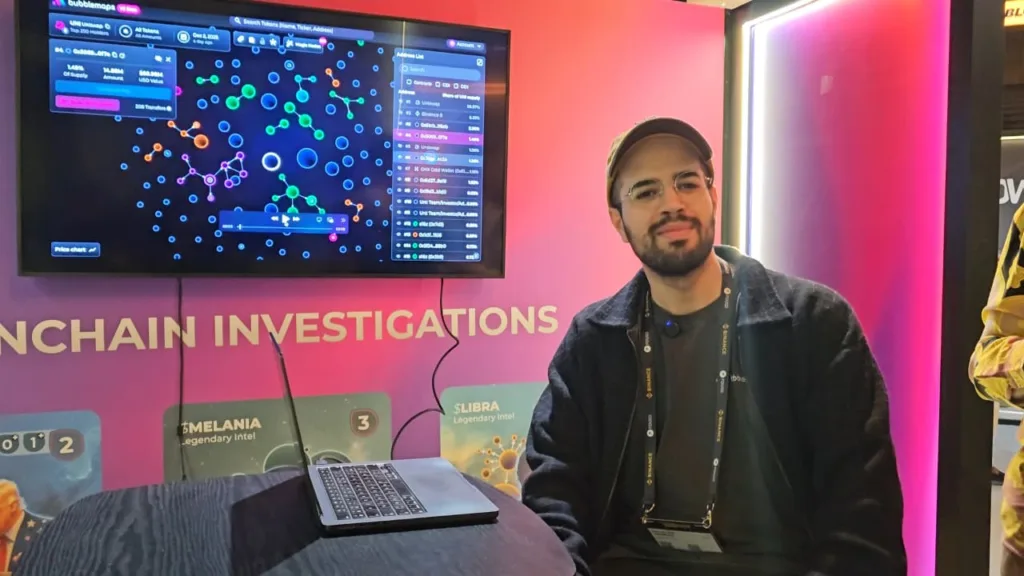
Nicholas says, “That’s where on-chain instinct and experience come into play.”
Bubblemaps also includes several powerful features. You can see the amount of funds being transferred between wallets. You can filter transfers—whether they’re on Ethereum, Avalanche, BNB, UNI tokens, or even cross-chain activity. We could call it the spy amidst the wallets that can never miss a detail.
Then there’s Magic Nodes, a feature unique to Bubblemaps, where you witness the maps suddenly expand into further infographics.
He further explains this feature: “Bubblemaps focuses on the top holders of a token. But often, these top holders are linked through many intermediary addresses. Even though those intermediaries aren’t major holders themselves, showing them can reveal crucial hidden connections.”
These intermediaries are not added randomly; they are carefully selected.
“Otherwise, everyone would appear connected to everyone,” he said. “Magic Nodes exist to ensure that you don’t miss the important relationships on the map.”
Data’s correlation with time
When comparing data, we prefer a timeline of what it used to be and how much it has changed. Nicholas talks about how Bubblemaps’ feature can rewind the tape.
A bubble map shows data at a specific moment in time: what did things look like in December 2020? By clicking a button, you can time-travel and see exactly how the token’s ownership and connections looked back then.
You can go all the way back to the birth or history of a token. “It’s surprisingly poetic,” he commented.
Nicholas used the analogy, explaining, “For Uniswap, it begins with a single wallet holding the entire supply. Two days later, everything explodes outward like a financial Big Bang. And with Bubblemap, you can actually watch the tokenomics take shape.”
The feature seemed useful while analyzing tokens that end up rugging. The current market trends on the map may speak of what happened at the beginning, but rewinding the analytics often reveals the hidden threats that may be hard to notice initially.
And finally, he stated:
And finally, here’s a map of Bullish. That large bubble in the center represents timing similarity. Normally, we don’t show exchanges or contract addresses, because they’d create misleading clusters. But if several wallets withdraw at the exact same time from an exchange and display similar patterns, we show that as a timing-based cluster. That’s part of our timing analysis feature.
It’s intuitive tools like Bubblemaps that will shape how traders read markets and uncover hidden stories on the blockchain to stay more aware.