



With over 18 years of experience in investment banking, financial change is not new to Patrick Ngan, the CIO of Zeta Network. He views the role of cryptocurrency with practicality while remaining receptive to the role of traditional assets.
Zeta Network Group covers a three-pillar ecosystem:
- Upstream: Bitcoin mining.
- Midstream: Purchasing and holding Bitcoin and solvdBTC.
- Downstream: Partnering for liquid staking and yield generation.
In the midstream, Zeta recently purchased $231 million worth of Bitcoin and solvdBTC. Regarding the downstream, Zeta plans to partner with liquid staking companies and platforms to generate yield and improve returns on their mined or purchased Bitcoin.
Zeta Network Group’s Bitcoin-backed investment
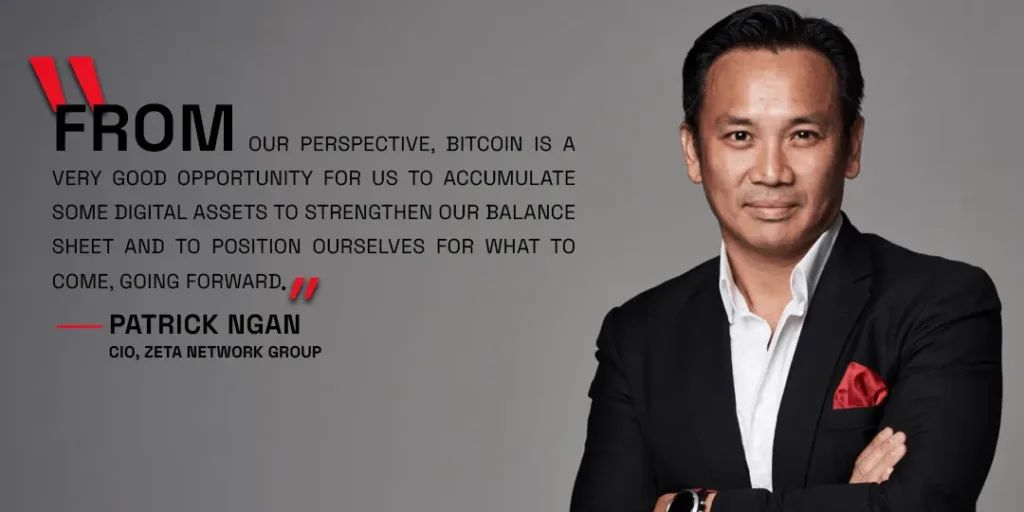
Zeta Network recently made a $231 million Bitcoin-backed investment. In an exclusive interview, Patrick Ngan stresses that the investment is not speculative. Instead, it is a move to strengthen the company’s balance sheet and provide liquidity.
Corporations are increasingly allocating cash reserves to digital assets to strengthen their balance sheets. The anticipated evolution, according to Patrick, is the move from off-chain to on-chain.
“What people do not realize is that buying Bitcoin has been happening for the last five to ten years. We now need to focus on how we can create liquidity. Many people equate liquidity with volatility. However, when you have more liquidity, volatility should decrease.”
Bitcoin despite the volatility
He addresses concerns about Bitcoin’s price volatility by framing market dips as “healthy corrections,” emphasizing that this is not a short-term bet. The company’s confidence in Bitcoin is rooted in a long-term, board-approved strategy, treated the same as traditional treasury decisions.
“It is not going to replace what you are buying traditionally; you will allocate a part of your cash reserve into the digital asset space to diversify your holdings. From our perspective, it is good to have an option.”
‘Peter Schiff called it a fake asset, You call it an institutional asset’
“How about gold? Is gold very liquid? It is absolutely not liquid at all,” Patrick says, starting with gold but ending with Bitcoin. He explains that it depends on how we perceive an asset and the value we associate with it. Bitcoin is an asset because there are instruments to liquidate it. He cites an interesting statement by CZ: “You cannot just carry gold around with you.”
“Bitcoin is ferociously liquid. However, there will be many more symbiotic instruments that make Bitcoin even more liquid, just like what you see with gold,” Patrick said.
Corporate skepticism meets strategy in digital assets
Patrick views the shift as a matter of adoption and education. Digital assets, particularly Bitcoin, are being recognized as institutional-grade assets. Corporations and listed companies look for treasury functions to develop assets that are tradable 24/7, liquid, and transparent.
“It is liquid, it is transparent, and I think this is where the trend will be,” he exclaims with enthusiasm.
Patrick is a strong believer in real-world asset tokenization, which he believes will bring more products, increase diversity, and enhance liquidity and yield for institutional investors.