
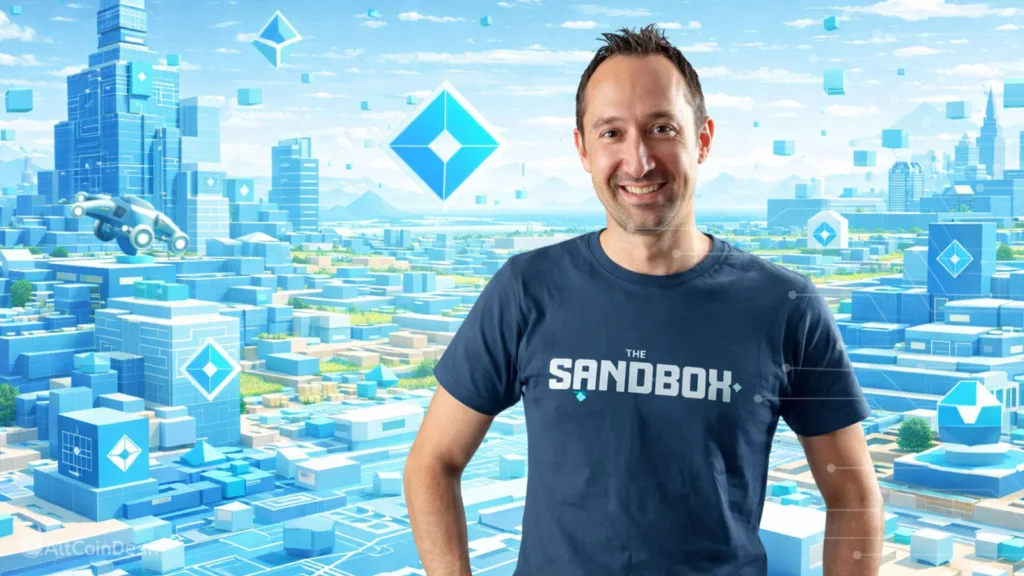

Sebastien Borget, Co-founder and COO of The Sandbox still remembers the moment he received his first video game console, a Super Nintendo with Super Mario World. “Wow, I love this game,” he recalls thinking. “I want to make a game myself one day.”
Shaping the journey toward The Sandbox
That journey didn’t start with a strict roadmap, but it had a clear destination. Borget attended engineering school, learned programming, and eventually developed products, games, and consoles. By 2011, he and co-founder Arthur Madrid had launched two startups. Their third was The Sandbox. What began as a mobile game has evolved into a leading metaverse where users create, own, and monetize digital assets.
“We saw the moment where we could make games accessible to everyone again,” Borget said, noting the rise of the iPhone and Android. “They enabled a ‘startup in a garage’ mode, where one or two people could make games without a big team, large investments, or restricted hardware access.”
The evolution of The Sandbox
The first era of mobile “free-to-play” games focused on character-driven titles like Garfield and Snoopy. Soon after, the first mobile version of The Sandbox launched.
“The idea was: I know how to make games, but that’s not enough,” Borget explained. “How do I enable anyone to make games, even without a background in programming?”
The result was a game where a simple touch could create pixelated worlds. Within months, it became a massive success with 40 million downloads and 70 million player-made creations. “We were excited to become the ‘2D Minecraft’ on mobile,” Borget said.
How blockchain illuminated the path
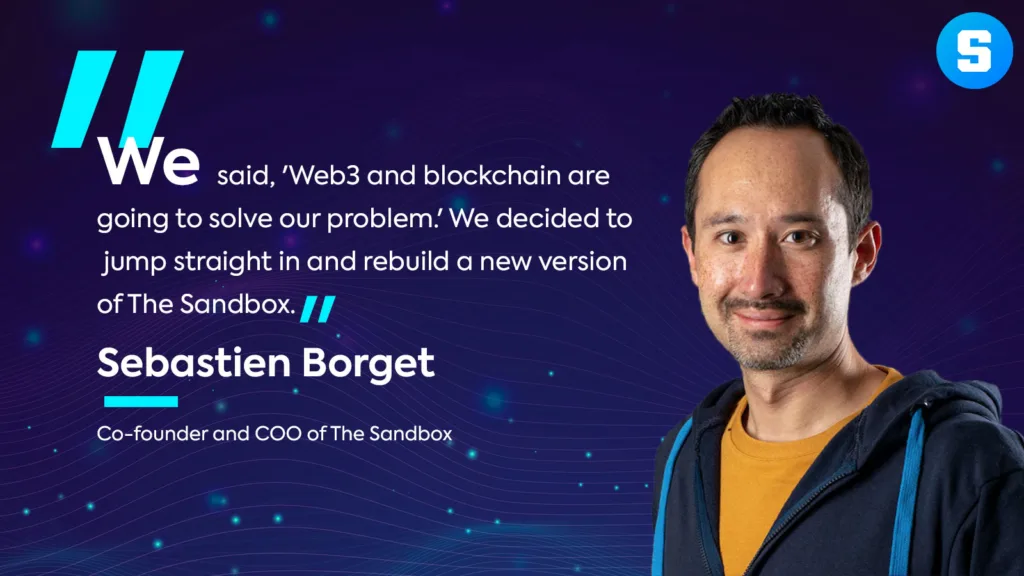
While the platform grew, Borget faced a scalability problem. Creators were investing passion and time, but they weren’t earning anything. Borget tried to pay them manually via PayPal, but the process was a logistical nightmare.
“I managed to contact a hundred, but that was not scalable,” he said.
The emergence of CryptoKitties showed Borget that blockchain was the solution. It allowed users to buy and sell assets on external marketplaces like OpenSea using cryptocurrency.
Protecting creators and authenticity
Borget believes blockchain’s public ledger helps establish creator reputations and ensures digital ownership through NFTs.
“You own content, but that doesn’t mean you can replicate it anywhere,” Borget explained, noting that licensing and community education are key. While content on a blockchain cannot be deleted, the platform can restrict the discovery of copyrighted or disrespectful material.
SandChain: Reimagining the future
The Sandbox is now creating its own Layer 2 sidechain, SandChain, using ZK-Sync. Announced on October 1st and slated for a Q1 2026 launch, SandChain aims to give creators total freedom to develop smart contracts and launch tokens without needing to code.
This move is a strategic shift to an in-house chain designed to retain the value generated by 8 million wallet holders and 400 major brands.
Key features include:
$SAND Utility: The token functions as the gas for the network and provides liquidity.
Early Traction: The testnet has already recorded over 1.4 million transactions.
LAND Value: Borget addressed speculation regarding LAND parcels, noting that utility — and proximity to “neighbors” like Snoop Dogg — drives value.
Distribution: Because $SAND is listed on over 100 global exchanges, any developer who accepts it gains immediate access to a massive pool of ready-to-spend users.
Global expansion
The Sandbox’s global strategy focuses on local culture, resulting in 40% of its audience coming from Asia. The platform has secured high-profile partnerships with K-pop brands like SM Entertainment and even the Virtual Asset Regulatory Authority (VARA) in the UAE: the first regulator to launch its own metaverse experience.