


“Creators generate value globally, yet often lack real-time visibility into how their IP is used, how royalties are calculated, and when settlements occur,” said Hazel Lee, co-founder of BeatSwap. This lack of transparency is what BeatSwap aims to fix. It aims to build a fully auditable, on-chain economy for music intellectual property (IP) that benefits both artists and investors.
In an exclusive interview with AltCoinDesk, Hazel Lee, the co-founder of decentralized music IP platform BeatSwap, shared that limited transparency regarding IP in the music industry is a major challenge facing the industry. In this interview, Lee talks about how BeatSwap works, misconceptions about the crypto industry among musicians, and a lot more.
BeatSwap tackles the music IP opacity issue
Speaking with AltCoinDesk, Lee stated that from the very beginning, BeatSwap’s objective was to tackle the opacity and inefficiency of traditional IP and music finance systems. Lee remarked that over the years, the music finance space has become a system that runs on trust instead of verification.
Creators generate value globally, yet often lack real-time visibility into how their IP is used, how royalties are calculated, and when settlements occur. In many cases, payments are delayed for six months to a year, with limited transparency regarding underlying data.
Hazel Lee, Co-founder, BeatSwap
Here’s where BeatSwap comes in, as it was developed to replace the trust-based system with a verification-based system. By registering IP rights on-chain, BeatSwap enables transparent, auditable, and real-time tracking of ownership, usage, and royalty flows.
Focus on sustainable IP economics
Lee clarified that BeatSwap is neither a music streaming platform nor a marketplace. Rather, it functions as infrastructure that’s geared toward enabling IP rights to function on-chain.
Lee added that although Web2 platforms like Spotify or YouTube Music have optimized content distribution and audience reach, important processes like ownership, licensing, and settlement continue to remain opaque. Although creators gain visibility, they are often unable to have control over value flows.
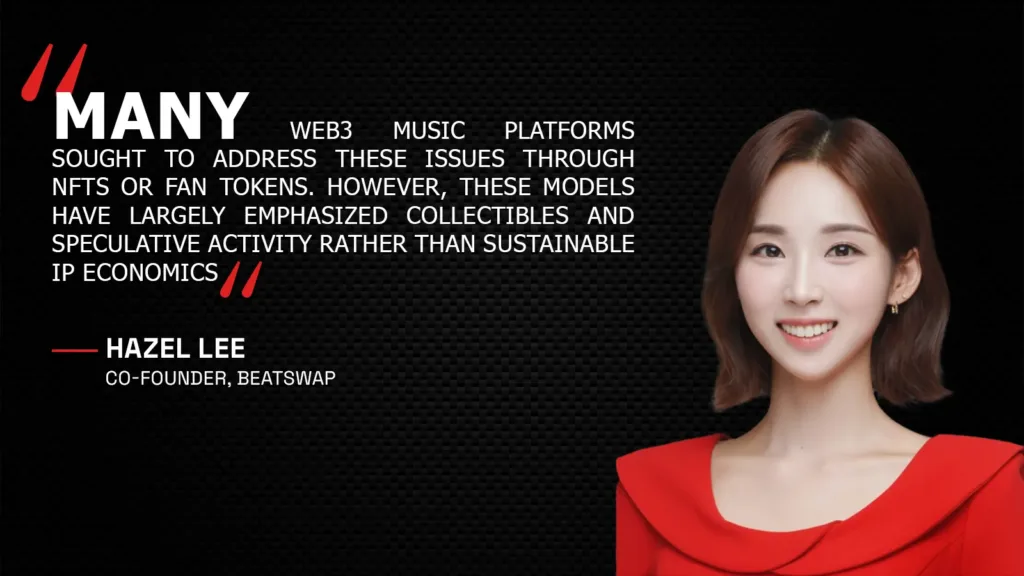
The BeatSwap co-founder stated that the platform focuses extensively on IP rights. She added that the thought process is to treat IP as a real-world asset that generates value through verified usage – including licensing, streaming, and fan engagement. She also highlighted what distinguishes BeatSwap from other infrastructure providers rather than a distribution platform.
Our platform is structured as a modular protocol in which social participation, IP tokenization, and liquidity operate as interconnected layers built upon a unified verification framework.
Hazel Lee, Co-founder, BeatSwap
Lee stated that the most common misconception people have about Web3 is that it exists purely for speculation purposes. That said, blockchain is not the final product. Rather, it is foundational infrastructure.
If applied effectively, blockchain technology can help creators address long-standing challenges pertaining to transparency, settlement delays, and rights management. She noted that BeatSwap ensures creators don’t directly engage with smart contracts.
Rather, BeatSwap operates in such a way in the background that it facilitates clear ownership records and more predictable revenue inflows. As a result, creators’ perception toward blockchain technology is poised to undergo a shift as it gets increasingly portrayed as a tool for rights protection rather than a technology that encourages speculation.
Simplifying the complexity around music rights
Lee emphasized that the complexity surrounding music IPs primarily stems from fragmented ownership structures and historically opaque settlement processes. BeatSwap solves this, as its Oracle layer validates off-chain events – including stream and content unlocks, and records them as verifiable licensing data.
Licensing-to-Earn ensures that value is distributed only when IP is actively utilized, transforming engagement into measurable economic signals. Vault-to-Earn complements this by aligning long-term capital with sustained IP performance.
Hazel Lee, Co-founder, BeatSwap
Together, these processes lead to a lot more transparency. Copyright and royalty flows become traceable and predictable for all stakeholders.
The future ahead
When asked how she would describe the current state of Web3 music in one word, Lee replied, “formative.” Towards the end of the interview, Lee also shared some thoughts on what lies ahead for BeatSwap.
She noted that the top priority for 2026 is to activate BeatSwap’s infrastructure and transform it into a fully-functional on-chain economy. Lee added that the BeatSwap team is laser-focused on three core layers.
Space serves as the SocialFi layer where creators and communities generate verifiable engagement. The RWA Launcher enables standardized and transparent tokenization of IP rights. The RWA DEX provides liquidity that is directly connected to IP-generated royalties.
Hazel Lee, Co-founder, BeatSwap
Lee concluded by saying that, rather than chasing feature expansion or add-ons, BeatSwap is currently dedicated to making IP operate as a reliable and sustainable asset class on the blockchain.